
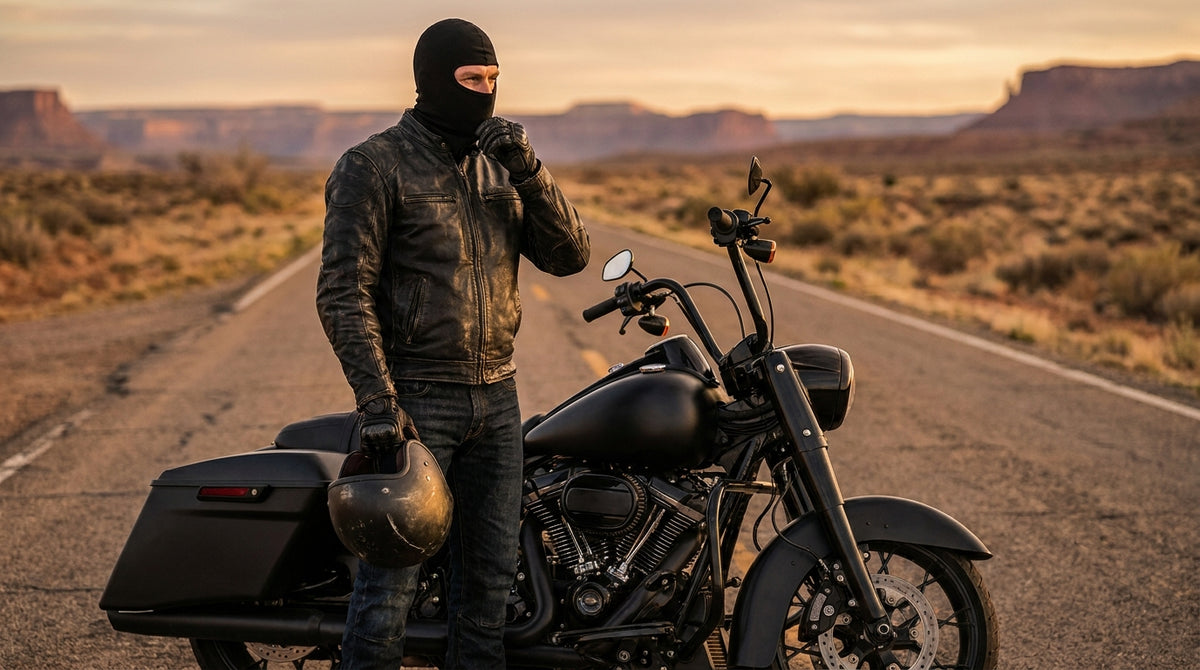
At 55 mph in 40°F air, the wind chill on bare skin lands near 25°F. Ten minutes in and your cheeks go numb, your eyes water, and you start riding with your chin tucked instead of your eyes up. So riders buy the thickest mask they can find, shove it under a helmet that already fits snug, and give up on it by the second ride because it pinches their ears flat.
The fix is not more fabric. A good full head cover mask wins on thickness and seam placement, not warmth alone. This guide covers what a full head cover mask actually covers, how fabric weight changes helmet fit, 8 styles worth owning, and the 5 mistakes that put most of them in the garage drawer.
What a full head cover mask actually covers
The naming is a mess online, which is why riders search for a head cover mask and land on a surgical mask. Here is what the three real categories do.
- Balaclava (full head cover mask). One piece that covers the skull, ears, neck and most of the face, with an open eye port. Nothing exposed except your eyes.
- Tube or motley neck tube. An open cylinder roughly 9.4 x 9.8 inches. It covers from the bridge of the nose down to the collarbone, but the top of your head stays bare.
- Half mask. Covers nose, mouth and chin only, usually with ear loops or a rear strap. Fastest on and off, least coverage.
Only the first one is a true full head cover mask. If your complaint is cold ears or a draft running down the back of your neck into your jacket, a tube will not fix it, because both of those gaps sit above and behind where a tube sits.

Helmet fit is the whole game
This is the part most buying guides skip. A thin polyester balaclava runs about 1 mm of material per side. A thermal fleece one runs 3 to 4 mm. That sounds trivial until you remember a helmet is sized to the millimeter against your skull.
Add 4 mm per side to a helmet that already fits correctly and you get hot spots on the temples, ears folded forward, and a pressure headache about 90 minutes in. The temptation is to buy the next helmet size up for winter. Do not. A helmet with that much extra room rotates on impact and can come off entirely, which is the one job it has.
The right order is the opposite: pick the mask to fit the helmet you already own.
- Snug helmet, no spare room: thin breathable liner only, 1 mm class.
- Normal fit with a little give: microfleece works, 2 mm class.
- Helmet is slightly loose or the pads are broken in: a thermal windproof mask fills the gap and fit actually improves.
Worth knowing: cheek pads compress roughly 10 to 15 percent over the first season of riding. A helmet that rejected a fleece mask in October often accepts one the following winter.

Pick the fabric by temperature, not by price
Nearly every complaint about a head cover mask traces back to wearing the wrong fabric for the weather. This is the chart I would hand a new rider.
| Fabric | Works at | Best for | Watch out |
|---|---|---|---|
| Polyester microfiber (1 mm) | 60 to 85°F | Sun, dust, bugs, helmet hygiene | Almost no warmth below 55°F |
| Ice silk / cooling knit | 75 to 100°F | UV protection on long summer days | Blocks zero wind chill |
| Microfleece | 32 to 55°F | Cold commutes, shoulder season | Adds real bulk under a tight helmet |
| Thermal fleece + windproof panel | Below 32°F | Deep winter, highway speed | Overheats badly above 50°F |
| Merino wool | 35 to 60°F | Multi-day trips, odor control | Costs two to three times the synthetics |
| Cotton | Never on a bike | Nothing | Holds sweat, then goes cold at speed |
One detail that matters more than the fabric name: a windproof membrane across the mouth and chest panel. Fleece alone traps warm air but lets a 55 mph headwind push straight through it. The windproof panel is what turns a warm mask into a cold-weather mask. Our cold-weather face mask breakdown goes deeper on that specific layer.
8 full head cover mask styles worth owning
Two masks cover almost every riding condition in the US: a thin summer liner and a windproof winter balaclava. The rest below are about coverage style and how you want to look doing it.
1. Thin breathable balaclava (the year-round default)
Single-layer polyester, open eye port, usually with a mesh or perforated mouth panel so your breath exits instead of fogging a visor. This is the one to buy first. It kills helmet stink, blocks sun and bugs, and takes up no room under the shell, so it works from 60°F up into the 90s. It also washes in a sink and dries overnight on a hotel towel rack, which matters on a trip.

2. Skull-print full face balaclava
Same construction as the plain version with a skull graphic printed across the jaw and mouth. The reason this style sells is simple: it is the only mask people actually see when you ride with an open-face or half helmet. Look for the print to be sublimated into the fabric rather than screen-printed on top, because screen print cracks along the fold line at the chin within a season of being pulled on and off.

3. Windproof thermal winter balaclava
Fleece-lined with a wind-blocking front panel, built for sub-freezing air at highway speed. This is the heaviest option here at roughly 3 to 4 mm of material, so test it under your helmet before you commit to a long ride. If it fits, nothing else comes close in January. If it does not, run a thin balaclava plus a separate neck tube instead and get most of the warmth with half the bulk around your skull.

4. Camo fleece balaclava
Mid-weight fleece in a camo pattern, equally at home on a bike and in a deer stand. Practical upside beyond the look: a patterned mask hides the grime and oil smudges that make a plain black mask look worn out after a month of daily riding. Mid-weight fleece is the sweet spot for the 35 to 50°F range where a thermal mask cooks you and a thin liner does nothing.

5. Quick-drying summer full face cover
Built around moisture-wicking knit that pulls sweat off your forehead and dries in minutes instead of hours. The specific problem it solves is stop-and-go heat: a mask that is soaked at a red light becomes a cold wet rag the moment you get moving again. Quick-dry fabric breaks that cycle, which is why it beats a cotton bandana in July by a wide margin.

6. Neck and face tube (motley tube)
An open cylinder you can wear eight or nine different ways: full face cover, neck gaiter, do-rag, headband, or bunched at the collar. It is the most versatile piece of fabric you can carry and it packs down to the size of a fist in a jacket pocket. Just be clear on what it is not. With the top of your head uncovered, it is a face and neck solution, not a true full head cover mask.

7. Cooling neck gaiter with UV protection
Ice-silk knit aimed squarely at sun exposure rather than warmth. Riders underrate this one. Your left forearm and the left side of your neck take the most sun on an American highway, and a summer of that adds up on skin that never sees shade under a half helmet. A UV gaiter handles it without the sweat-soaked feel of fleece.

8. Half face biker mask
Covers nose down to chin and nothing more. The case for it is speed: you can drop it off your face at a gas pump in one motion, which no balaclava does. The case against it is that your ears and forehead stay exposed, so it is a fair-weather piece. Good as a second mask, poor as your only one. If you ride in goggles rather than a visor, check how the top edge sits against the frame first, and our mask and goggle pairing guide covers the combinations that stay fog-free.

Full head cover mask vs balaclava vs ski mask
These three names describe nearly the same garment, and the difference is only in the opening.
- Ski mask: traditionally cut with a separate eye port and a closed mouth, because skiers are not breathing hard against a visor at 60 mph.
- Motorcycle balaclava: the same shape with a wider, often vented mouth panel, so exhaled breath escapes forward instead of rising into your eyewear.
- Full head cover mask: the plain-language search term for either of them, which is exactly why search results for it are such a mixed bag.
Practical takeaway: if a listing is sold as a ski mask and the mouth is a sealed panel of solid fleece, expect fogging the first time you stop at a light with the visor down. Buy the version with a vented mouth. The balaclava versus gaiter comparison lays out which style suits which helmet type.
5 mistakes that ruin a good head cover mask
- Buying the thickest one for a snug helmet. Why it fails: 4 mm of fleece per side turns a correct helmet fit into an ear-folding pressure point, and you stop wearing it within two rides.
- Pulling it over the bridge of the nose with the visor down. Why it fails: breath leaves your mouth near 95°F and hits cold polycarbonate. Routed upward by the mask, it fogs the visor in seconds. Keep the mask edge below the nostrils or use a vented mouth panel.
- Wearing cotton. Why it fails: cotton absorbs sweat and holds it. At speed that wet layer evaporates against your skin and actively chills you, which is the opposite of the job.
- Ignoring where the seam sits. Why it fails: a seam running across the forehead lands right under the helmet's brow pad. It is unnoticeable for 20 minutes and a real headache at hour two. Check for a flat-lock or offset seam.
- Running a loose tube under an open-face helmet on the highway. Why it fails: past roughly 55 mph, unanchored fabric flaps and works its way down off your nose. Either tuck it into the jacket collar or wear a balaclava the helmet holds in place.
How to size and wear one correctly
- Measure your head circumference around the widest point above the ears. Most full head cover masks are one-size stretch, but anything over 24 inches should be sized up where the option exists.
- Put the mask on before the helmet, never after. Pulling a helmet over a mask already on your head drags it out of position every time.
- Set the eye port first, then pull the neck skirt down flat. A twisted neck section is what creates those cold gaps at the collarbone.
- Tuck the skirt inside your jacket collar, not over it. Outside the collar the wind lifts it; inside, the collar clamps it down.
- Do a 30-second helmet check. Fasten the strap, roll your head side to side, and look for ear fold or temple pressure. If it pinches in your driveway, it will hurt on the interstate.
Wash it every few rides. A mask against your face and scalp is the single dirtiest piece of gear you own, and a clean liner is also the cheapest way to keep a helmet from smelling.
What I would buy
Start with a thin breathable balaclava and ride it through a full season. It costs the least, fits any helmet, and solves sun, dust and helmet odor in one piece. Add a windproof thermal version only once you know how much room your helmet actually has. That two-mask setup covers roughly 30°F to 95°F, which is most of the riding year in most of the country.
The part worth paying for is construction, not graphics. Sublimated print instead of screen print, flat seams, a vented mouth panel, and stitching that survives being yanked on and off at every gas stop. The no-name marketplace listings skip all four, which is why a $6 mask frays at the eye port inside a month and has nobody to email about it.
If you are shopping for one, the full face mask collection is where I would start. For the thinking on how different styles compare before you pick, this breakdown of what actually works is the companion piece to this guide. Wind chill numbers in this article follow the National Weather Service wind chill chart.

No comments yet. Be the first rider to weigh in.