

Look at any photo of a West Coast run from the last fifty years and the helmets are almost identical. Low, round, black, barely taller than the skull underneath. No graphics, no race replica paint, no wing vents. Most of them sit on riders who would happily go bare-headed if the state let them.
That silhouette is what people are picturing when they search for a Hells Angels helmet. It is not a club product and you cannot buy club insignia. It is a style, and it has a real history and a real safety problem worth understanding before you copy it.
Here is what riders in that world actually wear, why the German half shell became the default, how to tell a legal helmet from a plastic hat, and what to buy if you want the look without the hospital bill.
Do Hells Angels wear helmets?
Yes, in the states that require it. "Do Hells Angels wear helmets" is one of the most common questions on this topic, and the answer is less about club rules than about traffic law.
California has had a universal helmet law since January 1, 1992, covering every rider and passenger regardless of age or experience. The Oakland chapter is the club's most famous, and it rides under that law like everyone else. Only three states have no helmet requirement at all: Illinois, Iowa and New Hampshire.
So the pattern you see is practical. In helmet states, riders wear the smallest legal lid they can find. In free states, a lot of them carry it on the sissy bar instead. That preference for minimum coverage is exactly why the half shell dominates the look.
The German-style half shell: the helmet that defined the look
The German-style helmet copies the silhouette of the WWII Stahlhelm, with a rounded crown, a short flared brim and a small lip at the back of the neck. It showed up in American biker culture in the 1960s as war-surplus gear got cheap and stayed because nothing else sat that low.
It is the single most recognizable helmet in outlaw motorcycle culture. Paired with round goggles and a leather vest, it reads as 1%er at a hundred yards. Modern versions keep the shape but build it as a proper composite or ABS shell over an energy-absorbing liner.
The important distinction: the shape is legal, the construction is what varies. A German-style helmet can absolutely meet the federal standard. Plenty of them do not. We cover the full range in our guide to German motorcycle helmets and the best DOT picks.

Beanies and skull caps: the smallest legal profile
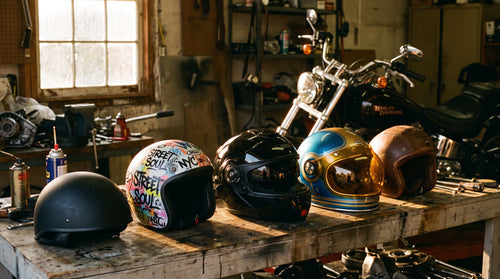
The beanie or skull cap strips the brim off entirely. It is a smooth dome that follows the head, and it is the lowest-profile helmet that can still carry a DOT certification.
A genuine DOT half helmet runs roughly 2 to 3 pounds. That weight is the liner doing its job. Riders who want the minimum look without dropping to an uncertified shell usually land here, and it is the most common upgrade path for someone leaving novelty helmets behind.
Fit matters more on a half helmet than on a full face, because there is no chin bar holding it in position. If it rocks forward when you shake your head, it is too big.

The novelty helmet trap
This is where the look gets people hurt. A "novelty" helmet is a shell with no impact liner, sold as costume gear rather than safety equipment. They are popular because they are the thinnest possible profile and they are cheap.
The federal standard is FMVSS 218, administered by NHTSA. A certified helmet has to absorb impact energy, and that takes an expanded polystyrene liner around an inch thick. A novelty shell has a thin foam comfort pad and nothing else.
How to spot a fake in ten seconds
- Weight. A novelty helmet weighs about 1 pound. A DOT half helmet weighs 2 to 3. You can feel the difference the moment you pick it up.
- Liner. Press the inside. A real helmet has firm, dense foam roughly an inch thick that does not compress under your thumb.
- The DOT label. A certified helmet carries a permanent DOT sticker on the back plus a manufacturer label inside with the model and production date. A stick-on DOT decal sold separately means nothing.
- Chin strap. Certified helmets use riveted straps anchored to the shell, not glued webbing.
A novelty helmet does not stop the road. It stops a ticket in some jurisdictions and that is all it is engineered to do.
Do Hells Angels only ride Harleys?
Close to it. The long-standing norm across the club is American-made motorcycles, which in practice means Harley-Davidson, and chapters have historically enforced that as a membership expectation rather than a suggestion.
Sonny Barger, the Oakland member who became the public face of the club for decades, rode Harleys his entire riding life and died in June 2022 at 83. The bike preference and the helmet preference come from the same place: a fixed idea of what the thing is supposed to look like.
That consistency is why the aesthetic is so easy to copy and so easy to get wrong. The gear is simple, which means the details are the whole story.
Helmet styles compared
| Style | Typical weight | Coverage | DOT available | Best for |
|---|---|---|---|---|
| German half shell | 2 to 3 lb | Crown and rear | Yes | The classic 1%er silhouette |
| Beanie / skull cap | 2 to 3 lb | Crown only | Yes | Smallest legal profile |
| Novelty shell | About 1 lb | None in practice | No | Nothing. Skip it. |
| Three-quarter / open face | 3 to 4 lb | Crown, ears, rear | Yes | Long highway miles, wind relief |
| Full face | 3.5 to 4 lb | Full head and jaw | Yes | Maximum protection |
The gap between a novelty shell and a DOT half helmet is about a pound and a half of foam. That pound and a half is the entire safety argument.
Five mistakes riders make chasing this look
- Buying the shape instead of the certification. The German silhouette is not the problem. An uncertified shell in that silhouette is. Both exist and they look nearly identical on a product page.
- Trusting a stick-on DOT decal. Those are sold loose online for a couple of dollars. A real certification is molded or permanently applied and backed by a manufacturer label inside the shell.
- Sizing up for comfort. A loose half helmet rotates off the forehead at speed and leaves the front of the skull exposed. Snug at purchase is correct, because the liner packs in slightly with use.
- Wearing insignia you have not earned. This one is not about safety. The Death Head and the 1% diamond are club property with real trademark protection and real cultural weight. Wearing either as a costume is the fastest way to a bad conversation at a rally. If you want the jewelry side of the culture done honestly, read our breakdown of outlaw biker jewelry and what the symbols actually mean.
- Skipping eye protection. A half helmet leaves your eyes fully exposed. Goggles or a shield are not a styling choice on an open lid, and most helmet-law states require eye protection separately.
What to buy if you want this look done right
The honest version of this style is a DOT-certified German or beanie shell, a set of goggles, and no insignia that belongs to somebody else. It costs slightly more than a novelty lid and it is the only version that does anything in a crash.
Skip the no-name marketplace listings with no manufacturer label and no returns. You cannot verify a liner you cannot inspect, and the whole point of the certification is that somebody tested it. A helmet is a one-time buy that should last years, which is the argument for buying a real one once.
If you are shopping, our motorcycle half helmets collection is where I would start, and the German motorcycle helmets lineup covers the classic shape specifically.
What the 1% diamond actually means
The helmet is only half the picture. The diamond-shaped 1% patch is the piece people ask about most, and the story behind it is specific.
After the 1947 Hollister rally made national news, the American Motorcyclist Association was quoted saying that 99 percent of motorcyclists were law-abiding citizens. Clubs that had no interest in that label took the remaining 1 percent as a name. The diamond patch has meant exactly that ever since.
It is worn, not bought. So is the Death Head. Both are registered marks the club has defended in court, and both carry a meaning inside that world that has nothing to do with fashion. A helmet style is public domain. A patch is not, and that line is worth respecting whether or not you care about the culture attached to it.
Half helmet vs full face for real riding
If you are buying for the look, the half shell wins on every aesthetic count. If you are buying for the miles, the math is less flattering.
Roughly a third of motorcycle crash impacts land on the chin bar area, which is the one part of your head a half helmet does not cover at all. That is the tradeoff in one sentence. No amount of certification changes it, because a DOT half helmet is only certified for the area it actually covers.
A reasonable middle ground
Plenty of riders run two lids. A German half shell for short runs, bar nights and slow bike-week traffic, and a three-quarter or full face for highway days and long hauls. A three-quarter open face keeps most of the classic profile, adds ear and temple coverage, and still lets you wear goggles.
That split costs more up front and solves the argument permanently. It is also the honest answer to why so many long-distance riders own a half helmet they mostly do not ride in.
Wind, weather and what goes under the lid
An open helmet moves the problem to your face. At 60 mph you are taking unfiltered wind, grit and bugs directly, and after two hours that stops being a style question.
The standard fix is a bandana or a half face mask under the shell and goggles over the eyes. A skull-print face mask is the traditional pairing with a German helmet, and it does real work in cold weather by keeping wind off your jaw and neck.
Goggles matter more than most first-time half helmet buyers expect. Most helmet-law states require eye protection as a separate legal item, so sunglasses that blow off at speed will not cover you.

No comments yet. Be the first rider to weigh in.