
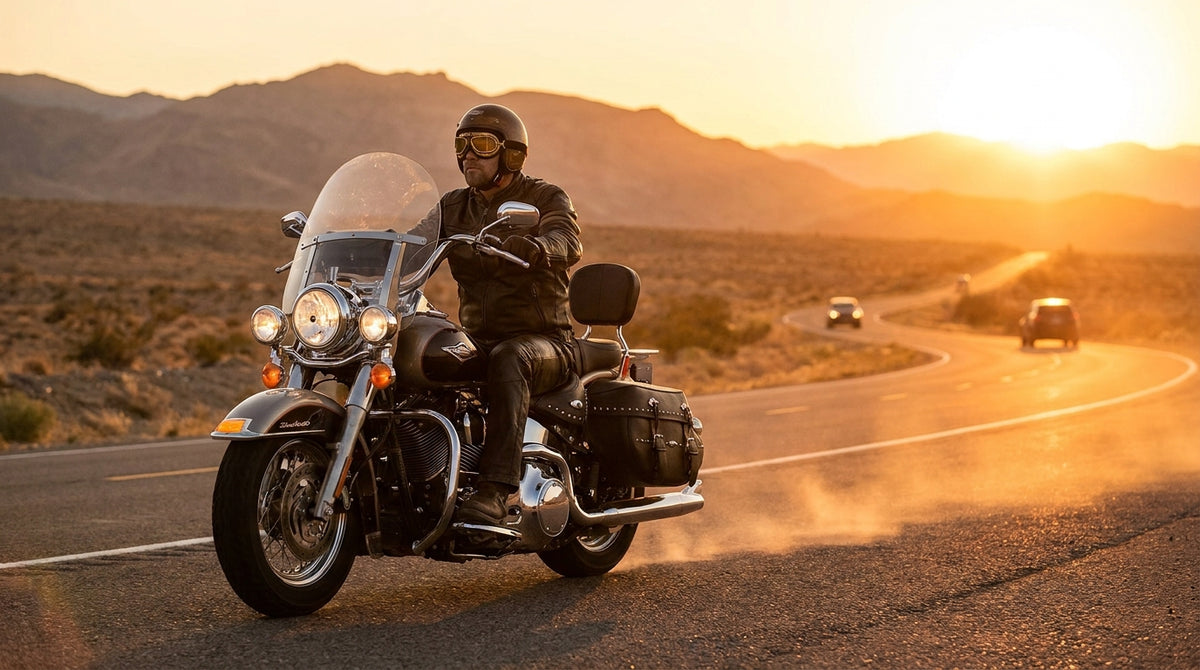
You pull up behind a dump truck and catch a faceful of road grit. Sunglasses knock some of it away. A full-face visor blocks all of it. But if you ride with an open-face, half, or three-quarter helmet, motorcycle goggles sit in the useful spot between those two options. They seal around your eyes, stay locked at highway speed, and fit helmet styles that visors never will.
This guide covers every major style of motorcycle goggles, from classic aviator designs to OTG (over-the-glasses) frames to steampunk builds. You will find real lens specs, practical fit tips, and the buying mistakes that waste money or leave you squinting at 70 mph. Whether you ride a cruiser, chopper, or cafe racer, the right pair is in here.
Why Motorcycle Goggles Instead of Sunglasses
The core difference is the seal. Sunglasses sit flat on your face with open gaps at the top, bottom, and sides. Motorcycle goggles use a foam or rubber gasket that wraps around your eye socket and blocks wind, dust, and debris from every angle.
At 60 mph, airflow pushes roughly 2.5 pounds of force per square foot against your face. That pressure drives particles into every gap sunglasses leave open. Goggles with a closed-cell foam gasket reduce that wind load on the eyes to almost nothing.
Then there is impact protection. A pair rated to ANSI Z87.1 means the lens survived a 1-inch steel ball dropped from 50 inches without cracking. Most gas station biker sunglasses will not pass that test. If a pebble kicks up from a semi's tire at highway speed, the lens quality is the only thing between that rock and your cornea.
UV coverage is the third gap. Flat-front sunglasses let UV radiation sneak in from the sides and top. Goggles with a wrap-around seal block UV from all angles. Any pair worth buying carries a UV400 rating, which means it filters wavelengths up to 400 nanometers, covering both UVA and UVB.
Types of Motorcycle Goggles: A Quick Comparison
Not all motorcycle goggles serve the same purpose. Here are the five main categories and where each one fits best.
Aviator goggles have round lenses set in a metal or leather frame, borrowed directly from WWI pilot gear. They look great on cruisers and cafe racers. Most sit on the face without a full foam seal, so they work better at moderate speeds than on the interstate.
Vintage and retro goggles lean into the padded, over-the-nose style popular with bobber and chopper riders. They use elastic straps and typically have a full foam gasket for a tight seal against wind and grit. This is the most popular style for everyday highway riding.
OTG (over-the-glasses) goggles have a wider frame cavity, usually 135mm or more of internal width, so prescription glasses fit underneath without pinching. The foam gasket is thicker to accommodate temple arms.
Steampunk goggles feature decorative frames with metal gears, rivets, or spike accents and tinted lenses. Most are style-first pieces for rallies and shows, but functional options exist with real UV protection and impact-rated lenses.
Mask-goggle combos pair a neoprene lower-face mask with attached or separate goggles. They are built for cold weather riding below 50°F when wind chill hits exposed skin hard.
| Style | Best For | Seal Type | Typical Price |
|---|---|---|---|
| Aviator | Cruisers, cafe racers | Partial (no foam) | $18 - $45 |
| Vintage / Retro | Half helmets, choppers | Full foam gasket | $15 - $35 |
| OTG | Glasses wearers | Full foam, wide cavity | $20 - $40 |
| Steampunk | Shows, short rides | Partial or decorative | $12 - $30 |
| Mask Combo | Cold weather | Full face coverage | $20 - $50 |

Over-the-Glasses (OTG) Motorcycle Goggles
If you wear prescription glasses, standard goggles will not work. The frame is too narrow, the foam pushes on your temple arms, and everything fogs up within minutes.
OTG goggles solve this with three design changes. First, the internal frame width runs 135mm to 145mm instead of the standard 120mm, leaving clearance for glasses up to a 55mm lens width. Second, the foam gasket is thicker and cut with channels where temple arms pass through. Third, most OTG pairs include anti-fog coating or vented frames to fight the double-lens fogging problem. Your prescription lenses plus the goggle lens equals twice the condensation surface, so ventilation matters.
When shopping for OTG motorcycle goggles, fit them while wearing your actual glasses and your helmet at the same time. A pair that works on your bare face may not work once both layers are stacked. Also, look for models with a quick-release strap so you can remove the goggles without taking off your helmet first.
Aviator and Vintage Motorcycle Goggles
Aviator goggles trace back to open-cockpit aircraft. The Halcyon Mark 49, first produced in England in 1940, is still manufactured today and remains one of the most recognizable aviator goggle designs on the market. That style, round lenses in a leather-padded metal frame, defines the whole category.
Vintage motorcycle goggles differ in one important way: they typically include a full foam seal. Where aviators sit on the face with open edges (fine for cafe racer speeds), vintage goggles wrap a closed-cell foam gasket around the entire eye area. That makes them better for highway riding on a half or open-face helmet.
Both styles pair well with aviator-style builds and classic cruiser setups. The key difference comes down to speed: aviators for town riding and shows, vintage sealed goggles for anything above 45 mph. If you are building a retro cafe racer look, a good pair of aviators tied to a matte black half shell is hard to beat.

Motorcycle Goggles with Face Mask
Below 50°F, wind chill turns an open-face helmet ride into a punishment. A neoprene mask-goggle combo covers the lower face and seals around the eyes in one piece.
The mask portion is typically 2mm to 3mm thick neoprene, enough to block wind but thin enough to breathe through. Some designs use mesh breathing panels at the nose and mouth for better airflow. The goggle portion either attaches directly to the mask or snaps on separately, which lets you swap goggle styles without buying a new mask.
The downside is fogging. In humid conditions, the warm air you exhale travels upward behind the mask and hits the cooler goggle lens. If the goggles do not have vented frames or anti-fog coating, visibility drops within minutes. Riders who use mask combos in the 35 to 50°F range often carry a small bottle of anti-fog spray as backup.
For a deeper look at riding masks, the motorcycle face mask guide covers materials, fits, and ventilation options in detail.

Lens Types: What Each Tint Actually Does
The lens is the most important part of any motorcycle goggle. Here is what each tint and coating does in real-world riding conditions.
Clear lenses have 90% or higher visible light transmission (VLT). Best for night riding and overcast days. They let in the most light, which is exactly what you want when visibility is already low.
Smoke or dark lenses cut VLT to 15-25%. They reduce glare and eye strain in direct sunlight. Not safe for riding after sunset.
Yellow and amber lenses sit around 75-80% VLT. They boost contrast in low-light conditions like dawn, dusk, and fog. The tint filters blue light, which sharpens outlines and makes road details easier to spot. Riders who commute at dawn or dusk often keep a yellow-lens pair in their saddlebag alongside their primary goggles.
Photochromic lenses adjust tint automatically based on UV exposure. They darken in bright sun and clear up in shade. The transition takes 30 to 60 seconds, so there is a short lag when you ride through tunnels or pass under heavy tree cover.
Anti-fog coating applies a hydrophilic layer to the inner lens surface. Instead of forming visible droplets, moisture spreads into a thin, clear film. This is critical for cold-weather riding and for OTG setups where double-lens fogging is a constant risk.
Under the EN 1836 European standard, a Category 3 lens blocks 82-92% of visible light. That is the sweet spot for most sunny riding conditions. Category 4 blocks even more but is too dark for road use in most countries.
How to Get the Right Fit
A goggle that fits wrong is worse than no goggle at all. It leaks wind, creates pressure headaches, and fogs up faster because the seal is broken.
Start by putting your helmet on first. Then position the goggles. The strap goes over the helmet shell on the outside, not underneath it. A strap that sits under the helmet will shift every time you turn your head.
Strap width matters more than most riders expect. Standard straps run 25mm to 40mm wide. A wider strap spreads pressure over a larger area and stays in place better at speed. Narrow straps concentrate force into a line across the back of your head, which gets uncomfortable after 30 minutes on the highway.
Foam type splits into two categories. Closed-cell foam resists sweat absorption and holds its shape for years. Open-cell foam feels softer against the skin but soaks through with sweat and breaks down faster. For regular riding, closed-cell is the better long-term choice.
Nose bridge design varies between adjustable and fixed. If the bridge does not match the shape of your nose, you will get pressure points or air gaps. Adjustable bridges let you bend the frame to fit. Fixed bridges work fine if the stock shape happens to match your face, but there is no way to know without trying them on.
5 Common Mistakes Riders Make with Motorcycle Goggles
1. Buying goggles without wearing the helmet. The fit changes completely with a helmet on. Foam compresses differently, the strap tension shifts, and the field of view narrows. Always test goggles with your actual helmet before committing.
2. Ignoring impact ratings. Cheap goggles from unknown brands may look fine but shatter on impact. ANSI Z87.1 or EN 166 certification means the lens has been tested against real projectile force. Without that rating, you are trusting your eyes to untested plastic.
3. Using dark lenses after sunset. It happens more than you would expect. A rider heads out in the afternoon with smoke lenses and stays out past dark. Keep a clear lens or a second pair in your bag if there is any chance you will ride at night.
4. Storing goggles lens-down. Scratches build up fast when the lens sits against hard surfaces. Use the microfiber pouch that comes with most pairs, or a hard case if you carry them in a saddlebag.
5. Skipping anti-fog treatment. If you ride below 60°F, fogging starts within 10 minutes on an untreated lens. Anti-fog sprays cost around $8 and last for weeks. It is the cheapest upgrade you can make to any goggle setup.
Whether you ride a half-helmet cruiser or a vintage cafe racer, the right pair of motorcycle goggles keeps debris out and lets you ride longer without eye fatigue. If you are looking for a pair, the motorcycle goggles collection at American Legend Rider has aviator, vintage, and OTG styles ready to ship.


No comments yet. Be the first rider to weigh in.