
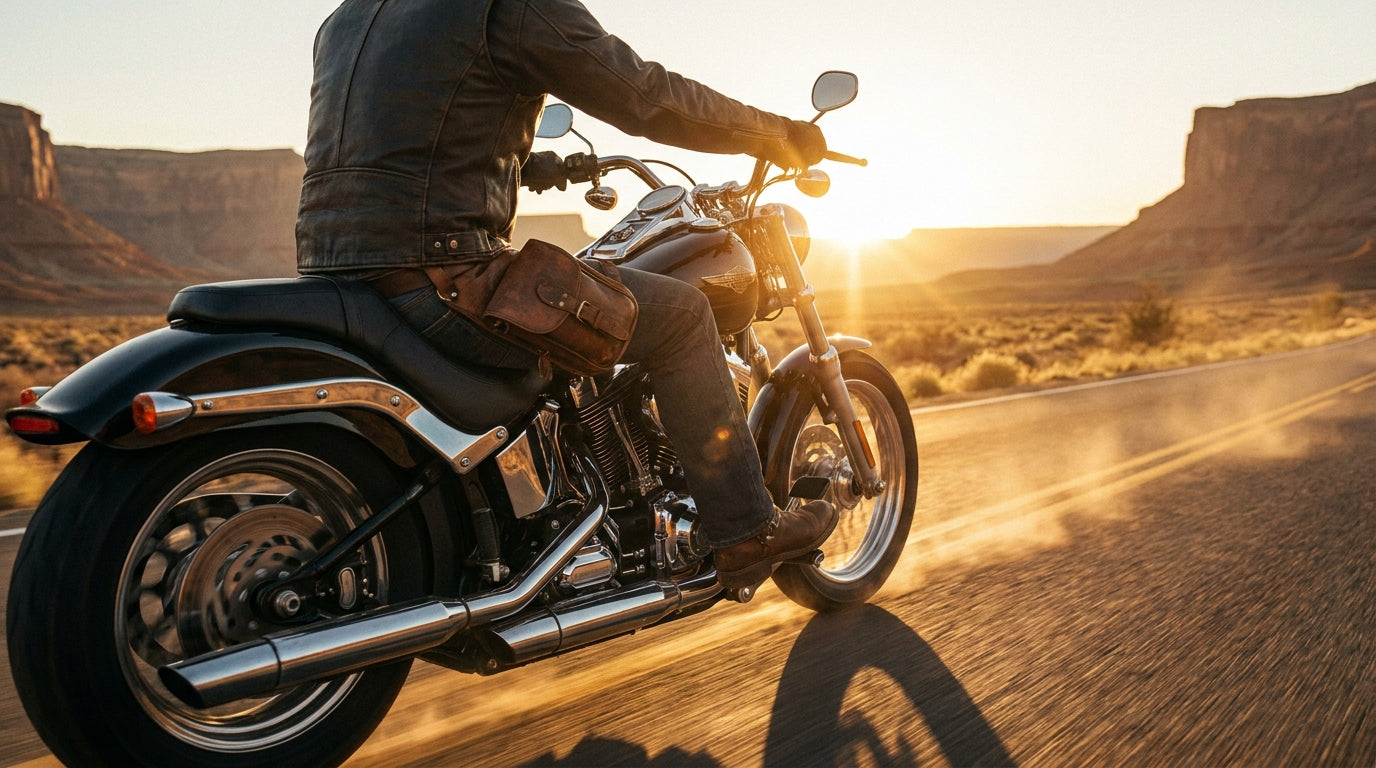
You pull into a gas station, gloves still on, and need your wallet. With a motorcycle leg bag, it is right there on your thigh. No digging through a tank bag. No swinging a backpack off your shoulder. Just reach down, flip the flap, and grab what you need. That instant access is why drop leg bags keep showing up on riders who swore they would never wear one.
This guide breaks down every type of motorcycle leg bag worth buying, from leather to waterproof nylon. You will get real dimensions, strap setups, and the fit details that separate a bag that stays locked on your leg from one that bounces loose at every red light. Here is what to look for and what to skip.
What Sets a Motorcycle Leg Bag Apart
A motorcycle leg bag mounts to the body with a belt loop at the waist and one or two straps that wrap around the upper thigh. That two-point system keeps the bag locked in place against the leg, creating zero interference with the seat, tank, or controls. Most leg bags hold between 1 and 3 liters of capacity. That is enough for a phone, wallet, keys, a multi-tool, and maybe a small first-aid kit.
The typical drop leg bag measures roughly 8.5 x 6 x 3 inches and weighs between 0.3 and 0.8 lbs empty. Loaded up, the total weight sits around 1 to 1.5 lbs. That is light enough that most riders forget the bag is there after the first 10 minutes of riding. Compare that to a sling bag at 2 to 4 lbs loaded, and the weight difference matters over a four-hour highway stretch.
Leg bags sit below the jacket hem, so they work with any riding jacket length. They also stay below the belt line, which means they do not restrict torso movement when you lean into turns. For riders on sport bikes or in aggressive riding positions, that low profile avoids the shoulder fatigue that backpacks and sling bags create on longer rides.
The main limitation is capacity. If you need to carry more than a phone and wallet, a hip bag or sling bag gives you 2 to 5 times the space. For daily commuters who keep their carry minimal, a motorcycle leg bag is the most practical body-worn option available.
Drop Leg Bag vs Hip Bag vs Thigh Bag: Which One Fits Your Ride
Riders often use "leg bag," "thigh bag," and "hip bag" as if they mean the same thing, but they mount differently and serve different purposes. Here is how they compare side by side.
| Feature | Drop Leg Bag | Hip / Waist Bag | Oversized Thigh Bag |
|---|---|---|---|
| Mounting | Waist belt + thigh strap(s) | Waist belt only | Waist belt + thigh strap(s) |
| Capacity | 1-3 L | 1-4 L | 3-5 L |
| Weight (loaded) | 0.5-1.5 lbs | 0.5-2 lbs | 1-3 lbs |
| Access | Flip-top or zipper at thigh level | Hip-level zipper | Thigh-level zipper |
| Best For | Phone, wallet, keys | Phone, wallet, small tools | Larger items, sunglasses case |
A standard drop leg bag is the most compact option. It sits tight against the outer thigh and holds only essentials. A hip bag shifts the weight to the waistline, which some riders prefer for comfort on longer rides. A larger thigh bag, like the models covered in the drop leg thigh bag sizing guide, carries more but adds heat against the leg in summer riding above 85 degrees Fahrenheit.
For most riders doing daily commutes or short rides, the standard motorcycle leg bag hits the sweet spot between access speed, weight, and profile.
Best Motorcycle Leg Bags for Men: What to Look For
Men's motorcycle leg bags typically accommodate thigh circumferences from 19 to 27 inches. The adjustable thigh strap needs enough range to fit snug without cutting off circulation at the top end or sliding loose at the bottom.
Three features separate a good motorcycle leg bag from a cheap one that falls apart in a month:
- Dual thigh straps. Budget bags use a single strap that allows the bag to rotate when you swing your leg over the bike. Two straps spaced 2 to 3 inches apart lock the bag flat against the thigh. This is the single biggest quality indicator.
- Quick-release buckles you can operate with gloves. Snap buckles that require pinching a tiny tab with bare fingers are useless with winter gauntlets. Look for hook-and-loop closures or magnetic snaps for the main flap, and wide-gate buckles for the thigh straps.
- Reinforced stitching at the belt loop. The belt loop carries the full weight of the bag. Single-stitch belt loops rip within months. Bar-tack or box-stitch reinforcement at the attachment point is what keeps the bag on your belt through a full riding season.
A well-built men's motorcycle leg bag runs $25 to $65 at retail. Below $20, the materials and hardware cut corners that show up within weeks. Above $80, you are usually paying for brand name rather than better construction. Focus on strap count, buckle quality, and stitch type before anything else.

Motorcycle Leg Bags for Women: Fit and Sizing Details
Women's thigh circumferences average 2 to 4 inches narrower than men's at the same height. Most unisex leg bags adjust down far enough, but the strap tail can flap loose if there is too much excess after tightening. A bag with trim-to-fit straps, like the kind using hook-and-loop webbing, solves this without adding bulk.
Placement matters more for women riders on smaller-frame bikes. A bag that sits too low, below mid-thigh, can press against the knee area when the leg bends. This gets uncomfortable on bikes with higher foot pegs like the Honda Rebel 300. The ideal position is roughly 3 inches below the hip joint, where the thigh is widest and the bag has the most stable platform.
Shorter inseams also mean the bag sits closer to the knee. For riders under 5 feet 4 inches, look for compact models that measure under 7 inches tall. Anything taller risks interfering with leg movement when shifting or putting a foot down at stops.
Color and style options have expanded over the last couple of years. Matte black leather, distressed brown, and canvas styles are all available in smaller sizing. The functional differences between men's and women's motorcycle leg bags are minimal. It comes down to strap length range and bag height. Women riders looking for a bag that works off the bike too, like walking around a rally or a downtown stop, should check the complete biker bag breakdown for crossbody options that serve both purposes.

Leather vs Nylon Motorcycle Leg Bags: Which Lasts Longer
Full-grain cowhide leather on a motorcycle leg bag weighs about 0.6 to 0.9 lbs for a standard-size pouch. That is roughly double the weight of a 600D nylon bag the same size. The trade-off: leather develops a patina over time and can last 10-plus years with basic care. Nylon holds its shape better out of the box and resists water without any treatment.
Leather leg bags need conditioning every 3 to 4 months with mink oil or a beeswax-based leather balm. Skip the conditioning, and the leather dries out, cracks at the fold points, and stiffens up. Treat it right, and a quality leather leg bag outlasts three or four nylon bags. Genuine leather also pairs naturally with a leather jacket and leather riding boots for a cohesive look.
Nylon and Cordura leg bags handle rain better straight off the shelf. A 1680D Cordura bag shrugs off light rain and road spray without any treatment. Heavier downpours still get in through the zipper teeth, so look for bags with water-resistant YKK zippers or a storm flap over the main closure. Nylon bags also clean up faster. A damp rag handles mud, road grime, and gas station spills in seconds.
For riders who commute rain or shine, nylon wins on low maintenance. For riders who mostly ride in dry conditions and want a bag that looks like it belongs on a motorcycle, leather is the better long-term buy. American Legend Rider carries both materials in the motorcycle bags collection, so you can compare the weight and feel side by side.
How to Mount a Drop Leg Bag So It Stays Put at 70 MPH
A leg bag that bounces, rotates, or slides down is almost always a mounting problem, not a bag problem. Here is the step-by-step setup that keeps it locked in place.
- Route the belt loop first. Thread your regular belt through the bag's belt loop, then buckle the belt as normal. The bag should hang at hip level before the thigh straps even touch your leg.
- Position the bag on the outer thigh. The center of the bag sits roughly 3 to 4 inches below the hip bone, on the flattest part of the outer thigh. Too far forward and it interferes with the left leg's shifting motion. Too far back and it catches on the seat when you mount the bike.
- Tighten thigh straps with the two-finger rule. Wrap each strap around the thigh and secure the buckle. You should be able to slide two fingers flat between the strap and your leg. Tighter than that restricts blood flow on long rides. Looser than that lets the bag swing outward at highway speed.
- Sit on the bike before the final adjustment. Your thigh shape changes when your leg is bent at riding angle versus standing straight. Tighten or loosen the straps a half-inch while sitting in your riding position. This single step eliminates most of the "it was fine at home but bounced on the highway" problems riders report.
- Do a parking-lot lap. Take 5 minutes and ride around the block. Check for any rotation, sliding, or contact with the exhaust or frame. Adjust before hitting the highway.
5 Mistakes Riders Make with Motorcycle Leg Bags
- Overloading past the bag's designed weight. Most motorcycle leg bags are built for 1 to 1.5 lbs of gear. Loading 3 lbs of tools, a water bottle, and a phone turns a secure pouch into a pendulum that swings at every stop. If you need to carry more than a phone, wallet, and keys, step up to a bigger bag type.
- Wearing the bag on the inner thigh. The inner thigh is softer tissue and less stable. A bag placed there shifts toward the groin when the leg bends, blocks shifting on the left side, and gets uncomfortable within 20 minutes. Always mount on the outer thigh where the quad muscle provides a firm, flat surface.
- Skipping the belt attachment. Some riders loop the thigh straps only, skipping the belt. This means the entire bag weight hangs from the thigh alone. The bag sags, bounces, and slides down within 15 minutes of riding. The belt loop carries the weight. The thigh straps only stabilize lateral movement.
- Buying an oversized bag "just in case." A half-empty leg bag with room to spare lets contents shift inside, creating uneven weight that makes the bag swing at speed. A tightly packed bag pressed flat against the thigh stays stable. Buy for your actual daily carry, not the maximum you might theoretically need.
- Ignoring exhaust clearance. On bikes with low-mounted exhaust pipes, like many Harley-Davidson models that run pipes along the right leg area, a leg bag that hangs too low or too far back can contact hot metal. One touch melts nylon instantly and scorches leather permanently. Measure the clearance with the bag loaded and your leg in riding position before your first real ride.
If you are shopping for a motorcycle leg bag built for actual riding, not a fashion piece that falls apart after one season, the motorcycle bags collection has drop leg styles, hip packs, and thigh bags that ship with free returns. Test the fit and strap quality before committing.



No comments yet. Be the first rider to weigh in.