
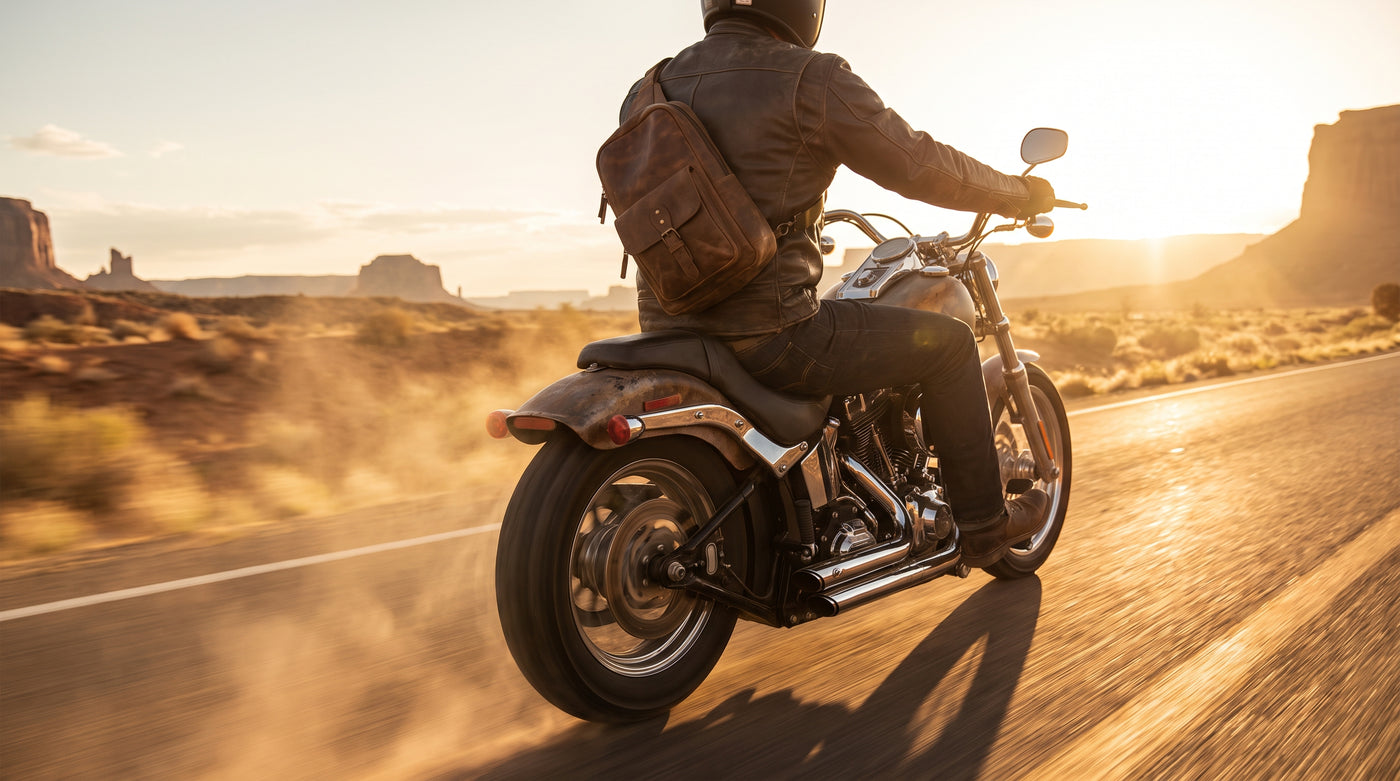
A $20 sling bag from a random marketplace seller looks fine hanging on a mannequin. Strap it across your chest at 65 mph and the whole thing rotates backward, bouncing against your ribs every time you hit a bump. The strap stretches. The buckle digs into your collarbone. By mile 40, you are pulling over to stuff it into a saddlebag you wish you had brought. The right motorcycle sling bag does not do any of that.
This guide breaks down what separates a motorcycle sling bag that stays locked to your body from one that fights you for the entire ride. You will learn which strap designs, materials, and sizes work best for riding, how sling bags compare to hip bags and leg bags, and what to check before buying.
Why a Sling Bag Beats a Backpack on a Motorcycle
A full-size backpack holds more gear, but for motorcycle commuting and day rides, that extra capacity works against you. A standard 20-liter backpack traps heat against your back. In temperatures above 80 degrees Fahrenheit, most riders develop a visible sweat patch within 15 minutes of riding. A sling bag sits across the chest or angled over one shoulder, with the bag resting against your side or lower ribcage. The contact area is smaller, and airflow reaches more of your back.
The access advantage is the real win. At a gas stop or traffic light, you can swing a sling bag to the front and grab your phone or wallet without taking off your helmet or shrugging out of straps. With a backpack, you either remove it entirely or twist awkwardly in the seat, which is not safe at an intersection.
Weight distribution matters more than most riders expect. A loaded motorcycle sling bag typically weighs 1.5 to 3 pounds total. That weight hangs from one padded strap across the chest, which is easier to manage at speed than a backpack pulling both shoulders backward. For anything under 8 liters of gear (phone, wallet, keys, sunglasses, a rain layer), a sling bag is the better tool for the job.

What to Look for in a Motorcycle Sling Bag
Strap width is the first thing to check. Straps under 1.5 inches wide dig into the shoulder on rides longer than 30 minutes. The sweet spot is 2 to 2.5 inches, with padding that extends at least 10 inches along the shoulder. Budget bags often use a narrow 1-inch strap that cuts into the collarbone at highway speed, and no amount of adjusting fixes it.
The buckle or clasp needs to release with one hand. Riders wearing gloves cannot fumble with small plastic clips. A magnetic buckle or a wide side-release buckle works best. Metal hardware lasts longer than plastic but adds a few ounces of weight.
Attachment points are what keep the bag from rotating during aggressive riding. Look for a secondary stabilizer strap that clips around the waist or across the chest. Without that strap, any crossbody bag swings to your back under wind load above 50 mph. This single feature separates a motorcycle-specific sling bag from a fashion sling you would carry around a city. A quick pull test in the store tells you everything: grab the bag and yank it sideways. If it slides, it will slide at speed.
The zipper should be a sealed or water-resistant type. YKK Aquaguard zippers are the industry standard for weather-resistant bags and add roughly $3 to the manufacturing cost, which is exactly why budget bags skip them. If the zipper has no rubber backing or sealed teeth, expect water to seep through during the first real rainstorm.
Best Motorcycle Sling Bag Styles for Men
Motorcycle sling bags for men fall into three broad categories, and each one fits a different kind of rider and bike.
Leather Crossbody Slings
These pair naturally with cruiser and chopper riders who already wear a leather jacket and boots. A full-grain leather sling bag weighs more than nylon, about 1 to 1.5 lbs for the bag alone, but it develops patina over time and looks better with age. The downside: leather is not waterproof without treatment, and it requires conditioning every few months to prevent cracking. For riders who keep their bike in the garage on rainy days, leather is a strong choice.
Tactical and Moto Nylon Slings
Built from 600D to 1000D Cordura or ballistic nylon, these are the workhorses. They handle rain, UV exposure, and road grime without any special care. Most include MOLLE webbing for attaching extra pouches or clips. Weight runs about 0.5 to 0.8 lbs for the empty bag. This is the best motorcycle sling bag style for daily commuters who ride in all weather conditions and do not want to babysit their gear.
Minimalist Tech Slings
Small-profile bags with a single main compartment and a front phone pocket. Capacity usually tops out at 3 to 4 liters. The appeal is that they sit flat against your body and create almost no wind resistance. For riders who carry nothing more than a phone, wallet, and keys, this is enough. The low profile also works well under a jacket without adding bulk.

How to Wear a Motorcycle Sling Bag at Highway Speed
The strap goes over the left shoulder for right-handed riders (or the right shoulder for left-handed riders). The bag rests on the opposite side of the body. For highway riding above 50 mph, rotate the bag so it sits against the front of your chest, not your back or side. This position uses your torso as a windbreak and keeps the bag from catching air.
Tighten the strap until the bag sits high on your chest, roughly between the bottom of your ribcage and the top of your sternum. A bag that hangs at belly level swings side to side during lane changes. High placement keeps the weight centered and reduces the rotational pull on your shoulder.
The stabilizer strap (if your bag has one) should clip to your belt loop or wrap around your torso on the opposite side. This creates a two-point anchor that prevents the bag from shifting under hard braking or sudden acceleration. If your bag does not have a stabilizer strap, you can add a simple nylon clip strap for under $5 at any outdoor supply store.
Load the heaviest item (usually a phone or small camera) in the pocket closest to your body. This pulls the center of gravity inward rather than away from your chest, which reduces bounce on rough roads and expansion joints.
Motorcycle Sling Bag vs Hip Bag vs Leg Bag
All three are better than a backpack for riding, but they sit in different positions and serve different purposes. If you already use a hip bag and need more room, a sling bag for motorcycle riding is the natural upgrade without jumping to a full saddlebag setup.
| Feature | Sling Bag | Hip Bag | Leg Bag |
|---|---|---|---|
| Position | Chest or shoulder | Waist or hip | Upper thigh |
| Capacity | 3 to 8 liters | 1 to 4 liters | 1 to 3 liters |
| Access while riding | Swing to front | Belt-level reach | Thigh-level reach |
| Wind resistance | Moderate | Low | Very low |
| Best for | Commuting, day rides | Quick-grab items | Minimalist carry |
| Comfort past 2 hours | Good | Very good | Moderate (thigh heat) |
A sling bag for motorcycle use is the most versatile of the three. It holds the most gear and sits high enough to avoid contact with the seat or tank. Hip bags are better for riders who need only a phone and wallet. Leg bags sit lowest and create the least wind drag, but they trap heat against the thigh in warm weather and can interfere with leg movement when you plant your foot at a stop.

Sizing Your Motorcycle Sling Bag Right
The biggest mistake is buying too large. A half-empty 10-liter sling bag shifts and bounces because the contents rattle around inside. A snug 5-liter bag packed properly sits tight against the body and moves with you, not against you.
- 3 to 4 liters: Phone, wallet, keys, sunglasses. Enough for a 1-hour commute or a quick errand run.
- 5 to 6 liters: Everything above plus a compact rain jacket or a water bottle (not both). Good for a 2 to 3 hour day ride.
- 7 to 8 liters: Full day-trip capacity. Fits a light layer, snacks, a small action camera, and basic tools. This is the upper limit before wind resistance becomes noticeable at highway speed.
Measure the main compartment, not just the exterior dimensions. Internal organization pockets reduce usable volume by about 15 to 20 percent. A bag marketed as 7 liters with three internal dividers may only fit 5.5 liters of actual gear.
Body size matters too. Riders under 5 feet 8 inches should stick to bags under 6 liters, because a larger bag wraps too far around the torso and restricts arm movement. Taller riders above 6 feet can comfortably run a 7 to 8 liter bag without it interfering with the riding position.
Materials and Waterproofing That Hold Up on the Road
Fabric options ranked by durability for a biker sling bag that sees regular use:
- 1000D Cordura nylon: The standard for motorcycle-specific bags. Abrasion-resistant, UV-stable, and takes years to wear through under normal riding conditions. Most reputable moto bag brands build around this fabric.
- 600D polyester: Acceptable for budget sling bags. Holds up for 1 to 2 seasons of regular riding but fades faster in UV and abrades more easily than Cordura.
- Full-grain leather: Tough and good-looking but heavier, not inherently waterproof, and requires conditioning. Best for riders who prioritize style and ride mostly in dry weather.
- Waxed canvas: Retro look with moderate water resistance from the wax coating. Needs re-waxing every 6 to 12 months. A solid match for vintage and bobber riders.
For waterproofing, there are two main approaches. Bags with a DWR (durable water repellent) coating shed light rain for the first few months, but the coating wears off and needs reapplication with a spray like Nikwax TX.Direct. Bags with welded-seam, roll-top construction keep water out permanently because there are no stitch holes for moisture to enter. If you ride in rain more than twice a month, welded seams are worth the price difference.
The strap itself needs attention. A motorcycle sling bag with a nylon strap and weak stitching will fail at the attachment point, not the fabric. Look for box-X stitching at every connection point, which is the same reinforcement pattern used on climbing harnesses. It distributes force across 8 stitch lines instead of 4, and it is the easiest quality indicator to spot when shopping.
5 Mistakes Riders Make When Buying a Motorcycle Sling Bag
- Wearing the bag on the back instead of the front. A sling bag worn across the back catches wind like a sail above 50 mph and creates drag that pulls your shoulder backward. Rotate it to the front or side of your chest before hitting the highway. This alone fixes most complaints about sling bags shifting at speed.
- Skipping the stabilizer strap. That secondary strap that clips from the bag to your belt or wraps around the torso is not just a nice extra. Without it, the bag swings freely under acceleration and braking. A $5 aftermarket clip solves a $50 frustration.
- Buying based on looks instead of strap width. A bag that photographs well but uses a 1-inch nylon strap will be uncomfortable after 20 minutes on the road. Wide straps of 2 inches or more with padding make every ride noticeably better.
- Overloading a small bag. Stuffing 6 liters of gear into a 4-liter bag stresses every zipper and seam. It also forces the bag into a round shape that presses against your ribs uncomfortably. Buy the right size for what you actually carry, not the smallest bag that technically holds everything.
- Ignoring the zipper direction. Right-handed riders should look for main zippers that open from right to left, allowing one-handed access while the left hand stays on the grip. Left-handed riders want the reverse. This detail is rarely listed in product descriptions, but it makes a real difference in daily use at gas stops and intersections.
If you are shopping for a motorcycle sling bag or crossbody bag built for real riding conditions, the motorcycle bags collection has options sorted by style and size. Every bag ships with free returns, so you can check the fit and strap quality before committing to the road.
No comments yet. Be the first rider to weigh in.