
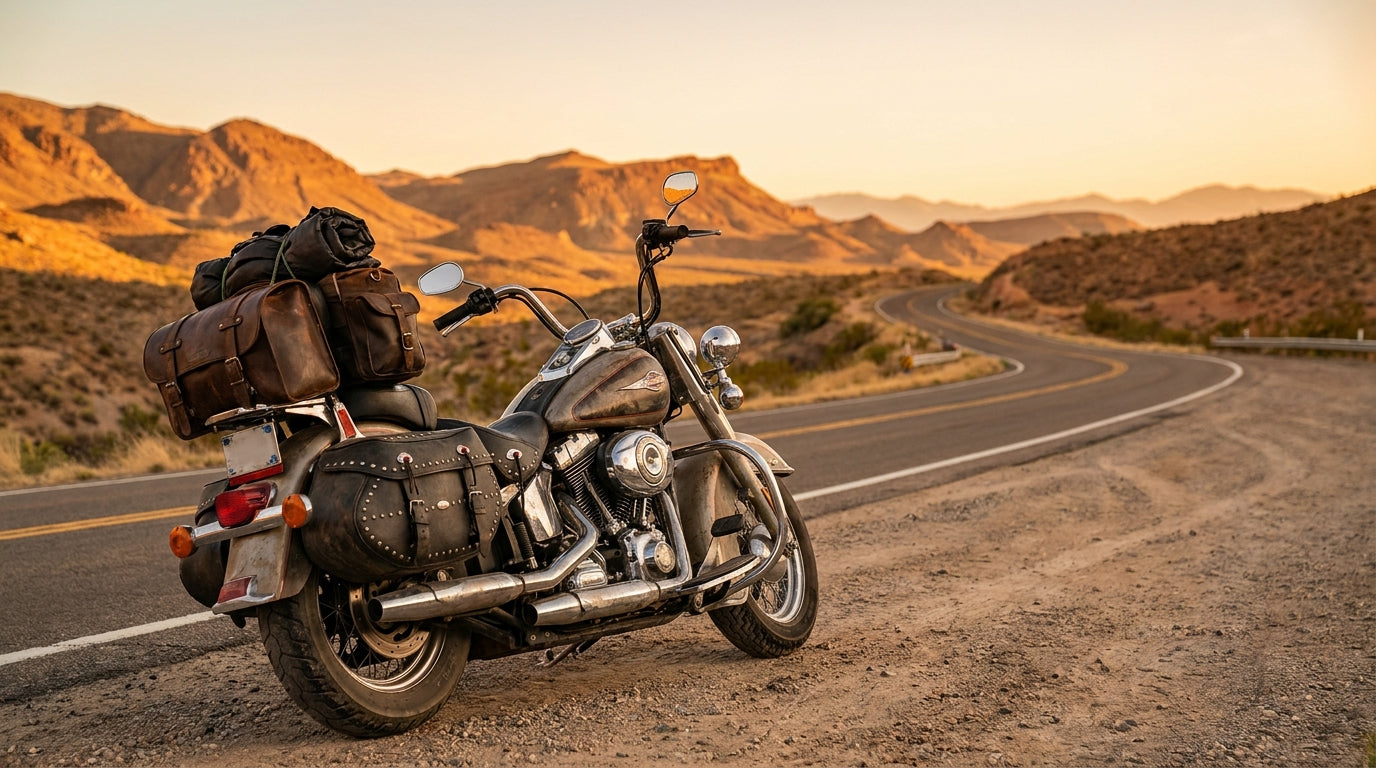
Most riders buy their first set of motorcycle saddlebags based on looks alone. They bolt them on, pull out of the garage, and find out the bags sag into the exhaust pipe, rub the rear tire, or barely hold a rain jacket. A $200 mistake that ends up collecting dust. The fix is straightforward: know what type, size, and mounting system your bike actually needs before you order anything.
This guide covers every major type of motorcycle saddlebag available today, from hard-shell touring cases to throw-over leather bags. You will get real dimensions, weight comparisons, and honest material breakdowns so you can pick the best motorcycle saddlebags for your riding style without wasting money on the wrong set.
Hard Shell vs Soft Leather Saddlebags
Every saddlebag on the market falls into one of two camps: hard shell or soft. The choice between them shapes what your bike can carry, how it handles at speed, and how much you spend.
Hard saddlebags are injection-molded ABS plastic or fiberglass. They lock with a key, seal out rain without aftermarket covers, and hold their shape whether full or empty. A standard Harley-Davidson touring saddlebag (the stock cases on a Road Glide or Street Glide) holds roughly 1.7 cubic feet per side, about 37 liters. That is enough for a weekend's worth of clothes, a pair of boots, and a compact toolkit. The trade-off is weight and fitment. Most hard bags weigh 15 to 22 lbs per side, and they only mount on the specific bike they were molded for.
Soft saddlebags are made from leather, Cordura nylon, or waxed canvas. They weigh half as much as hard shells, compress flat when empty, and many designs throw over the seat to fit almost any motorcycle. A pair of Dowco Iron Rider throw-overs holds about 24 liters per side and weighs under 5 lbs total. The downside: no built-in lock, and cheap versions lose shape at highway speed, flopping into the wheel or muffler. If the bags do not include built-in support stays, plan on adding support brackets.

What Size Motorcycle Saddlebags Do You Need?
Size depends entirely on what you carry and how far you ride. Day rides need 15 to 20 liters per side. That covers a rain layer, phone charger, sunscreen, and a water bottle. Weekend trips push the requirement to 25 to 35 liters. Cross-country touring means 35 liters or more per side, typically paired with a tail bag on the rear seat for overflow gear.
| Riding Type | Volume Per Bag | Typical Dimensions (L x W x H) |
|---|---|---|
| Day ride | 15-20 liters | 14" x 6" x 10" |
| Weekend trip | 25-35 liters | 17" x 7" x 12" |
| Touring | 35-50 liters | 22" x 9" x 14" |
| Heavy touring | 50+ liters | 24" x 10" x 15" |
Before ordering, measure three clearances on your bike. First, the gap between the seat and the exhaust pipe. You need at least 2 inches of air space. Second, the distance from the seat to the rear axle. Bags cannot contact the tire at any point in the suspension travel. Third, the gap between the mounting point and your turn signals. Skip this step and you risk melted bags or blocked signals on day one.
Universal Fit vs Model-Specific Motorcycle Saddlebags
One of the most common questions riders ask is whether motorcycle saddlebags are universal. The short answer: soft bags usually are, hard bags never are.
Throw-over soft bags (two pouches connected by a yoke that drapes across the seat) fit nearly any motorcycle with a flat rear fender section. SW-Motech and Kriega both make universal soft saddlebags with quick-release buckles that work on sport bikes, cruisers, and adventure bikes without drilling a single hole. If you ride a Sportster today and trade up to a Dyna next year, the bags come with you.
Model-specific hard bags are the opposite. Harley Road King saddlebags will not bolt onto a Sportster without a custom bracket and wiring adapter. Indian Challenger bags will not mount on a Scout. Before buying hard cases, confirm the exact model and production year of your bike. Even small year-to-year changes in fender strut spacing can make a set incompatible.
Semi-rigid bags split the difference. They use a hard internal frame wrapped in leather or nylon, giving you the shape retention of a hard case with broader fitment. Saddlemen makes a semi-rigid line with a universal mounting plate that fits over 80 cruiser models straight out of the box.
Best Saddlebag Materials and What Holds Up
Material is the single biggest factor in how long your motorcycle saddlebags last. Here is what actually holds up on the road and what falls apart.
Full-grain leather at least 1.2mm thick ages well, develops character, and resists abrasion. It is the standard for cruiser saddlebags. Top-grain is a step down but still performs. Avoid anything labeled "genuine leather" or "bonded leather." Those are industry terms for lower-grade hides that crack and peel under UV exposure within a single season. A set of quality full-grain leather saddlebags should last 7 to 10 years with basic conditioning twice a year. The same logic applies when shopping for leather motorcycle gloves or a motorcycle jacket.
Cordura 1000D nylon is the benchmark for textile bags. It resists abrasion, handles UV better than leather, and is easier to waterproof with factory-taped seams. The Tourmaster Cruiser III uses Cordura with a PVC backing and has been a touring workhorse for over a decade.
ABS plastic and fiberglass (used in hard shells) are the toughest options. They will survive a low-speed tip-over without deforming. But they scratch easily, and paint-matched replacement sets from Harley or Indian run $800 to $1,200 per pair.

How to Mount Motorcycle Saddlebags Without Drilling
You do not need to drill into your frame to run saddlebags on most bikes. The throw-over method is the simplest approach: lay the connecting yoke across the seat, tighten the buckle straps under the rear fender, and secure the support straps to the passenger peg mounts. Total install time is about 10 minutes with zero tools required.
For better stability at speed, saddlebag support brackets keep bags from swinging into the rear wheel. Fehling and National Cycle make universal bracket sets that bolt to existing frame holes on most cruisers. A solid set runs $40 to $80 and installs with basic hand tools in about 30 minutes. Worth the investment if you ride at highway speed on a regular basis.
Hard saddlebags require model-specific mounting hardware. On most Harley touring models, the docking hardware bolts to four threaded inserts on the fender struts. The factory torque spec is 14 ft-lbs. If you are doing this yourself, use a calibrated torque wrench. Overtightening strips the inserts, and the repair involves replacing the entire fender strut assembly. When you are gearing up for a ride, making sure your bags are secure matters as much as having solid boots on your feet.
How to Lock and Secure Your Saddlebags
Theft at gas stations and rest stops is a real concern for any touring rider. Hard saddlebags with factory locks offer the most protection, but the stock Harley tumbler locks are notoriously easy to pick. A $40 aftermarket upgrade to disc-detainer locks (like the ABUS Plus cylinder) makes a measurable difference. For quick deterrence under $20, the Master Lock 8417D cable wraps around the bag lid and frame mount.
Soft leather saddlebags have no great locking solution. A small cable lock threaded through the D-rings and around the frame will slow down an opportunistic grab, but it will not stop someone with a pair of cutters. The real security strategy for soft bags is portability: pick bags with quick-release buckles, detach them at every stop, and carry them inside. It takes 30 seconds and eliminates the problem entirely.
PacSafe makes steel-mesh net protectors (originally designed for backpack travel) that wrap around motorcycle saddlebags. They will not defeat bolt cutters, but they block the quick snatch-and-run, which is how most bag theft actually happens at rest stops.

Hard vs Soft vs Semi-Rigid: The Full Comparison
| Feature | Hard Shell | Soft (Leather/Nylon) | Semi-Rigid |
|---|---|---|---|
| Weight per bag | 15-22 lbs | 4-8 lbs | 6-12 lbs |
| Waterproof | Yes (factory sealed) | Rain cover needed | Varies by model |
| Lockable | Yes (keyed) | No (add cable lock) | Some models |
| Universal fit | No (model-specific) | Yes (throw-over) | Most cruisers |
| Typical price (pair) | $400-$1,200 | $80-$350 | $150-$500 |
| Durability | 10+ years | 2-7 years | 5-8 years |
| Best for | Touring, daily commute | Casual riding, multi-bike owners | Cruiser touring |
5 Common Mistakes When Buying Motorcycle Saddlebags
1. Ignoring exhaust clearance. Soft bags without support brackets sag into the muffler and melt. Exhaust pipes run 300 to 600 degrees Fahrenheit, and nylon starts deforming at around 200 degrees. Always measure the gap and use support brackets if the clearance is under 3 inches.
2. Buying by volume alone. A 50-liter bag sounds great until the extra weight shifts your center of gravity on the highway. Most cruisers handle best with 25 to 35 liters per side, loaded symmetrically. Need more space? Add a tail bag on the rear seat instead of oversizing the saddlebags.
3. Trusting "water-resistant" labels. Water-resistant is not waterproof. If the bag lacks taped seams or a roll-top closure, it will leak during a multi-hour rain ride. Pack electronics in a separate dry bag even inside bags marketed as waterproof.
4. Using zip ties as permanent mounts. They work for a temporary fix, but UV exposure degrades standard zip ties within a few months. They snap at highway speed, and your bag bounces into traffic behind you. Use stainless steel bolts or nylon locking straps rated for vibration.
5. Loading weight unevenly. Putting tools in one bag and a jacket in the other creates a lateral pull that fights your steering input at every lean. Split weight evenly between both sides, keep heavy items low in the bag, and cap each side at around 20 lbs on a standard cruiser frame.
The right motorcycle saddlebags turn your bike from a point-A-to-B ride into something you can actually travel on. Match the type to your riding style, measure your clearances first, and invest in quality materials once instead of replacing cheap bags every season. If you are shopping for motorcycle bags and riding gear, the motorcycle bags collection is where I'd start.
No comments yet. Be the first rider to weigh in.