
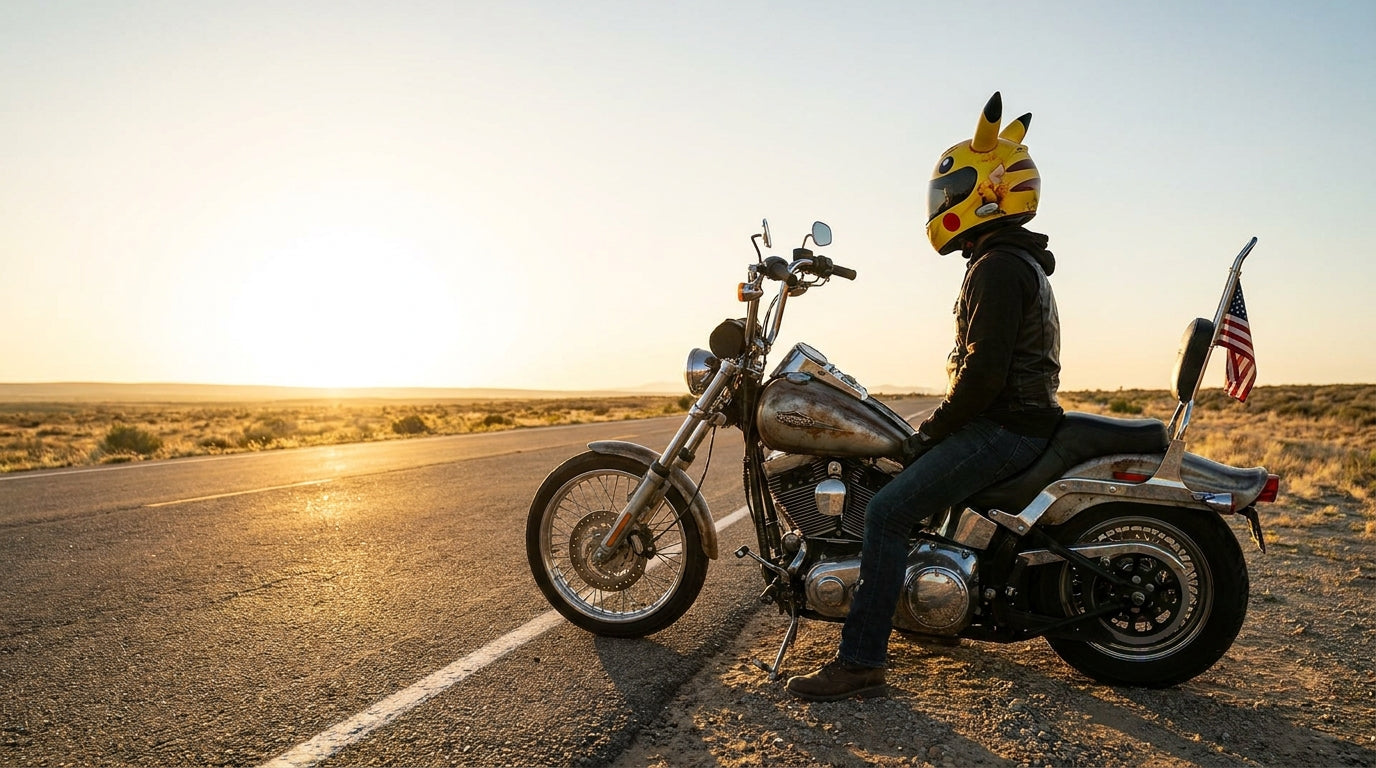
You pull up to a group ride wearing a Pikachu helmet cover and two things happen: half the crew laughs, the other half asks where you got it. Pokemon motorcycle helmets have gone from a niche cosplay joke to a real segment of the riding gear market. And there are more options now than most riders realize.
This guide breaks down every way to get a Pokemon motorcycle helmet that actually works on the road. We cover helmet covers, custom airbrush jobs, 3D-printed shell add-ons, and the safety questions you need to answer before buying any of them. By the end, you will know exactly what fits your budget, your bike, and your local DOT requirements.
What Counts as a Pokemon Motorcycle Helmet?
The term "pokemon helmet" covers three very different products, and mixing them up leads to bad purchases. Here is what riders actually mean when they search for one:
- Helmet covers (slip-ons): A fabric or plush shell that stretches over your existing DOT-rated helmet. The Pikachu version is the most popular by a wide margin. These run $15 to $40, install in under a minute, and come off just as fast. Your base helmet stays fully DOT/ECE compliant because the cover sits on the outside.
- Custom airbrushed helmets: A professional painter applies Pokemon artwork directly to a certified helmet shell. Prices start around $250 for a basic Charizard or Gengar design and climb past $600 for full wrap-around scenes. The helmet retains its certification since the paint does not alter the shell structure.
- 3D-printed add-ons: Ears, horns, or shaped pieces that bolt or velcro onto a helmet to create a sculpted Pokemon look. These are mostly DIY or Etsy-sourced, with prices from $20 to $80 for the printed parts alone.
The Pikachu helmet cover outsells every other style combined. According to Google Trends data from 2025, "pikachu helmet cover" pulls roughly 5x the search volume of any other character-specific motorcycle helmet search. It is cheap, it is funny, and it fits almost any full-face or modular helmet without modification.

Pikachu Helmet Covers: Why They Dominate
The standard Pikachu helmet cover is a plush slip-on with stuffed ears, embroidered eyes, and a rear elastic band. It fits full-face helmets from size S through XL, with the sweet spot around a medium Shoei RF-1400 or HJC i70 shell size. Most versions weigh about 180 grams, so you will not feel it on your head at highway speed.
Wind drag is the first question every rider asks. At city speeds below 45 mph, there is zero noticeable buffeting. Above 65 mph, the ears start to flutter, and you will hear a light whipping sound. It is not dangerous, but if you are a sport rider doing triple-digit pulls, the cover will not survive. For cruiser and standard riders who sit upright, it works fine on the highway.
Installation takes about 30 seconds. Stretch the elastic base over the bottom of the helmet, tuck in the chin area, and adjust the ears. Removal is just as fast, which makes it easy to toss in a saddlebag when you arrive somewhere that calls for a more serious look.
A few things to watch for: cheap knockoffs with thin stitching that tears after one ride, oversized versions that sag over your visor, and covers with rigid internal frames that could crack on impact. Stick with covers that use soft fill material only. No hard plastic pieces should sit between the cover and your helmet shell.
Custom Airbrush Pokemon Helmets: The Premium Route
If you want something permanent and unique, a custom airbrushed Pokemon helmet is the route to take. This means sending a DOT-rated base helmet to a professional painter who applies your chosen design directly to the shell.
The most popular characters for motorcycle helmets, based on painter portfolio frequency, are Charizard, Gengar, Mewtwo, and the classic Pokeball design. Charizard flame wraps work especially well on dark base helmets because the orange and red gradients pop against matte black.
Expect to pay between $250 and $650 depending on complexity. A simple Pokeball logo on both sides runs around $250. A full Gengar scene wrapping from the chin bar to the crown costs $500 or more. Turnaround time averages 3 to 5 weeks, and most painters require a $100 deposit up front.
The paint does not void your helmet's DOT or ECE certification. FMVSS 218 (the DOT standard) tests the helmet shell and liner, not the exterior finish. As long as the painter does not sand through the shell or use solvents that compromise the resin, the certification holds. Reputable helmet painters know this and will clear-coat the finished design with a UV-resistant layer that also protects the artwork from road debris.
One caveat: resale value drops on a custom-painted helmet because the design is personal. If you plan to sell your helmet after a few seasons, a removable cover is a smarter choice financially.
3D-Printed Pokemon Helmet Add-Ons
The maker community has gone deep on this one. Thingiverse and Printables host dozens of free STL files for Pokemon-themed helmet attachments: Pikachu ears that mount with industrial velcro, a Bulbasaur bulb that sits on top of a half-shell, and full Jigglypuff ear sets that fit modular helmets.
Material matters here. PLA (the most common 3D printing filament) gets brittle in direct sunlight and can warp above 140 degrees Fahrenheit, which the surface of a black helmet reaches on a summer afternoon in Arizona or Texas. PETG holds up better to UV and heat. ASA is the best choice for outdoor motorcycle use since it was originally developed for automotive exterior parts.
Attachment method is the safety-critical decision. Velcro strips (3M VHB tape backed) are the safest because they shear off on impact. Never bolt a rigid 3D-printed piece through the helmet shell. Drilling into a DOT-rated shell voids the certification immediately and creates a stress point that can crack on impact. This is not a gray area. It is a hard safety rule.
Total cost for a DIY 3D-printed Pokemon helmet setup runs about $15 to $30 in filament plus the print time if you own a printer, or $40 to $80 from an Etsy seller who prints and ships.

Pokemon Helmet Safety: What You Need to Check
The base helmet under any Pokemon modification must carry a DOT sticker (FMVSS 218) at minimum. ECE 22.06 is even better, and Snell M2020D is the gold standard. The Pokemon element, whether a cover, paint, or add-on, should never compromise these three things:
- Shell integrity: No holes drilled, no material removed, no adhesive that dissolves resin.
- Visor operation: The cover or add-on must not block the visor from opening and closing fully. Test this before every ride.
- Retention system: The chin strap must buckle and release exactly as designed. Some oversized covers can snag the D-ring, so check this during fitting.
One more point that gets overlooked: aerodynamic profile. A smooth helmet shell is engineered to slide across pavement in a crash, reducing rotational forces on the neck. A bulky 3D-printed Pikachu ear could catch on asphalt and jerk your head sideways. This is why soft, tear-away covers are safer than rigid bolt-on pieces. The cover rips off on contact. A bolted ear does not.
Pokemon Helmet Options Compared
| Type | Cost | DOT Impact | Install Time | Best For |
|---|---|---|---|---|
| Helmet Cover (Pikachu) | $15 - $40 | None | 30 seconds | Casual riders, group rides, gifts |
| Custom Airbrush | $250 - $650 | None (if done right) | 3 - 5 weeks | Permanent builds, show bikes |
| 3D-Printed Add-Ons | $20 - $80 | Risk if bolted | 10 - 20 minutes | DIY builders, cosplay events |
| Pre-Painted Character Helmets | $80 - $200 | Check for DOT sticker | None (ready to wear) | Budget buyers who want convenience |
Common Mistakes When Buying a Pokemon Motorcycle Helmet
Buying a character helmet with no DOT certification. Cheap full-shell Pokemon helmets sold on marketplace sites often look great in photos but carry no safety rating at all. A $45 Pikachu full-face helmet from an overseas seller is a toy, not protective gear. Check for the DOT sticker on the back and the manufacturer's FMVSS 218 compliance label inside the liner. If neither is present, it is a novelty item and should never be worn on a motorcycle.
Using superglue or epoxy to attach add-ons. Cyanoacrylate (superglue) and two-part epoxy can chemically attack polycarbonate and ABS helmet shells. The bond might feel solid, but it can weaken the shell at the attachment point. Use 3M VHB tape or industrial-strength velcro instead. Both provide strong hold without chemical bonding to the shell material.
Ignoring visor clearance. A helmet cover that bunches around the chin bar can block the visor from sealing shut. At highway speed, an unsealed visor lets wind, rain, and road debris into your face. Always close and open the visor three times after fitting any cover to make sure it operates smoothly.
Buying the wrong size cover. Helmet covers are not universal. A cover designed for a Shoei GT-Air II (which has a wider shell profile) will be loose and saggy on an AGV K1 (narrower shell). Check the seller's size chart and match it to your specific helmet model, not just S/M/L.
Riding with a damaged cover. A cover with torn stitching or a hanging ear is a snag hazard. If it is flapping loose, take it off before riding. Tuck it in your saddlebag or a riding bag and ride with the bare helmet until you can repair or replace the cover.
Where to Find a Pokemon Motorcycle Helmet
For helmet covers, especially the Pikachu design, the best options are specialty biker gear shops that vet their products for fit and material quality. Generic marketplace listings are hit-or-miss. Half of them ship from overseas warehouses with 3-week delivery times and no return policy. A dedicated gear shop will have accurate sizing info and a return window if the cover does not fit your shell.
For custom airbrush work, search for "motorcycle helmet painter" in your state. Most custom painters are small shops or solo artists. Look at their portfolio for clean lines and consistent clear coat. Ask if they have painted a Pokemon design before. Experienced painters will have reference photos of past character work.
For 3D-printed pieces, Etsy is the largest marketplace. Filter by reviews (4.5 stars or higher) and check that the seller specifies ASA or PETG filament. PLA sellers are fine for display pieces but not for gear that sits in the sun on your motorcycle helmet all day.
If you are shopping for quality motorcycle helmets or fun helmet covers that hold up, American Legend Rider carries DOT-rated options and covers built for real riding. That is a good place to start.

No comments yet. Be the first rider to weigh in.