
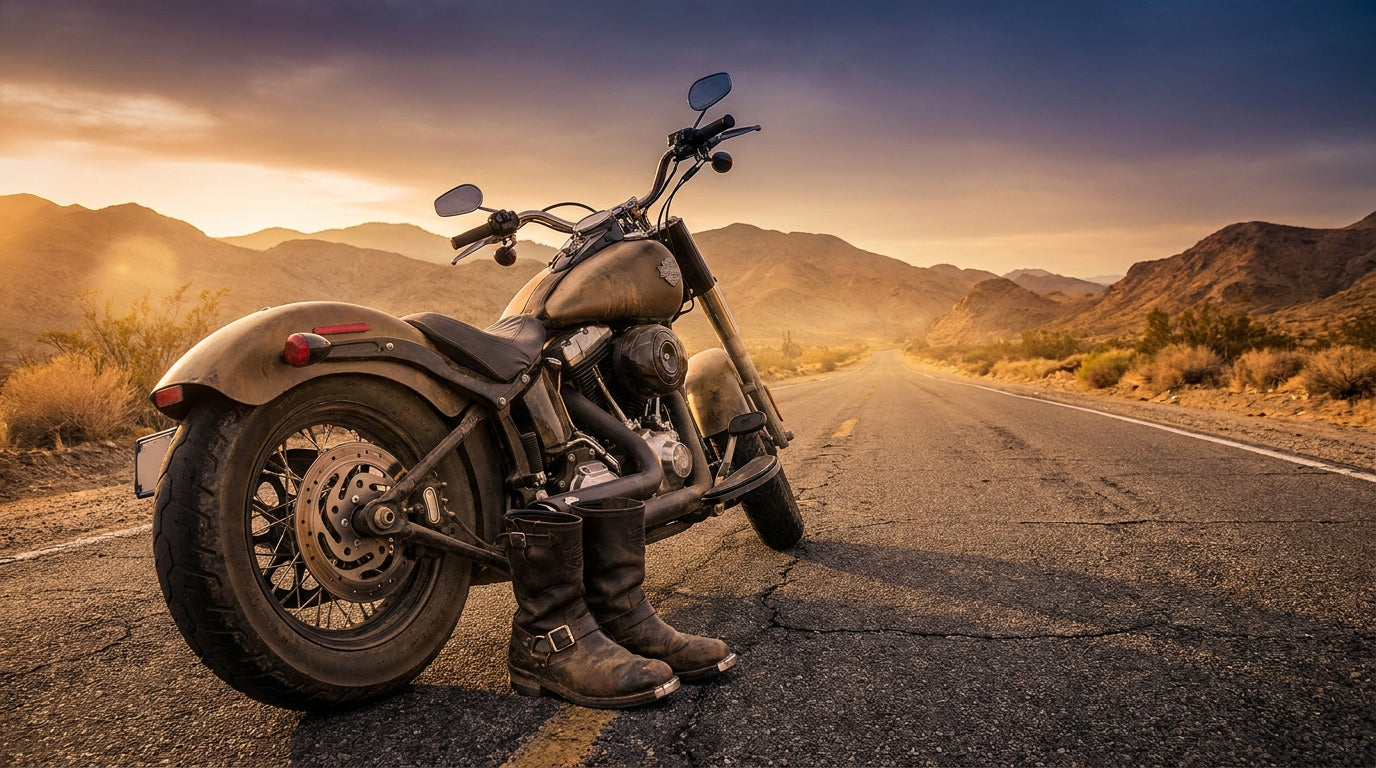
Most cowboy boots play it safe. Smooth leather, a clean toe, maybe a stitched pattern if you are feeling bold. Then there are punk cowboy boots, the ones with skull buckles, steel hardware, and enough attitude to clear a bar. They take the western silhouette and run it through a mosh pit. The result looks like nothing else on a boot rack.
This guide breaks down the best punk cowboy boot styles for riders and everyday wear. You will learn which materials hold up, which hardware details matter, and how to tell a quality pair from a costume-shop fake. Every style listed here ships with real leather construction and hardware that does not fall off after three wears.
What Makes a Boot "Punk Cowboy"
A standard cowboy boot has a pointed or snip toe, an angled heel (usually 1.5 to 2 inches), and a pull-on shaft that hits mid-calf. A punk cowboy boot keeps that silhouette but adds aggressive details: skull medallions, antique-brass buckle straps, chain accents, distressed leather, or exposed stitching. Think Harley meets Nashville.
The key difference is hardware. A traditional cowboy boot is clean lines and polished leather. A punk version loads the shaft and instep with metal. The Lucchese cowboy boot averages about 14 oz of leather per boot. A hardware-loaded punk version can weigh 18 to 22 oz because of the buckles and chain rings riveted into the leather.
Good punk cowboy boots use the same Goodyear welt or cement construction as proper western boots. The hardware is riveted, not glued. If you flip the boot over and see a real leather or rubber outsole with visible stitching, that is a sign of actual build quality versus a costume piece.
The shaft on most punk cowboy boots runs 11 to 13 inches from the sole to the top opening. That is a few inches taller than a typical engineer boot (which stops around 9 to 10 inches). The extra height is one reason riders like them. A taller shaft means more leather between your calf and a 500-degree exhaust pipe.
Skull Cowboy Boots for Men
Skull cowboy boots sit at the center of this niche. The skull detail usually appears as a cast-metal buckle on the strap, an embossed pattern pressed into the leather shaft, or a laser-cut overlay. The best versions use 316L stainless steel for the skull hardware because it resists corrosion from rain, sweat, and road grime.
A handmade pair with real skull buckles typically runs $170 to $250. The leather is usually full-grain cowhide, 1.2 to 1.4 mm thick, which is sturdy enough for riding and breaks in over 2 to 3 weeks of regular wear. Thinner leather (under 1.0 mm) creases fast and splits at stress points around the ankle.

If the skull detail is a stamped-on decal or a glued-on plastic piece, walk away. That is the first sign of a marketplace knockoff. Real skull cowboy boots for men feature cast or CNC-machined metal bolted through the leather with a backing plate on the inside.
Color matters too. Most skull cowboy boots come in black or dark brown, but some brands offer a distressed gray or oil-rubbed finish that brings out the embossing detail. Black full-grain cowhide hides scuffs better on the road. Brown or gray shows off tooling and embossing patterns more clearly when you are off the bike. Pick based on whether the boots see more highway or more barroom.
Badass Cowboy Boots with Buckles and Chains
Buckle-and-chain styles are the loudest category. These leather biker boots combine western shaft height with double or triple buckle straps across the instep and ankle. Some add a draped chain from the pull-on loop down to the heel counter.
The buckle hardware matters more than the leather on these. Look for solid brass or stainless buckles with a roller bar, not a stamped-flat friction buckle. Roller bars slide in and out of the strap holes smoothly and do not chew up the leather over time. A solid brass roller buckle costs the manufacturer about $3 to $4 per unit. A stamped zinc alloy buckle costs $0.40. The price gap shows up in durability within the first year.

Chain accents should be welded-link, not split-ring hobby chain. A welded stainless chain on a boot can handle 40+ lbs of pull force, which matters when your boot catches on a peg or a curb. Split-ring chain snaps at around 8 lbs.
O-ring strap boots are a subset worth knowing. They wrap a single leather strap around the ankle with an O-ring or D-ring at the outside. The Chippewa engineer boot made this design famous in the 1970s, and every punk cowboy version riffs on it. A double-strap version adds a second band across the instep, creating an X-pattern that locks your foot in place and looks aggressive from across the room.
How to Check Hardware Quality in 30 Seconds
Before you buy, run this quick check. Grab any buckle or chain on the boot and try to wiggle it. If it moves more than 1 to 2 mm at the base, the rivets are loose or the backing plate is thin. Then flip the boot and check the inside lining behind the hardware. You should feel or see a metal washer or plate. No plate means the rivet is punched directly into the leather, and it will pull through after a few months of wear.
Punk Rock Cowboy Boots vs Standard Motorcycle Boots
Riders searching for punk rock cowboy boots sometimes wonder how they stack up against a standard motorcycle boot. Here is a direct comparison.
| Feature | Punk Cowboy Boot | Standard Moto Boot |
|---|---|---|
| Shaft height | 11 to 13 inches (mid-calf) | 8 to 10 inches (above ankle) |
| Heel | Angled, 1.5 to 2 in | Flat or block, 1 in |
| Toe protection | Reinforced toe box, no steel | Steel or composite toe cap |
| Ankle armor | None (leather only) | CE-rated ankle puck (some) |
| Sole grip | Smooth leather or rubber lug | Oil-resistant rubber lug |
| Shift pad | No | Yes (some models) |
| Style factor | High (turns heads off the bike) | Moderate (functional look) |
| Price range | $130 to $250 | $100 to $300 |
For cruiser and chopper riders doing city and highway miles, punk cowboy boots work well. The taller shaft protects more of the calf from exhaust heat. For sport riding or off-road, a dedicated motorcycle boot with ankle armor is the safer call. The punk cowboy boot wins on style and calf coverage but gives up engineered ankle protection.
One option worth considering: wearing an ankle brace under a punk cowboy boot. A basic ASO ankle stabilizer runs about $25, fits under most mid-calf boots, and adds the lateral support the boot lacks on its own. That combination gives you the look of a cowboy boot with closer to motorcycle-grade ankle protection.
Vintage Punk Boots and 80s-Inspired Styles
The 80s punk scene ran on Doc Martens, Grinders, and DIY-studded cowboy boots. Today's vintage punk boots pull from that era with details like antiqued brass studs in rows, wax-finished leather that looks pre-worn, and blocky square toes instead of the traditional pointed snip.
The Grinder brand (UK-made) built its reputation on exactly this style. Their "Galveston" boot combined a western shaft with steel cap toe and triple-buckle straps. It weighed 2.4 lbs per boot and used 2.0 mm full-grain leather. That boot set the template for most punk cowboy designs you see today.

Modern lace-up skull boots carry the same DNA. The lace-up front gives you a tighter fit at the ankle than a pull-on, which helps on a bike. Look for eyelets made of brass or nickel-plated steel. Aluminum eyelets bend after a few dozen tightenings and start to cut into the leather.
If you are chasing the 80s punk look specifically, look for boots with round or square toes rather than pointed snip toes. The pointed toe is a traditional country-western detail. The 80s punk scene chopped that off and went blunt. A round-toe punk cowboy boot reads more Ramones and less rodeo, which is usually the goal for riders after this style.
Can You Ride in Punk Cowboy Boots
Yes, with caveats. Thousands of cruiser riders wear cowboy-style boots every day. The taller shaft is good for calf protection against exhaust pipes (a Harley Softail exhaust runs 400 to 600 degrees F on a warm day). The angled heel catches the foot peg naturally.
The two weak points are ankle rigidity and sole grip. A cowboy boot has no lateral ankle support beyond the leather itself. If you drop the bike at a stop, your ankle takes the full load. And smooth leather soles can slip on wet pegs. The fix: pick a pair with a rubber lug outsole or add a stick-on rubber half-sole (about $12 from any cobbler).

For highway cruising on a Harley, Indian, or Triumph, punk cowboy boots are a solid choice. For rain riding, sport riding, or anything involving dirt, reach for a purpose-built motorcycle boot with proper ankle armor.
One more riding tip: condition the leather before your first long ride. A coat of Obenauf's Heavy Duty LP or Huberd's Shoe Grease seals the pores, adds mild water resistance, and softens the leather for faster break-in. Apply it the night before, let it soak for 8 hours, and wipe off any excess. This one step cuts break-in time nearly in half and protects the leather from road salt and chain lube splatter.
5 Mistakes When Buying Punk Cowboy Boots
- Buying glued-on hardware. If the skulls, buckles, or chains are glued and not riveted or bolted, they will peel off within weeks. Check the inside of the boot for rivet backs.
- Choosing bonded leather. Bonded leather (ground leather scraps glued to a fabric backing) cracks and peels. It is often labeled "genuine leather," which is the lowest grade. Look for "full-grain" or "top-grain cowhide" on the product spec.
- Ignoring the sole material. Smooth leather soles look authentic but are dangerous on wet surfaces. A Vibram-style rubber lug sole adds grip without killing the western aesthetic.
- Buying too tight and hoping for stretch. Cowboy boots stretch about a half-size in width over the first 20 wears. They do not stretch in length. If your toes hit the front wall on day one, go up a half size.
- Skipping the break-in. Real leather cowboy boots need 10 to 15 wears to break in. Wearing them for a long ride on day one guarantees blisters at the heel and ball. Wear them around the house for a week first.
Which Style Fits Your Ride
If you ride a cruiser or chopper and want boots that work on and off the bike, punk cowboy boots are one of the few styles that pull it off. Skull buckle versions skew heavier and more aggressive. Chain-accent styles fit the outlaw look. Lace-up vintage designs give a tighter fit for actual riding.
If you are shopping for a pair, the leather motorcycle boots collection is where to start. Every pair is full-grain leather, verified in stock, and ships from the US.

No comments yet. Be the first rider to weigh in.