
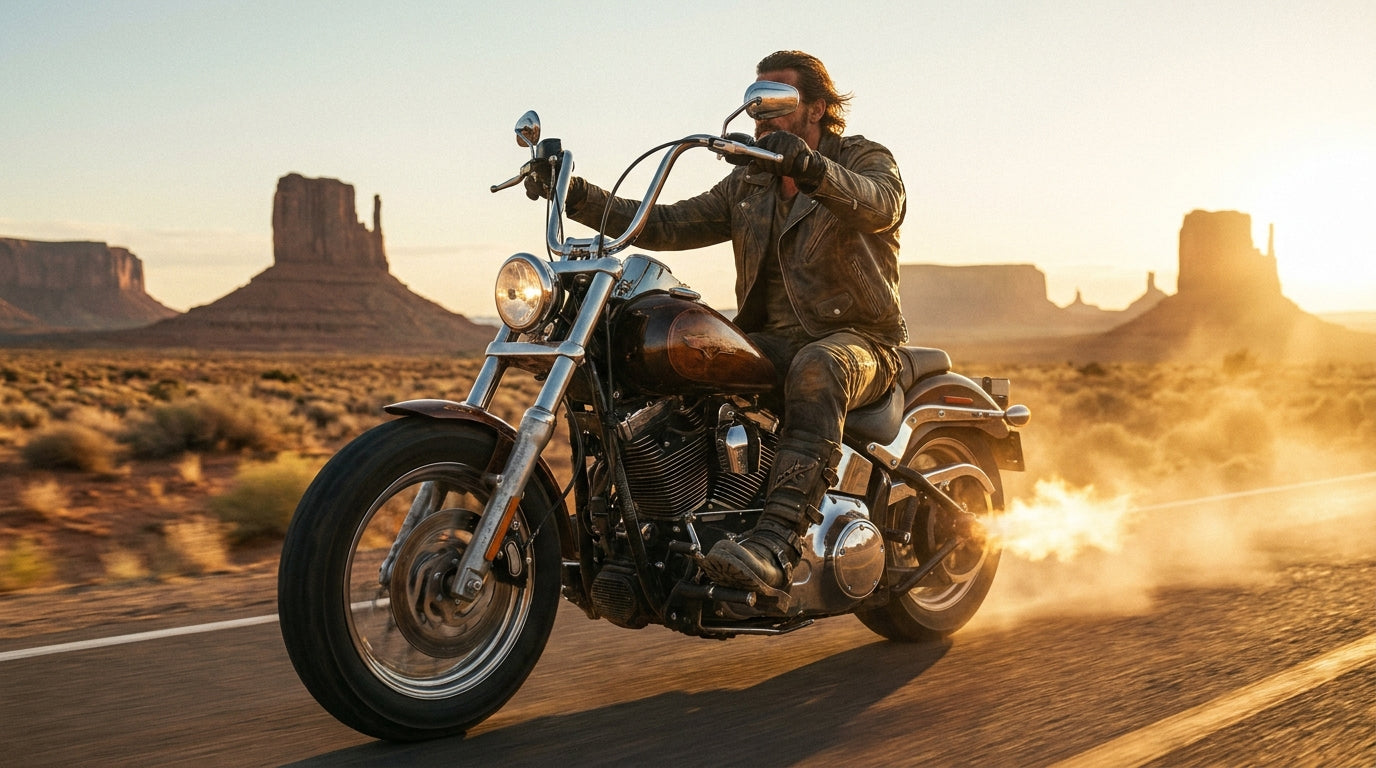
A plain black boot gets the job done. It protects your ankles, grips the pegs, and nobody gives it a second look. But some riders want boots that make people look twice. The kind that hits concrete with a heavy thud, loaded with hardware, thick soles, and leather that looks like it has been through something real. That is what separates badass biker boots from a basic riding shoe.
This guide breaks down 9 aggressive boot styles that look mean and actually hold up on the road. Every section covers the specific construction details that set real badass biker boots apart from costume pieces that fall apart after one season. You will know which style fits your bike, your look, and your riding by the end of this page.
What Makes a Biker Boot Actually Badass
Most boots get called "badass" for cosmetic reasons alone. The look only works long-term when the construction backs it up. Three things define an aggressive biker boot.
First, sole thickness. A standard motorcycle boot has a sole around 0.75 inches thick. A proper tough boot sits on 1.25 to 1.75 inches of rubber or Vibram lug sole, giving it a chunky, planted stance. That extra height also raises the rider's heel above the foot peg, which gives better control over the rear brake and shift lever.
Second, hardware. Buckles, D-rings, harness straps, and rivets catch light and create visual weight. A single stainless steel harness ring on an engineer boot adds less than 2 ounces but completely changes the silhouette. The key is solid metal, not pot metal that bends when you tighten it.
Third, the leather itself. Full-grain cowhide at 1.2 to 1.4 mm thickness develops real character as it ages, with creases, scuffs, and patina that look better over time. Bonded or corrected-grain leather stays flat, looks plastic, then cracks and peels within months. That is why $70 "biker boots" from no-name marketplace sellers look cheap within one season, while a $160 pair of full-grain boots look better at year three than they did new.
Harness Boots: The Original Badass Biker Boot
Harness boots launched the entire biker boot aesthetic. Marlon Brando wore a pair of Chippewa harness boots in The Wild One (1953), and the style has been locked into motorcycle culture ever since. The defining feature is a leather strap with a metal ring that wraps around the ankle, attaching to a metal O-ring on the outer side of the boot.
The standard harness boot sits 11 to 13 inches tall with a square toe, stacked leather heel at 1.5 to 1.75 inches, and Goodyear welt construction that allows resoling. A pair from Chippewa or Frye weighs roughly 3.5 lbs per boot, which is heavier than a sport riding boot but lighter than a full engineer style. That weight comes from double-layer leather in the shaft and a solid heel stack.
Harness boots look best on cruisers and choppers. The wide shaft clears the shift lever without snagging, and the smooth sole slides onto foot pegs without catching on serrated edges. The biker boots fit guide covers sizing details across every style if you want exact measurements before ordering.

Engineer Boots: Heavy Soles and Steel Toes
Engineer boots were designed for railroad workers and linemen who needed heavy-duty foot protection. They crossed into biker culture in the 1950s when riders adopted them for their steel toes, thick soles, and pull-on design that eliminated laces entirely.
A proper engineer boot features a steel or composite safety toe rated ASTM F2413, a 14 to 16 inch shaft, two buckle straps (one at the ankle, one at the top), and a Vibram or lug sole between 1.25 and 1.75 inches thick. A pair of Wesco Boss boots weighs about 4.5 lbs per boot, making them the heaviest on this list. That weight is part of the appeal. The boots hit the ground with authority.
The downside is break-in time. New engineer boots with thick full-grain leather take 40 to 80 hours of wear before the leather softens enough for comfortable all-day use. Wear them around the house for short sessions before a long ride. Do not soak them in water to speed up the process, because that weakens the stitching on Goodyear welted boots and can void warranty coverage. For riders who want the most aggressive boot available, engineer boots are the top of the list.

Lace-Up Combat Style Biker Boots
Combat-style biker boots borrow from military design: 8 to 12 inches of lace-up shaft, lug sole, and reinforced toe. What separates motorcycle versions from actual military surplus is the addition of a medial shifter pad on the left toe (where the shift lever makes contact) and ankle armor inserts for impact protection.
The lace-up closure lets riders adjust tightness around the calf and ankle, which is harder with pull-on harness or engineer boots. That adjustability makes combat boots a strong choice for riders with wider calves or those who wear heavy boot-cut jeans over the shaft. Speed hooks (the open metal hooks near the top, replacing eyelets) cut lacing time from about 45 seconds to roughly 15.
Combat biker boots are the most crossover-friendly style on this list. They work with jeans, cargo pants, and dressed-up outfits where harness or engineer boots would look out of place. A 10-inch lace-up with a Vibram outsole handles both the bike and the bar afterward. The black biker boots guide covers specific lace-up picks if this is the direction you are going.

Buckle and Strap Boots with Maximum Hardware
Buckle boots take the hardware element further than harness boots by adding two to four buckle straps along the shaft. Each buckle adds adjustability and visual weight. A solid four-buckle boot uses brass or stainless steel hardware, not pot metal that bends when you tighten it.
The classic four-buckle style sits 11 to 14 inches tall with straps at the ankle, mid-calf, upper calf, and top of the shaft. Total hardware weight runs about 6 to 8 ounces per boot. That sounds minor, but you feel it when you pick up the boot compared to a clean harness style.
Black leather biker boots with multiple buckles read as more aggressive than almost any other boot style simply because of the amount of metal visible. For riders who want maximum visual impact, a four-buckle boot in black leather is the loudest statement you can make below the knee. Watch the buckle placement on the left boot. If a buckle sits directly over the shift lever contact point, it can interfere with upshifts. The best designs offset the ankle buckle to the outer side or include a built-in shift pad on the inner toe.

Skull and Studded Boots for Maximum Edge
For riders who want boots that go beyond functional tough and into outright visual aggression, skull-detail and studded boots sit in their own category. These feature embossed or laser-cut skull graphics on the shaft, metal stud patterns, and sometimes chain accents across the instep.
The important detail: skulls and studs need to sit flush with the leather, not protrude in a way that catches on the bike. A raised stud near the shift lever or brake pedal contact point creates a pressure point that hurts after 20 minutes. Good skull boots integrate the graphics into the leather itself through embossing, stitching, or laser cutting, not by gluing on separate metal pieces.
Weight ranges from 3 to 4 lbs per boot depending on hardware density. Studded boots sit on the heavier end. Full-grain leather with embedded studs ages well, while synthetic leather with glued-on pieces loses hardware within a few months of regular wear. The skull boots guide covers specific picks that actually hold up to riding.

How to Tell Quality from Costume Pieces
The biggest risk with badass biker boots is buying something that looks aggressive in photos but falls apart on the road. Three quick checks separate real gear from costume pieces.
Leather test. Full-grain leather has visible pores and natural grain texture. Press your thumb into it. Real leather wrinkles naturally and bounces back. Bonded leather (ground-up scraps glued to a fabric backing) feels papery and cracks at the flex points within weeks.
Sole attachment. A Goodyear welt uses a strip of leather or rubber stitched around the perimeter, connecting the upper to the sole. You can see the stitching from the outside. This construction allows resoling, which means boots that last 5 to 10 years. Cemented (glued) soles cannot be resoled, and the glue weakens with heat from hot pavement and exhaust pipes.
Hardware material. Stainless steel buckles resist rust and hold their shape. Pot metal (zinc alloy) buckles tarnish, bend, and snap under force. A magnet test works: stainless steel is usually non-magnetic or weakly magnetic, while pot metal sticks firmly. This is where boots from the leather motorcycle boots collection separate from marketplace knockoffs. Real leather, welted construction, and solid hardware cost more upfront but last years longer.
Badass Biker Boots Comparison: Style by Style
| Style | Shaft Height | Sole Thickness | Weight (per boot) | Best For |
|---|---|---|---|---|
| Harness boot | 11-13 in | 1.0-1.5 in | 3.0-3.5 lbs | Classic cruiser look |
| Engineer boot | 14-16 in | 1.25-1.75 in | 4.0-4.5 lbs | Maximum toughness |
| Combat lace-up | 8-12 in | 1.0-1.5 in | 2.5-3.5 lbs | Crossover versatility |
| Buckle/strap boot | 11-14 in | 1.0-1.5 in | 3.0-4.0 lbs | Maximum hardware impact |
| Skull/studded boot | 10-13 in | 1.0-1.5 in | 3.0-4.0 lbs | Visual aggression |
5 Mistakes That Ruin the Look and the Ride
- Buying for looks without checking the sole. A boot with a leather sole looks great in photos but has zero grip on wet pavement, oil spills, or gravel. For riding, you need a rubber or Vibram outsole with at least some lug pattern. Fashion boots with smooth soles belong on a bar floor, not a foot peg.
- Ignoring break-in time. New full-grain leather boots need 40 to 80 hours of break-in before they feel comfortable. Wearing them on a 300-mile ride the day you buy them guarantees blisters on the heel and ankle. Wear them at home for a week first.
- Choosing style over shift pad placement. If the boot has no reinforcement on the left toe where the shift lever sits, the leather wears through fast and the lever pressure bruises the top of the foot. A medial shifter pad extends both boot life and riding comfort.
- Going with synthetic leather to save money. Synthetic leather does not break in, does not develop patina, and cracks at the flex points within one to two seasons. Real leather costs more and actually gets better looking over time. Factor in how long each pair lasts, and full-grain leather wins the cost-per-year math every time.
- Overlooking ankle support. A boot that looks aggressive but has no ankle structure folds over in a low-speed tip-over, offering zero protection. Look for boots with internal ankle reinforcement or a stiff heel counter. This matters more than any cosmetic feature.
If you want badass biker boots built with real leather, proper hardware, and soles that actually grip, the leather motorcycle boots collection has pairs tested for real riding. Every order ships with free returns, so you can check the fit and feel the leather before you commit.

No comments yet. Be the first rider to weigh in.