
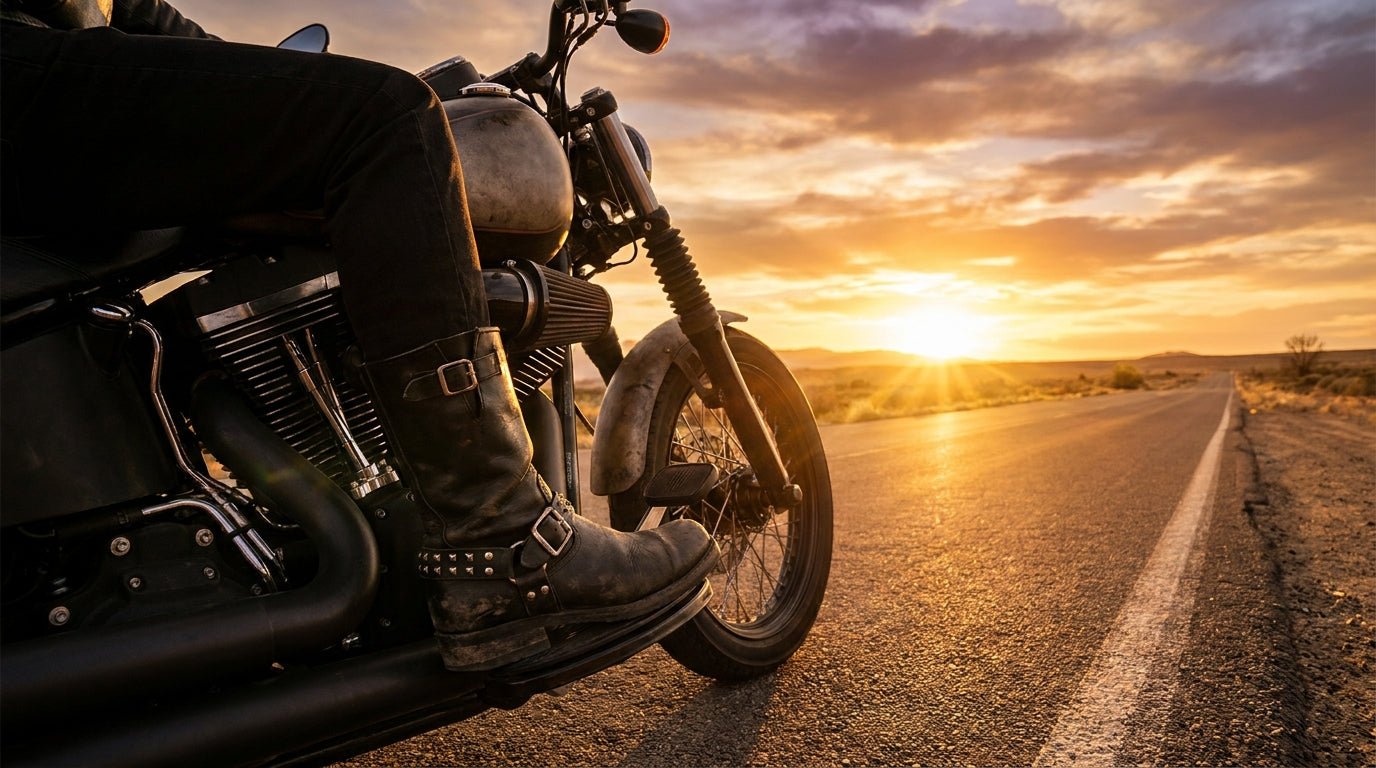
A pair of worn-out fashion boots on a vibrating footpeg at 70 mph will remind you, painfully, why riding gear exists. Punk boots look the part on stage and on the street. But most punk boots sold online were built for sidewalks, not saddlebags. Thin soles, no ankle support, glued construction that falls apart after one season of shifting gears.
This guide covers 11 punk boots that actually work on a motorcycle. You will learn which sole compounds grip a wet peg, which brands reinforce the ankle and toe box, and which "punk" boots are just overpriced costume pieces. Every pick below has been checked for shift pad durability, oil-resistant outsoles, and real rider fit.
What Makes Punk Boots Rideable (Not Just Wearable)
A genuine riding boot needs three things a fashion punk boot almost never has: a shank-reinforced sole, an oil-resistant outsole rated to ASTM F2413-18, and a toe box rigid enough to survive a shifter lever 5,000 times a season. Standard Dr. Martens, for example, use a PVC air-cushioned sole that weighs about 14 oz per boot. That works for a concert pit. On a bike, PVC gets slick when wet, and the lack of a steel shank means your arch flexes on every bump.
Punk riding boots fix this by using Goodyear welt or cement construction with rubber compound outsoles (look for nitrile rubber, which resists gasoline and brake fluid). The best ones add a reinforced ankle cup and a shift pad on the left toe. They still look aggressive, just with actual function underneath.
The other detail most buyers overlook is the insole. A flat punk boot with no arch support will fatigue your foot on rides longer than an hour. Look for a removable insole so you can swap in a riding-specific insert with heel cup support. Boots with a fiberglass shank are lighter than steel but still prevent arch flex on highway pegs.
11 Best Punk Boots for Motorcycle Riders
1. Classic Lace-Up Combat Boot
The 8-eyelet combat boot is the template for punk footwear. For riding, skip the fashion versions and look for a full-grain leather upper with a padded collar. A proper motorcycle combat boot weighs around 2.8 lbs per boot and uses a Vibram-style lug sole with at least 12mm tread depth. That tread pattern matters because shallow lugs hydroplane on rain-soaked gas station concrete. Best fit: mid-calf height (8 to 10 inches) so it sits above the shift lever without bunching.
2. Harness Boot with Punk Hardware
The harness boot (think Frye 87400 or its riding-grade cousins) adds a metal O-ring strap around the ankle. On a motorcycle, that strap does more than look mean. It holds the boot snug against your lower shin, preventing the top from flapping at speed. Look for a version with a square toe, which gives your foot more room over the shift lever. A solid harness boot runs about $180 to $260 for genuine leather with a Goodyear welt.
3. Buckle-Strap Engineer Boot
Engineer boots with double buckle straps sit right in the punk-meets-moto sweet spot. The buckles let you adjust tightness around the calf, which is useful if you wear riding jeans with knee armor. Original Chippewa 27899 engineers weigh 3.2 lbs per boot and feature a steel shank with a Vibram V-bar sole. That sole compound is rated for oil, acid, and heat up to 300 degrees F. For punk style, look for versions with matte black hardware instead of polished chrome.
4. Steel-Toe Punk Boot
Steel-toe boots protect your foot from a dropped bike or a careless driver's bumper. A standard steel toe cap adds about 3.5 oz per boot and meets ASTM I/75 impact resistance (75 foot-pounds of force). For riding, the trade-off is worth it: the added rigidity in the toe box also gives you a more precise feel on the shift lever. Avoid composite toe if you want the punk aesthetic. Steel shows through scuffs and scratches, which is the look. Pair these with a nitrile rubber outsole for grip on oil-spotted surfaces.
5. Black Leather Tall Punk Boot
A 14-inch tall black leather boot with speed hooks or side lacing screams punk and covers your shin from exhaust pipe burns. The tall shaft acts as a heat shield on bikes with exposed pipes (Harley Sportsters run pipe temps around 500 degrees F at idle). Tall boots also prevent pant legs from catching on the chain or belt drive. The key is a side zipper or speed hooks for quick on/off. Full lace-up takes 2 to 3 minutes per boot, which gets old at gas stops.
6. Platform Sole Punk Boot
Platform soles (1.5 to 2.5 inches) have a real advantage for shorter riders: they lower the effective seat height without any suspension modifications. A rider who is 5 foot 6 on a Harley Softail (seat height 25.6 inches) gains enough ground reach with a 2-inch platform to flat-foot at stops. The catch is weight. A platform punk boot can hit 3.8 lbs per boot, and the thick sole reduces pedal feel. Stick with rubber platforms, not foam, and make sure the platform edge does not catch on the foot peg during shifts.
7. Studded Punk Riding Boot
Metal studs on leather boots are a punk signature. For riding, make sure the studs are riveted (not glued) and sit on the outer shaft, not the inner ankle where they could press against the bike frame. A boot with 40 to 60 riveted pyramid studs on the outer panel adds maybe 2 oz total weight. The studs also act as minor abrasion points in a slide, which some riders consider a safety bonus. Just keep them away from painted tank panels to avoid scratching your bike when you grip the tank with your knees.
8. 80s Punk Creeper Boot
Creeper boots with thick crepe soles were born in the 1950s and adopted by punk in the late 1970s. The original Brothel Creeper used a 1-inch natural rubber sole. For motorcycle use, that same thick rubber gives excellent vibration damping on long rides. However, most creepers lack ankle reinforcement, so look for a high-top version (above the ankle bone) with a padded collar. These work best on cruisers and cafe racers where the foot position is forward or flat rather than tucked under the rider.
9. Goth-Punk Riding Boot
The overlap between goth and punk footwear gives riders boots with dramatic buckle systems, matte black leather, and sometimes internal armor. New Rock, a Spanish brand founded in 1978, makes reactor-sole boots with a built-in steel toe and a sole that weighs over 4 lbs. That is too heavy for sport riding, but on a bagger or touring bike, the weight is barely noticeable. Their M-373 model runs about $320 and includes an oil-resistant rubber outsole with a tread depth of 10mm.
10. Moto-Cross Punk Boot
Motocross boots with punk detailing (flat black finish, minimal branding, angular shin plates) bridge the gap between off-road protection and street punk style. A pair like the Alpinestars Tech 3 weighs 4.1 lbs per boot but offers a pivoting ankle system, reinforced heel cup, and a sole compound rated for both dirt and pavement. They look aggressive enough for punk, and they are the most protective option on this list by a wide margin.
11. Ankle-Height Punk Boot
Not every rider wants a tall boot. An ankle-height punk boot (6 to 7 inches) covers the ankle bone and the shift zone without the bulk. The Danner Bull Run (6-inch, 2.4 lbs per boot, wedge sole) is a solid template: full-grain leather, Goodyear welt, and a sole that grips metal pegs. For punk style, go with an all-black colorway and swap in waxed round laces. These are the easiest punk boots to wear off the bike, too, which matters if you commute and walk around all day.
Punk Boot Styles Compared
| Style | Height | Weight (per boot) | Best For | Ankle Support |
|---|---|---|---|---|
| Combat lace-up | 8-10 in | 2.8 lbs | All-around riding | Good |
| Harness | 11-13 in | 3.0 lbs | Cruisers | Moderate |
| Engineer buckle | 11-12 in | 3.2 lbs | Touring, cruisers | Good |
| Steel-toe | 8-10 in | 3.1 lbs | Heavy bikes, commuting | Good |
| Platform | 8-10 in | 3.8 lbs | Short riders on tall bikes | Moderate |
| Studded | 10-12 in | 2.9 lbs | Cruisers, choppers | Good |
| Goth-punk (New Rock) | 12-14 in | 4.0+ lbs | Baggers, touring | Excellent |
| Motocross punk | 14-16 in | 4.1 lbs | Dual-sport, ADV | Excellent |
| Ankle punk | 6-7 in | 2.4 lbs | Cafe racers, commuting | Basic |
Best Punk Boot Brands That Hold Up on a Bike
Not every punk brand builds for riders. Here are four that do, or at least build boots tough enough to survive regular riding:
- Wesco (Scappoose, Oregon) makes the Boss and Jobmaster boots with a 9-iron steel shank and triple-row stitching. They run $500 to $700, last 10+ years, and can be resoled. The look is industrial punk at its finest.
- Chippewa builds its engineer and lace-up boots on a Goodyear welt with Vibram outsoles. The 27899 engineer at $240 is a sweet spot for quality versus cost. Their leather softens nicely after the break-in period without losing structure.
- New Rock covers the goth-punk lane. Heavy, dramatic, and built with real leather. The soles are proprietary rubber, oil-resistant. Expect $280 to $400 depending on height and hardware.
- Danner is a hiking/work boot brand, but the Bull Run line in all-black reads pure punk and uses construction that can handle riding. Around $200, and their recrafting program means you can resole them when the tread wears down.
For riders who want the punk look with genuine motorcycle-grade construction, dedicated leather motorcycle boots from biker brands give you reinforced ankles, shift pads, and oil-resistant soles built from the start. That is what fashion brands have to retrofit, and the retrofit is never as good as purpose-built.
5 Mistakes Riders Make with Punk Boots
- Buying glued soles. Cement-only construction (no stitching) fails after about 6,000 miles of vibration. A Goodyear welt or Blake stitch costs more upfront but can be resoled twice, tripling the boot's life.
- Ignoring the shift pad zone. The left toe box takes the hardest wear on a manual transmission bike. If the boot has no reinforcement there, the leather wears through in one season. Look for a rubberized or double-layered shift zone.
- Choosing smooth soles for looks. A slick leather sole on a wet metal footpeg is a fall waiting to happen. Oil-resistant rubber with 8mm+ tread depth is the minimum for safe riding.
- Skipping ankle protection. Punk boots with thin, unstructured ankle panels offer zero protection in a tip-over. The ankle is the most commonly injured joint in low-speed motorcycle crashes (per NHTSA data). Get padding or a rigid cup there.
- Buying no-name marketplace knockoffs. Those $45 "punk biker boots" on random marketplace listings use bonded leather (basically cardboard with a leather veneer) and chrome-plated plastic hardware. The zippers fail, the soles delaminate, and the "leather" peels. Real full-grain cowhide starts around $120 for a reason: it is an actual hide, not a pressed composite.
If you are shopping for a pair that balances punk style with real riding function, the motorcycle boots collection is where to start. Every pair is built with genuine leather and actual rider protection, not fast-fashion shortcuts.
For more riding gear guides, check out the complete biker boots guide or browse motorcycle vests to round out the look.

No comments yet. Be the first rider to weigh in.