
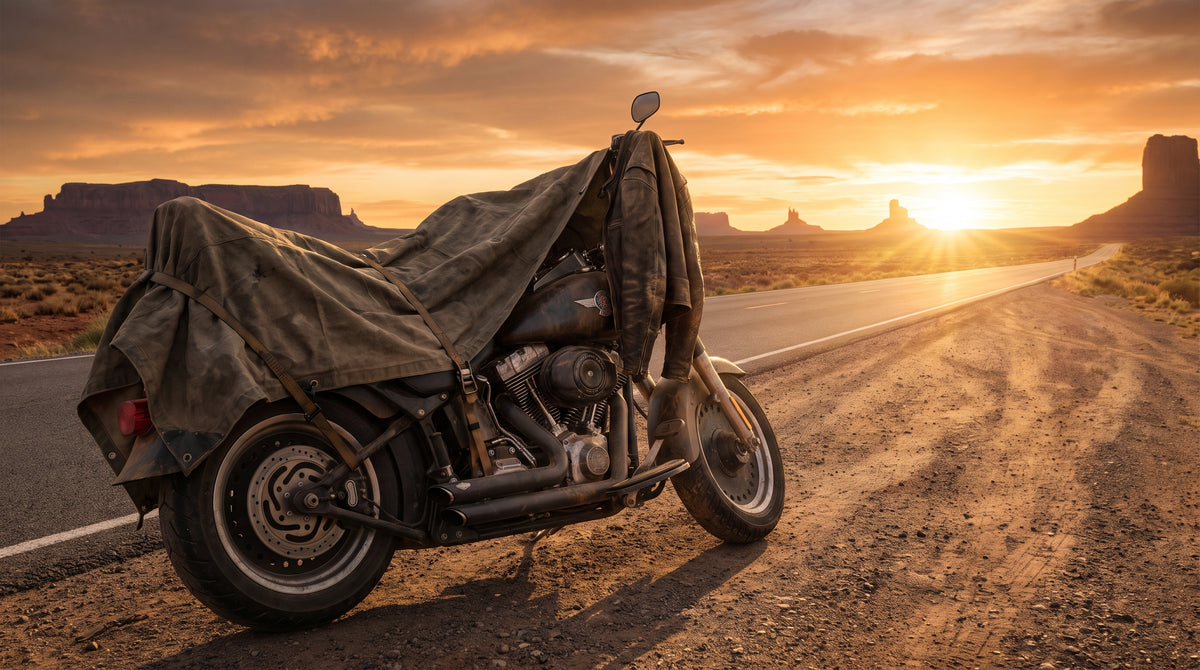
A $25,000 Harley sitting in the driveway without a cover is basically a UV experiment. Sun bakes the paint, rain fills the exhaust, and morning dew corrodes every exposed bolt. A good motorcycle cover costs $35 to $120 and adds years to your bike's finish, electrical system and seat material. The wrong one traps moisture against the frame and does more harm than nothing at all.
This guide breaks down the four motorcycle cover types that actually work for outdoor storage, what materials hold up in real weather, and which features separate a $40 cover that lasts one season from one that protects your bike for years. If you park outside, even part-time, this is the gear decision most riders skip and regret first.
Why a Motorcycle Cover Is Not Optional for Outdoor Parking
UV radiation degrades clear coat at a measurable rate. The Motorcycle Industry Council notes that prolonged sun exposure causes paint oxidation within 6 to 12 months on unprotected surfaces. A flat black tank on a Harley Street Glide can hit 180 degrees Fahrenheit in direct summer sun, which softens vinyl seat covers and warps plastic components over time.
Rain is the second threat. Water pooling in the exhaust tip causes internal rust, and standing moisture on chrome or nickel surfaces creates pitting that no amount of polish removes. Riders in the Southeast and Pacific Northwest see this damage within a single rainy season on uncovered bikes.
Then there is theft visibility. A covered motorcycle is harder to identify by model and easier to overlook. The NICB reported 52,553 motorcycle thefts in the US in 2023. A cover does not replace a disc lock or GPS tracker, but it removes the visual temptation that starts the process.
4 Types of Motorcycle Covers and When to Use Each
Not every cover works for every situation. Here is what each type handles and where it fails.
Basic Polyester Covers
The entry-level option. 150D to 190D polyester fabric with a water-resistant coating. These weigh 2 to 3 lbs and fold into a compact pouch. They block UV and light rain but are not truly waterproof. After 4 to 6 months of outdoor use, the coating breaks down and water seeps through seams. Best use: short-term overnight protection or indoor dust covers. Price range: $20 to $40.
Heavy-Duty 300D Oxford Covers
The workhorse for year-round outdoor parking. 300D Oxford fabric is roughly twice the thickness of basic polyester, with heat-sealed seams and a PU waterproof backing. A good 300D cover weighs 4 to 6 lbs and handles rain, snow, UV and wind without flapping loose. Look for double-stitched hems and reinforced grommets at the bottom for a lock-through loop. This is the type most serious riders buy. Price range: $45 to $90.

All-Weather Multilayer Covers
Premium covers use a three-layer sandwich: waterproof outer shell, breathable middle membrane, and soft inner lining. The soft lining prevents the cover itself from scratching paint and chrome when wind pushes it against the bike. The breathable layer allows trapped moisture to escape rather than condensing against the frame, which is the main reason cheap covers cause corrosion. Brands like Nelson-Rigg and Dowco build covers this way. Price range: $80 to $150.
Half Covers and Indoor Dust Covers
Half covers protect the seat, tank and dash without wrapping the entire bike. Useful for quick stops or carport parking where full coverage is overkill. Indoor dust covers use lightweight cotton or microfiber and should never go outside. They soak through instantly and hold water against the finish like a wet towel. Know which type you need before ordering.
Motorcycle Cover Materials Compared
Material determines how long a cover lasts and how well it protects. Here is a direct comparison of the three most common fabrics.
| Feature | 150D Polyester | 300D Oxford | 3-Layer Premium |
|---|---|---|---|
| Waterproof Rating | Water-resistant only | Waterproof (PU-backed) | Waterproof + breathable |
| UV Protection | 6-12 months | 2-3 years | 3-5 years |
| Tear Resistance | Low (rips at grommets) | Moderate | High (reinforced seams) |
| Breathability | None (traps moisture) | Minimal (vents help) | Yes (membrane layer) |
| Weight | 2-3 lbs | 4-6 lbs | 5-8 lbs |
| Expected Lifespan | 6-12 months outdoor | 2-3 years outdoor | 4-5 years outdoor |
The pattern is clear. A 150D cover protects your bike for one season, then the coating fails and you buy another one. A 300D Oxford cover lasts 2 to 3 years for roughly double the upfront cost. The premium three-layer option costs more but pays for itself over 4 to 5 years of continuous outdoor use. For riders who park outside full-time, the 300D or three-layer cover is the only practical choice.
How to Size a Motorcycle Cover Correctly
A cover that is too small exposes the exhaust and lower frame. One that is too large catches wind and flaps against the paint all night. Here is how to get the right fit.
Measure three things: overall length (front tire to rear fender), height (ground to the tallest point, usually the windshield or handlebar), and width at the widest point (mirror to mirror, or saddlebag to saddlebag if equipped). Most manufacturers list their covers by motorcycle type rather than exact dimensions.
Standard sizing works like this. A "medium" cover fits sport bikes and naked bikes up to about 90 inches long. A "large" covers most cruisers including the Harley Sportster and Indian Scout at 95 to 100 inches. An "XL" or "touring" size fits baggers like the Road Glide and Gold Wing at 105 to 115 inches. If your bike has aftermarket saddlebags, a trunk or a tall windshield, go one size up. A slightly loose cover causes less damage than a tight one that stretches across the exhaust pipe and melts.
One detail riders miss: if your exhaust system is hot, wait at least 20 minutes before putting the cover on. A 300D Oxford cover can handle moderate engine heat, but a still-hot header pipe will melt synthetic fabric and ruin both the cover and the pipe's finish.
5 Features That Separate Good Covers from Disposable Ones
1. Lock-through grommets at the bottom. Metal-reinforced eyelets on both sides of the lower hem let you run a cable lock or chain through the cover and around the wheel. This prevents someone from lifting the cover off in seconds and also keeps the cover from blowing away in a storm. If a cover has no grommets, skip it.
2. Heat-sealed seams. Stitched seams alone leak water at every needle hole. Heat-sealed or taped seams create a continuous waterproof barrier. Check the spec sheet. If it only says "stitched," water will find its way in within the first serious rain.
3. Venting panels. Two small mesh or vented panels near the top allow hot, moist air to escape. Without vents, condensation builds inside the cover overnight and creates the exact moisture problem you are trying to prevent. Covers with vents dry out faster after rain too.
4. Elastic hem with adjustable straps. An elastic bottom hugs the lower frame and keeps wind from turning the cover into a sail. Buckle straps under the belly of the bike add a second layer of wind resistance. Covers without straps end up in the neighbor's yard after a 30 mph gust.
5. Soft inner lining on contact points. The areas where the cover sits on the tank, fenders and mirrors get rubbed by wind movement hundreds of times per night. A fleece or microfiber inner lining on those contact points prevents micro-scratches that dull the finish over time. Budget covers use the same rough polyester inside and out, which acts like fine sandpaper on clear coat.

Motorcycle Cover Mistakes That Damage Your Bike
Covering a hot bike. Placing a synthetic cover over exhaust pipes above 200 degrees Fahrenheit melts the fabric directly onto the chrome or ceramic coating. The melted material bonds to the pipe and requires abrasive removal that scratches the finish. Wait 20 minutes after shutdown, or use a heat shield sleeve over the pipes first.
Using a tarp instead of a fitted cover. A flat tarp pools water on every horizontal surface. That standing water seeps into the electrical connections, tank seams and brake fluid reservoirs. A fitted motorcycle cover sheds water off the sides. Tarps also lack grommets and blow off at the first wind gust.
Leaving a wet cover on for days. If you get caught in rain and cover the bike while everything is soaked, the cover traps moisture against every surface. Pull the cover off the next dry morning, let the bike air out for a few hours, then replace it. This one step prevents 90% of cover-caused corrosion.
Skipping the lock-through cable. An unsecured cover blows off in wind and also makes theft easier. A thief can lift an unattached cover in 2 seconds, identify the bike and decide whether to steal it. A cable through the grommets and around the wheel forces them to cut the cable first, which adds noise and time.
Buying by price alone. A $15 cover from an unknown Amazon seller uses 100D fabric with uncoated seams. It works for about 6 weeks before UV breaks down the material and water pours through. Two $15 covers per year costs more than one $60 cover that lasts three years.
How to Store Your Bike Under a Cover the Right Way
The cover is only part of the equation. Here is the full outdoor storage routine that prevents damage.
Start by washing the bike and applying a coat of wax or spray sealant. Clean surfaces resist corrosion better because dirt and road salt hold moisture against metal. A $10 spray wax application before covering the bike doubles the protection.
Inflate the tires to the manufacturer's recommended PSI. Underinflated tires develop flat spots when sitting for weeks. If the bike will sit for a month or more, use a center stand or paddock stand to lift the tires off the ground completely.
Add fuel stabilizer to a full tank. Air space in a partially filled tank allows condensation that contaminates fuel and corrodes the tank interior. Sta-Bil or Sea Foam in a full tank keeps fuel fresh for up to 12 months.
Disconnect the battery or use a trickle charger. A motorcycle battery loses 1% to 3% charge per day sitting idle. After 30 days without a charger, most batteries drop below the voltage needed to start the engine. A Battery Tender Junior runs about $25 and keeps the battery at full charge all winter.
Then put the cover on, run the lock cable through the grommets and around a wheel, and you are done. Check on the bike every 2 to 3 weeks to make sure the cover has not shifted and no water is pooling.
Which Motorcycle Cover Should You Buy?
If you park in a garage and just need dust protection, a basic polyester cover for $25 works fine. Do not overthink indoor storage.
If you park outside regularly, even a few nights per week, get a 300D Oxford cover with heat-sealed seams, grommets and venting. That is the sweet spot of protection and price for most riders. Pair it with a cable lock and you have genuine weather and theft deterrence for under $80 total.
If your bike is a daily rider parked outdoors year-round in rain, snow or coastal salt air, invest in a three-layer cover with a soft lining. The upfront cost is higher, but the finish protection and 4 to 5 year lifespan make it the cheapest option per year.
If you are shopping for covers and outdoor storage gear, the ALR motorcycle cover collection has options sorted by size and weather rating. Pair it with a disc lock or cable lock for the full outdoor protection setup.
No comments yet. Be the first rider to weigh in.