
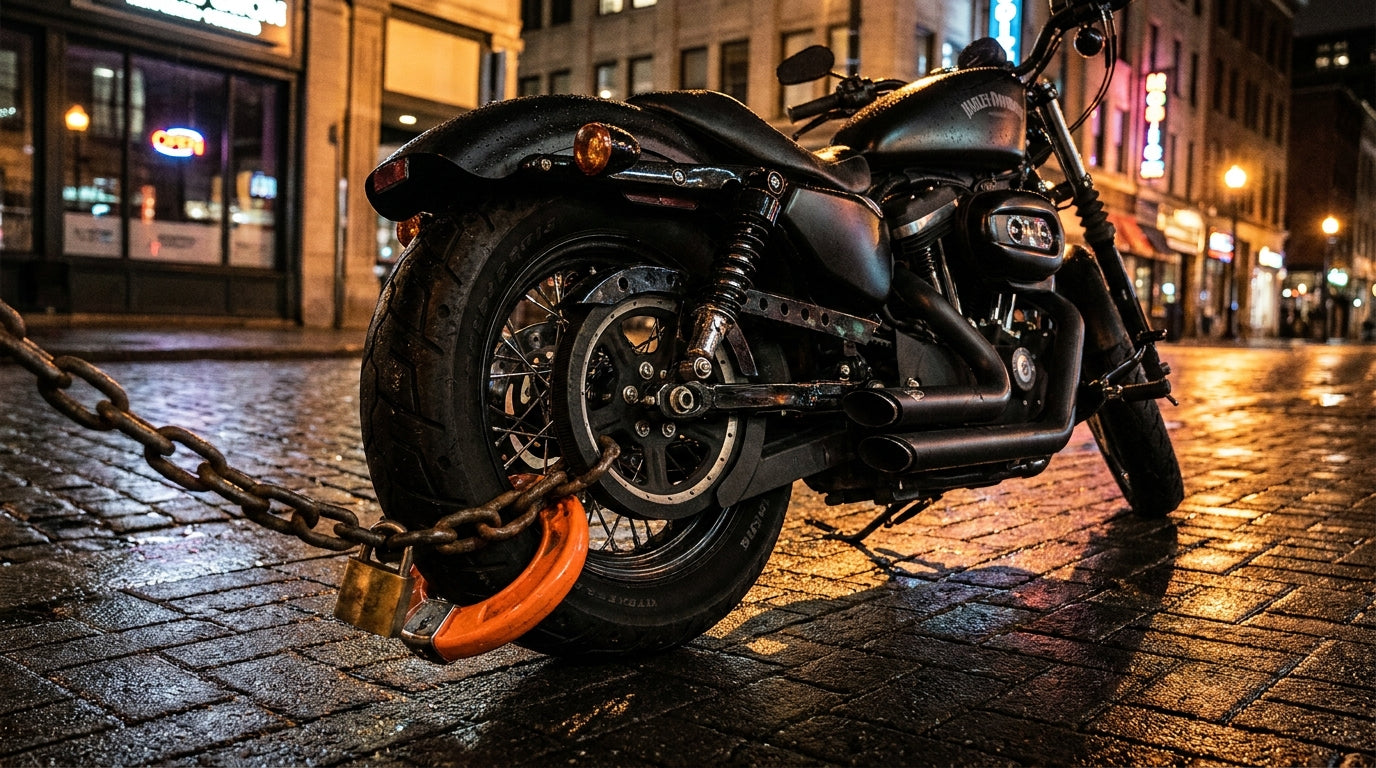
A motorcycle gets stolen roughly every 11 minutes in the United States, according to the National Insurance Crime Bureau. Most of those bikes had no lock at all. A quality motorcycle lock will not make your ride impossible to steal, but it turns a 30-second grab-and-go into a 5-minute ordeal. And most thieves walk away after 60 seconds of resistance.

This guide breaks down the best motorcycle locks you can buy in 2026. You will see how disc locks, chain locks, U-locks and grip locks compare in real-world security, portability and price. Every type has strengths and blind spots, so the smartest move is knowing which combination fits your parking situation.
What Makes a Motorcycle Lock Worth Buying
Motorcycle theft is overwhelmingly opportunistic. A 2024 NICB report found that 46,562 motorcycles were reported stolen in the U.S. that year. The majority were grabbed from driveways, apartment lots and street-side spots with zero visible security. That tells you two things: presence matters, and even a basic lock changes the odds.
A good motorcycle lock does three jobs. First, it creates a time barrier. Bolt cutters, pry bars and angle grinders all work, but they all take time and make noise. Second, a visible lock signals that the rider cares about security, which pushes thieves toward easier targets. Third, a lock paired with a loud alarm draws attention. No thief wants a crowd.
There is no unbreakable lock. Period. Security is about layers and deterrence, not about finding one magic device. That said, some locks perform dramatically better than others. Here is how each type stacks up.
Disc Locks: Portable and Loud
A disc lock clamps directly onto your brake rotor through one of the rotor's vent holes. Most weigh between 1 and 2 pounds, small enough to toss in a saddlebag or tank bag and forget about until you park.
The Xena XX-6 is one of the most proven disc locks on the market. It packs a 120 dB alarm triggered by motion, runs on a single CR2 battery, and weighs just 14 ounces. The hardened steel pin is thick enough to resist casual prying, and the alarm is loud enough to rattle windows on a quiet street.
Disc locks shine for quick stops: gas stations, restaurants, errand runs. They add maybe 15 seconds to your parking routine. The downside is that a disc lock does not anchor the bike to anything. Two people can still lift a disc-locked motorcycle into a van. For overnight street parking, you need more.
Reminder Cables Save Rotors
Always use a bright reminder cable that stretches from the lock to your handlebar. Riding away with a disc lock still attached will warp your rotor and drop you. It happens more often than anyone likes to admit.

Chain Locks: Heavy Duty Street Security
A hardened chain lock is the toughest portable option for overnight parking. The best chains use 10mm to 16mm manganese or boron steel links that resist bolt cutters and hacksaws. Weight is the tradeoff: a 4-foot, 14mm chain like the Kryptonite New York Fahgettaboudit tips the scale at about 15 pounds.
Thread the chain through your rear wheel, swingarm and a fixed ground anchor or street post. The rear wheel is harder to remove than the front, and looping through the frame or swingarm means a thief cannot simply unbolt the wheel and walk. A quality chain paired with a disc-style padlock is what most insurance companies consider "serious" security.
Shorter chains (2-3 feet) are lighter and easier to carry but limit what you can lock to. If you park on the street regularly, a 4-foot or 5-foot chain gives you enough reach for most posts and railings. Keep the chain off the ground when possible. Bolt cutters get more leverage when a chain rests flat on concrete.

U-Locks: Compact and Angle-Grinder Resistant
U-locks, also called D-locks, use a rigid shackle made from hardened steel. The fixed shape means there is no flexible link for bolt cutters to bite. The Abus Granit X-Plus 540, rated Sold Secure Gold, uses a 13mm parabolic shackle and a double-bolt locking mechanism that resists twisting attacks better than single-bolt designs.
The main benefit is compactness. A U-lock fits inside a backpack, mounts to a frame bracket, or tucks under a bungee net. For urban riders who lock to a post or bike rack daily, a U-lock is hard to beat on convenience.
The weakness is reach. A U-lock can grab a wheel and a slim post, but forget about wrapping around a thick lamppost or tree. If you regularly park where the anchor points are wide, a chain lock is more versatile.
Handlebar and Grip Locks: The Visible Warning
A grip lock clamps across your brake lever and throttle, making it impossible to steer or roll the bike normally. The Grip-Lock fits in about 3 seconds and weighs under a pound. These locks are cheap, fast, and extremely visible, which is the real point. A bright yellow or red bar across the handlebar screams "this bike is locked" to anyone walking by.
On their own, grip locks are the weakest option here. A thief with a pry bar can defeat most in under a minute. But as a second layer on top of a disc lock or chain, they add another obstacle and another minute of noise and hassle. That added time is what pushes an opportunistic thief to the next bike.
Best Motorcycle Locks Compared: Every Type Side by Side
| Lock Type | Weight | Portability | Bolt Cutter Resistance | Best For | Price Range |
|---|---|---|---|---|---|
| Disc Lock (with alarm) | 0.9 - 2 lbs | Excellent | Moderate | Quick stops, day parking | $25 - $80 |
| Chain Lock (10-16mm) | 5 - 15 lbs | Low | High | Overnight street parking | $60 - $200 |
| U-Lock / D-Lock | 2 - 5 lbs | Good | High | Urban fixed-post parking | $40 - $120 |
| Grip / Handlebar Lock | 0.5 - 1 lb | Excellent | Low | Visual deterrent, second layer | $15 - $40 |
| GPS Tracker + Lock Combo | Varies | Varies | Varies | Recovery after theft | $40 - $100 + lock |
How to Layer Motorcycle Locks for Real Protection
The strongest setup is not one expensive lock. It is two different types used together. A disc lock on the front rotor plus a chain through the rear wheel and a ground anchor forces a thief to bring two separate tools and spend twice as long. That combination covers both the "quick grab" threat and the "came prepared with bolt cutters" threat.
If you park on the street and cannot install a ground anchor, loop a chain around the frame or swingarm and through a heavy fixed object: a lamppost, a railing, or a parking meter. Keep the lock as high off the ground as possible. Bolt cutters and angle grinders both work better when the operator can brace against the pavement.
Adding a GPS tracker is the third layer. Locks slow a thief down. A GPS tracker tells you exactly where the bike goes if the locks fail. Together, prevention and recovery cover both sides of the problem. It is the setup that serious riders and insurance companies both recommend.
5 Motorcycle Lock Mistakes That Cost Riders Their Bikes
1. Buying a Lock and Leaving It at Home
A lock only works when it is on the bike. If your lock is too heavy or annoying to carry, you will stop using it within a month. Pick a size and weight you will actually bring every ride.
2. Locking Only the Front Wheel
Front wheels unbolt with a single socket wrench in under two minutes. Always lock through the rear wheel, swingarm or frame.
3. Using a Cable Lock
Braided cable locks can be cut with a $12 pair of cable cutters in about 5 seconds. They are fine for bicycles. They are not fine for a $15,000 motorcycle.
4. Forgetting the Disc Lock Reminder Cable
Riding away with a disc lock on the rotor warps the disc and can throw you off the bike. A $4 neon reminder cable is the cheapest insurance you will ever buy.
5. Trusting a Cover Alone
A motorcycle cover hides your bike from casual eyes, but it does not stop anyone from lifting the cover and rolling the bike away. A cover plus a lock works. A cover alone does not.
When a Lock Is Not Enough: The GPS Tracker Upgrade
Every lock can be defeated with enough time and the right tool. That is not a failure of the lock. It is just reality. What changes the equation is knowing where your bike is the moment it moves. A magnetic GPS tracker hidden under the seat or inside a fairing gives you real-time location data and instant alerts. If someone does beat your locks, you have coordinates for police instead of a police report and a prayer.
The combination of a disc lock, a chain, and a hidden GPS tracker is the closest thing to a complete motorcycle security system you can build without a garage. Locks buy time. Alarms draw attention. Trackers close the loop. If you are shopping for a lock setup, the ALR locks and chains collection is a solid place to start.


No comments yet. Be the first rider to weigh in.