
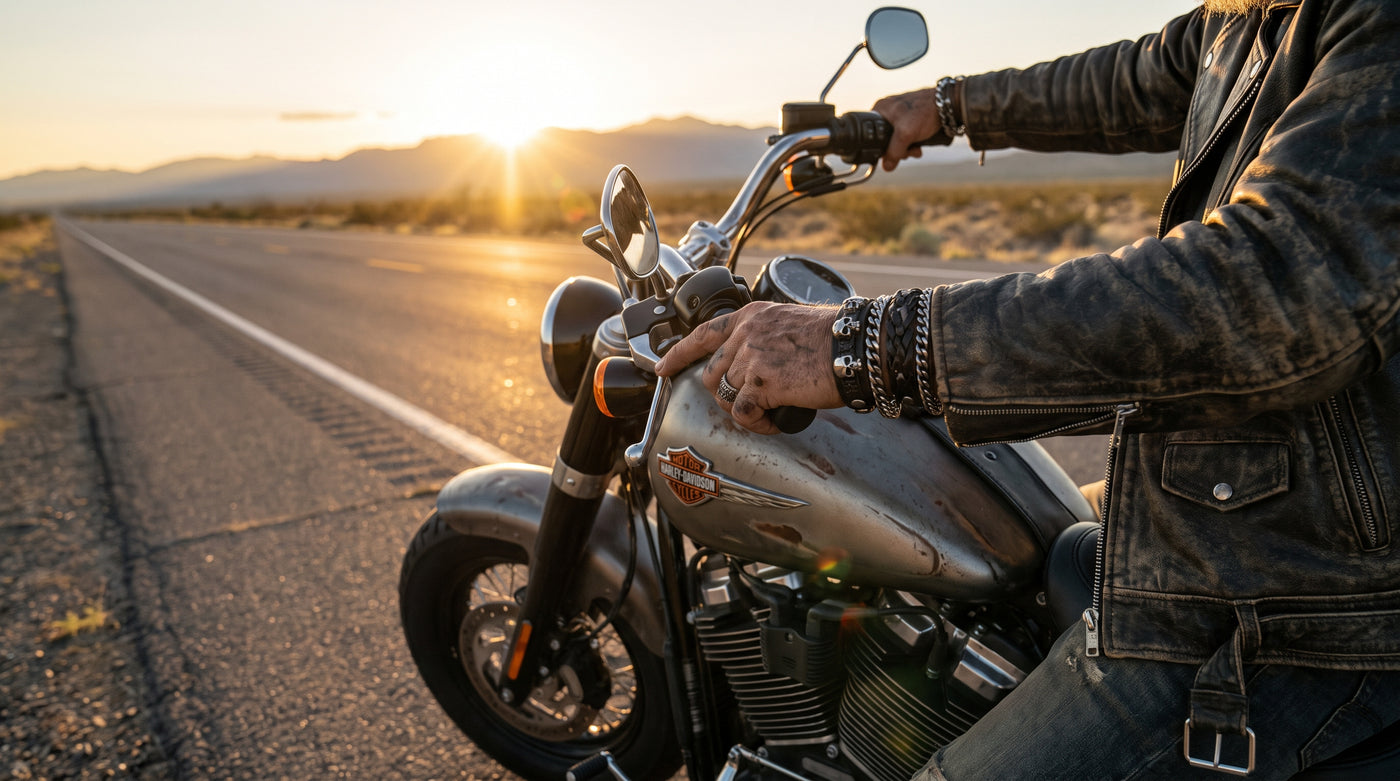
Most biker bracelets sold online are cheap zinc alloy that turns your wrist green after two highway rides. The clasp breaks, the plating flakes off, and you end up tossing a $20 piece of junk in a drawer. The listing photo looked great. The bracelet did not.
This guide breaks down the three main biker bracelet categories, compares materials in a side-by-side table, and shows you how to size one correctly. Whether you want a stainless steel chain bracelet, a skull design, or a leather cuff, you will know exactly what to look for and what to skip.
How Chain Bracelets Became a Biker Staple
The biker bracelet traces back to the same post-WWII culture that gave us motorcycle clubs and leather jackets. Returning veterans in the late 1940s stripped down military surplus bikes, wore what they had, and turned functional items into identity markers. Wallet chains served a practical purpose on the road. The thick chain link migrated from wallets to wrists as a style statement within a few years.
By the time the Hells Angels formed their first chapter in San Bernardino in 1948, chain jewelry was already part of the uniform. That tradition stuck. Today, a heavy stainless steel chain bracelet is still one of the most recognizable pieces of biker gear after the jacket and the boots.
If you have already looked into biker wallet chains, the bracelet is the natural next piece to add.

Stainless Steel Biker Bracelets
Stainless steel is the most popular material for mens biker bracelets, and there is a good reason. 316L surgical-grade stainless steel resists rust, does not tarnish, and handles rain, sweat, and gasoline without corroding. It is the same alloy used in marine hardware and surgical instruments. If it can survive saltwater, it can handle a summer ride through Texas.
Most quality chain bracelets use links between 8mm and 14mm wide. Wider links in the 12mm-plus range give you that heavy, classic biker look. Narrower links around 8mm to 10mm work better if you are wearing the bracelet under a jacket cuff or stacking it with a watch.
Weight matters here. A solid 316L chain bracelet in a 12mm width runs about 100 to 150 grams. That is enough heft to feel substantial without dragging your arm down on a long ride. If a bracelet labeled "stainless steel" feels lighter than a set of house keys, it is probably hollow or not actually 316L.

The double-link and curb-chain patterns are the most common for biker chain bracelets. Double-link has an interlocking figure-eight shape that flexes well around the wrist. Curb chain sits flat and looks cleaner under a jacket cuff. Both hold up equally well on the road.

Skull Biker Bracelets That Actually Look Good
Skull motifs have been part of biker culture since before there was a name for it. The death's head symbol showed up on WWII bomber jackets, made its way onto MC patches, and eventually landed on everything from skull motorcycle helmets to rings to bracelets. It is not about shock value. It is a reminder that you are mortal, and you ride anyway.
The best skull bracelets use individual cast skull links rather than stamped or printed designs. Cast links have depth and shadow that catch light differently as you move. The detail holds up over time because the shape is in the metal itself, not a coating on top of it.
Stainless steel skull bracelets from ALR typically run $35 to $45 and use individual link construction with toggle or lobster clasps. That is a different product from the $8 marketplace bracelet with a rubber skull charm hot-glued to a cord.

Skeleton and bone-motif chain bracelets split the difference between a pure skull design and a clean chain look. They keep the biker identity without being as bold as a full skull-link bracelet. Good for riders who want something that works at the office and on the road.

Leather Biker Bracelets
Leather cuffs are the lightweight option. A braided leather bracelet with a snap or buckle closure weighs under 30 grams and sits flat against your wrist inside a glove or jacket sleeve. That makes it the practical choice for riders who do not want metal clanking against their handlebar grips at 70 mph.
The distinction that matters is full-grain versus bonded leather. Full-grain is the outer hide, unaltered. It develops a patina over time and gets more character with wear. Bonded leather is shredded scraps glued together and stamped to look like the real thing. It peels and cracks within months. If the listing does not specify "full-grain" or "top-grain," assume the worst.
A leather biker bracelet with a skull charm or bullet accent adds biker identity without the weight of a chain. Just make sure the hardware, including snaps, buckles, and rivets, is stainless steel or brass, not painted plastic.

Biker Bracelet Materials Compared
Here is how the four most common biker bracelet materials stack up side by side:
| Material | Weight | Durability | Tarnish? | Price Range |
|---|---|---|---|---|
| 316L Stainless Steel | 100-150g | Excellent (10+ years) | None | $30-$70 |
| Sterling Silver (925) | 80-120g | Good (needs polishing) | Yes (patina) | $80-$300+ |
| Full-Grain Leather | 20-40g | Good (2-5 years) | N/A | $15-$50 |
| Zinc Alloy / Pot Metal | 40-60g | Poor (months) | Yes (green stain) | $5-$15 |
The bottom line: 316L stainless steel gives you the best combination of weight, durability, and price for a biker bracelet that spends time outdoors. Sterling silver looks great but needs regular polishing and costs 3 to 4 times as much. Zinc alloy is not worth the trouble at any price.
How to Size a Biker Bracelet
Most mens biker bracelets come in 20cm (7.87 inches), 21cm (8.27 inches), or 23cm (9.06 inches) lengths. Getting the right fit is simple:
- Measure your wrist at the widest point with a flexible tape or a strip of paper.
- For chain bracelets, add 1 to 2cm (about 0.5 to 0.75 inches) of clearance. The bracelet should slide one finger-width past your wrist bone.
- For leather cuffs, add just 0.5cm (0.25 inches). Leather stretches slightly with wear and should fit snug out of the box.
- If you are between sizes, go up. You can remove a link from a chain bracelet. You cannot add one.
The average American male wrist measures 7.25 inches (18.4cm) according to CDC anthropometric reference data. That puts most riders in the 20cm or 21cm range for chain bracelets.
5 Mistakes to Avoid When Buying a Biker Bracelet
1. Assuming "stainless steel" means 316L. Cheap listings use the words "stainless steel" to describe 201-grade or iron alloy with a chrome wash. If the listing does not specifically say 316L, ask the seller. No answer means no sale.
2. Ignoring the clasp type. Lobster clasps are the most secure for riding. Toggle clasps look cool but can unhook under vibration. Magnetic clasps are the worst choice for motorcycle riders because they pop open from engine vibration and cornering forces.
3. Buying based on the listing photo alone. Bracelet photos often show pieces on small wrists or use macro lenses that make links look twice their actual size. Always check the stated link width in millimeters and total weight in grams before ordering.
4. Stacking too many at once. One or two bracelets is a style choice. Four is a tangle that catches on clutch cables and jacket zippers. Riders who wear biker jewelry tend to keep the throttle-hand wrist clean for grip and control.
5. Paying silver prices for nickel-plated zinc. If a "silver" biker bracelet costs under $40, it is not sterling. Check for a 925 hallmark stamp on the clasp or inner link. No stamp means not silver.
Picking the Right Biker Bracelet
A solid biker bracelet lasts years and works with everything from a leather jacket to a plain black tee. The right one depends on whether you want the weight of a stainless steel chain, the detail of a skull design, or the low profile of a leather cuff.
If you are ready to pick one up, the ALR biker bracelets collection has stainless steel and leather options built to handle real riding. Every piece ships from actual inventory with real product photos, not marketplace renderings from a factory you will never find again.

No comments yet. Be the first rider to weigh in.