
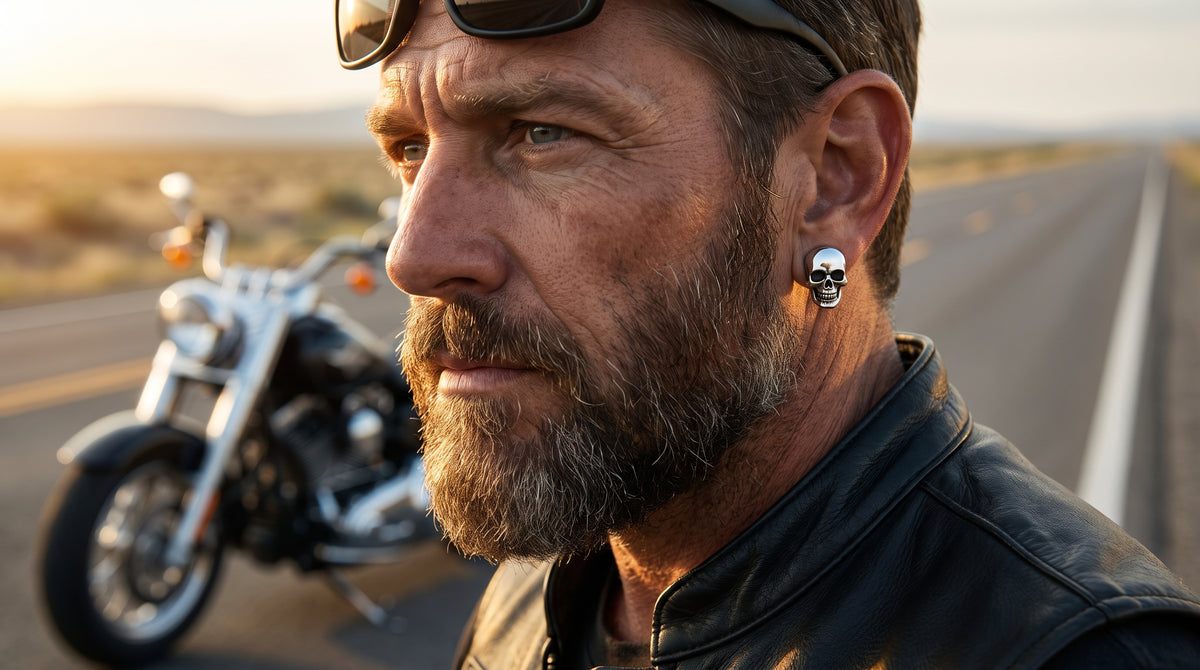
A push-back earring at 70 mph is a coin toss. The wind pulls the butterfly clutch loose, the post walks forward a millimeter at a time, and somewhere around the second gas stop you reach up and find a bare earlobe. The earring is on the shoulder of a highway two counties back. That is the single most common way riders lose jewelry, and it has nothing to do with price.
Good biker earrings are built around three things: a metal that will not react to sweat, a back that locks instead of clips, and a profile low enough to sit under a helmet without digging in. Below are 9 skull styles that pass all three, plus a metal comparison, the real story behind the which-ear question, and the 5 mistakes that put earrings on the pavement.
What Separates a Biker Earring From Regular Jewelry
A standard pierced lobe is 20 gauge, about 0.8 mm. Almost every earring on the market fits that hole, so the post is never the problem. The problem is everything around it.
Fashion earrings are designed for an evening out. They use thin brass cores, a few microns of plating, and a friction back that relies on tension alone. Ride four hours in 90 degree heat and you have salt, vibration and wind load working on a clutch that was never rated for any of it.
Gear built for riding solves it differently:
- Solid metal, not plated core. 316L surgical stainless or titanium all the way through, so a scratch does not expose a different metal underneath.
- Screw backs or locking hoop closures. A screw back needs three full turns to come off. Wind cannot do that.
- Low profile. Anything under roughly 10 mm of stand-off clears a full-face helmet liner.
- Matte or blackened finishes. Polished chrome throws glare straight into a mirror on a west-facing afternoon run.
That is the filter used for every pick below.
The 9 Best Biker Earrings for 2026
Ranked by how well each one holds up to daily riding, not by how loud it looks in a photo. Prices are current at American Legend Rider.
1. Silver Skull Stud Earrings for Men and Women
The default answer. A compact polished skull stud reads as jewelry from ten feet and as a biker piece from two. At $24.95 for the pair it is the one to buy if you are only buying one, and the sculpted brow and jaw give it depth that flat stamped skulls never have. Unisex sizing means it works on a lobe of any size.

2. Skull Stud Earrings for Men, Titanium Screw Back
This is the pick for riders who have already lost a pair. Titanium body, screw-back posts, and three finishes (silver, black, gold) in one listing at $21.95. Titanium weighs roughly 40 percent less than steel, so there is almost no pendulum effect when you hit a rough patch of asphalt. If you commute in gear every day, start here.

3. Skull Hoop Earrings, Titanium Steel
A small hoop with a skull terminal, $14.95, and the cheapest genuinely road-worthy pair on this list. The hoop diameter stays tight to the lobe rather than swinging, which is the whole trick with hoops on a bike. Titanium steel shrugs off rain and does not need polishing after a wet week.

4. Black Skull Hoop Earrings with Crossbones
Blackened finish, crossbones detail, $21.95. The matte black is the practical part: no glare, no obvious shine when you are parked somewhere you would rather not advertise. Pairs cleanly with a black leather vest and blacked-out hardware, and it is the style that reads most traditionally outlaw without being costume.

5. Red Eye Skull Stud Earrings
Stainless steel skull with set crystal eyes, 0.4 x 0.3 in, $27.95. The size matters more than the color here. At under half an inch it sits flat enough to disappear under a full-face helmet liner, so you are not choosing between the earring and the lid. The red catches light only when you turn your head, which is the right amount of loud.

6. Sugar Skull Stud Earrings, Day of the Dead
$24.95, and the one style on this list with actual cultural weight behind it. Day of the Dead calavera designs carry a specific meaning about remembering the people you have lost, which is why they have been adopted so widely in rider memorial runs. The floral detail work also makes it the most wearable pick off the bike.

7. Gothic Skull Earrings
At $21.44 this is the most aggressive sculpt in the collection, with deeper eye sockets and harder edges than the polished silver pair at number one. Good choice if you already wear skull rings and want the pieces to match in tone rather than fight each other. Heavier styling, same stud footprint.

8. Stainless Steel Skeleton Stud Earring
0.8 x 1.6 in, $19.95, and the only long-profile piece worth riding in. It is a full skeleton form rather than a skull, so it hangs past the lobe. That makes it a half-helmet or open-face piece, not a full-face one. Stainless construction means it takes a drop on a gas station floor without deforming.

9. Woman's Gold Plated Skull Cubic Zircon Stud Earrings
$19.95, push back, with red, blue or green zircon. This is the dress-up option and the honest note is that gold plating over a base metal is the least durable finish on this page. Wear it for nights out and rallies, not for a 300 mile day in the rain. If you want gold tone you can actually commute in, the titanium screw-back pair at number two comes in a gold finish.

Studs vs Hoops vs Dangles: What Survives Highway Wind
Format decides more than metal does. A $12 stud will outlast a $90 dangle on a bike every time, because wind cannot get a grip on something that does not move.
| Style | Typical size | Full-face helmet | Loss risk at speed | Best for |
|---|---|---|---|---|
| Stud, screw back | 6 to 10 mm | Yes | Very low | Daily riding, commuting |
| Stud, push back | 6 to 10 mm | Yes | Moderate | Short rides, off the bike |
| Small hoop, 10 to 15 mm | 10 to 15 mm | Tight fit | Low | Half helmet, open face |
| Large hoop, 25 mm plus | 25 mm plus | No | High | Off the bike only |
| Dangle or drop | 30 mm plus | No | Very high | Rallies, events, bar nights |
The practical rule: if it swings when you shake your head in the mirror, it will swing against your neck for four hours and it will catch on a balaclava or a helmet strap. Keep anything past 25 mm for the days you are not riding.
Metals That Hold Up Against Sweat, Rain and Cheap Plating
Riding jewelry lives in salt. Sweat under a helmet, rain, and road grime all attack plating first, which is why a $6 marketplace pair looks green in three weeks and a solid steel pair looks the same after three years.
| Metal | Corrosion resistance | Nickel risk | Notes |
|---|---|---|---|
| 316L surgical stainless | Excellent | Low | The workhorse. Same grade used in surgical instruments. Holds an edge on sculpted detail. |
| Titanium | Excellent | None | Lightest option, roughly 40 percent lighter than steel. Best for sensitive ears. |
| Sterling silver 925 | Good | Low | Tarnishes and needs a polish cloth. Softer, so detail wears down over years. |
| Gold plated base metal | Poor | Varies | Plating wears through at contact points. Dress wear, not road wear. |
| Unmarked alloy | Poor | High | No grade stamp means no accountability. Skip it. |
If your ears sting or crust after a day of wear, that is usually nickel, not an infection. Nickel allergy affects a meaningful share of pierced adults and it does not go away on its own, so the fix is switching metal rather than waiting it out. The Mayo Clinic overview of nickel allergy covers what the reaction actually looks like. Titanium is the safe default if you have reacted before.
This is the same reason we build the rest of the skull earring lineup in solid steel and titanium rather than plated brass. A no-name marketplace pair is not cheaper, it is just a shorter loan.
Which Ear? Where the Biker Earring Tradition Actually Comes From
Search "which ear should a biker wear an earring in" and you get a hundred confident answers that contradict each other. Here is what is actually documented.
The oldest thread is maritime. Sailors wore a single gold hoop after crossing the equator or rounding Cape Horn, and the gold doubled as burial money if the body washed ashore far from home. That tradition of a single earring marking a rite of passage carried into motorcycle culture through the same working-class, long-distance-travel lineage that gave bikers most of their symbols.
The "left ear means one thing, right ear means another" rule is a 1980s American schoolyard invention. It was never a motorcycle club rule, it has no consistent meaning across regions, and you will find riders wearing either side at any rally in the country. No club charter assigns meaning to earring side the way patches and rockers are assigned meaning.
Where earrings do carry weight is memorial wear. Riders commonly wear a single stud for someone they have lost, which is why sugar skull and calavera designs show up so often on memorial runs. If you want the full symbol vocabulary, our guide to what biker jewelry symbols actually mean covers rings, chains and skulls together.
Practical answer: wear it on whichever side does not fight your helmet strap and your phone. For most right-handed riders that is the left.
Wearing Biker Earrings Under a Helmet
A full-face helmet cheek pad presses on the lobe with steady, low pressure for the entire ride. Ten minutes is nothing. Three hours with a raised stud pressing into cartilage leaves a bruise.
What works:
- Keep the profile under 10 mm. The stud should sit close enough that you cannot hook a fingernail behind it.
- Put the flat side against the head. Screw backs sit flatter than butterfly clutches, which is a second reason to prefer them.
- Roll the helmet on from the back. Pulling a lid straight down over the ears is how hoops get torn out. Spread the chin bar and roll it back to front.
- Balaclava goes on first, earrings check second. Fabric drags on any open hoop. Seat the mask, then confirm the earring is still seated.
- Half helmet or open face, you have more room. That is where the larger hoops and the skeleton dangle at number eight belong.
If you ride a full-face lid every day, buy studs. The hoops can live in the drawer with the rally gear.
5 Mistakes That Cost Riders Their Earrings
1. Trusting a push back on the highway. A butterfly clutch holds by friction, and friction loses to 70 mph of sustained buffeting. Why it fails: nothing mechanically prevents the clutch from walking off the post. Fix it with a screw back or a rubber safety back over the existing clutch.
2. Buying plated when you ride daily. Plating measured in microns wears through at exactly the contact points a helmet touches. Why it fails: the base metal underneath is usually an unmarked alloy, so the moment plating breaks you are putting raw nickel against a healing channel.
3. Wearing new earrings on a long trip. A piece you have not worn for a full day has not shown you its pressure points yet. Why it fails: you find out at hour three, 150 miles from home, with nowhere to put it. Break in new jewelry on a short local ride.
4. Sleeping in dangles at a rally. Drop earrings catch on pillows, sleeping bags and tent mesh. Why it fails: the post bends, then the bent post tears the piercing. Studs in, dangles out, every night.
5. Buying one earring when you wanted a pair. Listings for men's skull earrings are sold both ways and the difference is rarely obvious in the title. Why it fails: you end up with a single and no way to match it later once the run sells out. Check the quantity line before you check out.
Matching Earrings to the Rest of Your Gear
One rule keeps a jewelry stack from looking accidental: pick one metal tone and stay there. Silver skull studs next to a gold chain and a blackened ring reads as three separate decisions. Silver studs, a steel chain and a silver ring reads as a set.
The usual build order for riders is earrings first (cheapest entry, $12 to $28), then a ring, then a chain. Earrings also survive the most abuse, which makes them the natural first piece. If you are assembling the whole stack, our guide to men's biker jewelry that lasts on the road walks through how the pieces work together, and the rings breakdown covers sizing under gloves.
Finish note: blackened and matte pieces hide scratches, polished pieces show every one. If you are hard on gear, go matte.
The Short Version
Buy solid steel or titanium, buy a screw back, and keep the profile under 10 mm if you wear a full-face helmet. That covers 90 percent of what goes wrong with biker earrings. The skull sculpt is the part you get to pick for fun.
If you are shopping for a first pair, the silver skull studs at $24.95 are the safest starting point, and the titanium screw-back set is the upgrade once you know you will wear them every day. The full skull earrings collection is where I would start browsing.


No comments yet. Be the first rider to weigh in.