
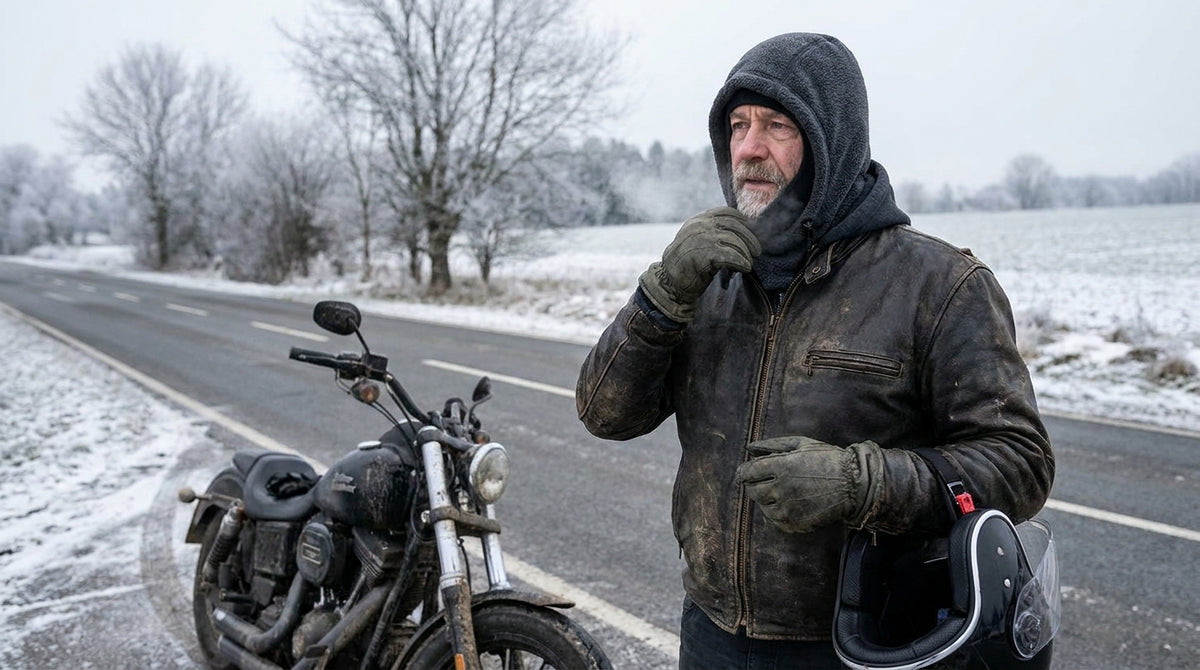
Thirty five degrees on the dash is not the number that matters. At 45 mph that same air hits your face like 19 degrees, which is what the National Weather Service wind chill chart says it should feel like. A thin lycra balaclava does almost nothing against that. It stops the grit and keeps the sun off, and then the cold goes straight through it.
A fleece balaclava hoodie is the fix, and it is a different piece of gear than the summer mask you already own. Longer hood, thicker loft, a bib that tucks into your jacket collar. This guide covers what makes a fleece hood work, how fleece stacks up against neoprene and merino, the eight fleece hoods and balaclavas in the ALR lineup worth your money, and how to get one under a helmet without squeezing your skull.
What a fleece balaclava hoodie actually is
Standard balaclavas stop at the collarbone. A fleece hood keeps going. The skirt on a proper fleece mask hoodie drops roughly 8 to 10 inches past the jaw so it sits flat under your jacket instead of riding up and letting a draft in at the neck.
The fabric is usually polar fleece in the 200 to 300 gsm range, often with a brushed inner face and a smoother knit outside. That puts a finished hood at around 3 ounces, against roughly 1 ounce for a thin summer liner. You feel that difference the first time you stop at a light and your chin is still warm.
Three terms get used for the same shape, which is why search results are a mess: balaclava fleece hoodie, hooded fleece mask, fleece hood and neck warmer. If the piece covers head, face and shoulders in one pull, it is the same thing.
Fleece vs neoprene, microfiber and merino
Material decides more than brand here. Each one trades warmth against breathability and bulk, and the right pick depends on how cold it actually gets where you ride.
| Material | Typical weight | Best temp range | Breathability | Bulk under a helmet |
|---|---|---|---|---|
| Polar fleece | 200 to 300 gsm | 20F to 50F | Moderate | Medium |
| Neoprene | 2 to 3 mm | 25F to 45F | Poor | High on the face |
| Microfiber / lycra | 90 to 120 gsm | 55F and up | Excellent | Almost none |
| Merino wool | 150 to 250 gsm | 25F to 55F | Good | Low to medium |
Fleece is the middle of that table on purpose. It traps a lot of still air for its thickness, it keeps most of its warmth when it gets damp from your breath, and it costs a fraction of merino. Neoprene blocks wind better but it is a sweat trap, which is why riders who try a neoprene half mask in traffic usually go back to fleece.
One thing worth saying plainly. There is a lot of unbranded fleece on the marketplaces at six dollars with no weight listed and no idea what the knit is. It goes flat after a month and the seams rub a hot spot behind the ear. A hood with a stated weight, a flat seam and a retailer who will take it back is the cheaper buy over two winters, and that is the gear American Legend Rider stocks.
The temperature window where fleece wins
Run the wind chill numbers and the window gets obvious. At 50F and 60 mph the apparent temperature is in the low 40s, which fleece handles without you sweating. At 20F and 60 mph you are down near zero apparent, and that is where fleece alone stops being enough and you want a windproof outer layer or a fleece hood with a laminated front panel.
Above about 55F a 250 gsm fleece hood is too much. You will overheat at the first red light and the sweat will chill you when you move again. That is the job of a breathable summer balaclava, and the honest split is two masks, not one that pretends to do both. If you want the full material breakdown by season, our balaclava vs gaiter vs half mask comparison lays it out.
The other half of staying warm is under the jacket, not on the face. A fleece hood on top of a cotton tee is a wasted layer. Pair it with a real base layer from our thermal base layer picks and the hood suddenly feels twice as warm.
8 fleece hoods and balaclavas worth the money
Everything below is live in the ALR catalog with the current price. I have grouped them by the job they do rather than by price, since a 25 dollar hood and a 59 dollar neck system are not really competing.
1. Thermal Fleece Hoodie Face Cover, Black
This is the default pick and the one most riders should start with. Full hood, extended shoulder skirt, 29.95 dollars with a 39.95 dollar list price. Black hides road grime better than the lighter colors, which matters because a face cover gets dirty faster than any other piece of gear you own.

2. Fleece Balaclava Hood Ski Mask, Navy Blue
Same cut as the black, different look. Navy reads less tactical than black if you ride a bagger and do not want to look like you are about to rob a bank at the gas pump. Same 29.95 dollar price, same hood length.

3. Fleece Balaclava Ski Mask Windproof, Light Gray
The light gray version is the one to grab if you ride at dawn or dusk. A gray hood under an open face helmet shows up against a dark road far better than black does, and 29.95 dollars is cheap visibility.

4. Thermal Fleece Hoodie Face Cover, Army Green
Fourth color in the same family at 29.95 dollars. Worth a mention because riders who wear a hood five days a week end up buying two so one is always clean, and two of the same color gets boring fast.

5. Camo Balaclava Winter Fleece Face Mask
The camo fleece balaclava is the second most searched version of this product and this is the ALR take on it, down to 24.45 dollars from 39.99. Fleece lined, cut short enough that it does not bunch at the collar, and it doubles for hunting season. If camo is the whole reason you are here, we ranked eight of them in the camo ski mask guide.

6. ALR Fashion Winter Thermal Fleece Balaclava
Cheapest fleece in the lineup at 22.95 dollars, marked down from 39.45. Shorter neck than the hoodie style, so it is the pick for a full face helmet where a long skirt has nowhere to go. Thinner loft too, which makes it the better choice at 40F to 50F.

7. Windproof Winter Balaclava with Thermal Lining
This one solves the sub 25F problem. A windproof shell face with the thermal lining behind it, 25.97 dollars down from 44.95. Plain fleece lets a 60 mph headwind push through the knit. A laminated front panel does not, and that is the single biggest upgrade for January riding.

8. Motorcycle Neck Warmer with Windproof Chest Bib
Not a hood, but it is the piece that finishes the system. The bib runs down over the chest and under the jacket so the gap at the zipper stops funnelling cold air up into the hood. 59.49 dollars from 89.49, and it is the item riders tell us they should have bought first.

Two more worth knowing about
The Winter Fleece Warmer Full Face Cover at 24.95 dollars is a simpler shape with a wider mouth opening, and the Black MultiCam Balaclava at 22.95 dollars is a thinner three season option in the same pattern family. Both live in the balaclavas collection if you want to compare them side by side.

Making a fleece hood fit under a helmet
Three measurements decide whether a fleece hood works for you. Your bare head circumference, which for most adult men lands between 22 and 24 inches. The thickness the fleece adds, which is 2 to 4 mm per side on a 250 gsm hood. And the remaining gap in your helmet, which on a correctly fitted lid is close to zero.
That math is why a fleece balaclava hoodie squeezes in a helmet that fit fine in July. Two fixes actually work. Pull the hood on first and seat the helmet over it in one motion so the fabric does not roll at the temples. Or pick the thinner fleece for a full face lid and save the thick hood for a half or open face helmet, where there is room above the ears.
Do not size the helmet up to make room. A helmet that moves on your head is doing a worse job than a cold one that does not, and the 20 mm of extra shell play is not something a liner can take back.
Why riders pick a camo fleece balaclava
Camo fleece sells about as hard as black, and the reason is not fashion. Riders who hunt want one mask that does both jobs, and MultiCam style patterns hide the dirt that shows up on a mask that spends every ride six inches from a front tire.
The cheapest way in is the Camo Balaclava Ski Mask at 14.95 dollars, which is a thinner knit than the fleece hood above. Treat it as a three season mask and keep the 24.45 dollar fleece camo for the cold months.
The fogging problem nobody warns you about
Your breath leaves your mouth at roughly 95F and close to fully saturated. Push that into a visor sitting at 30F and it condenses instantly. A fleece hood makes it worse than a thin mask does, because the thick knit redirects more of that breath upward instead of letting it pass through.
Two habits fix most of it. Pull the hood down below the nose and let the helmet chin bar do the wind blocking, or buy a hood with a mesh or perforated mouth panel and point your exhale down and forward. A nose wire helps too, since the leak that fogs a visor is almost always the gap at the bridge of the nose. For the full list of what works, see our cold weather face mask breakdown.
Washing fleece without killing it
Fleece dies from heat and fabric softener, not from use. Softener coats the polyester fibers, flattens the loft and kills the wicking, so a hood that was warm in November feels thin by February. Wash cold, around 86F, on a gentle cycle.
Skip the dryer. A low tumble setting still runs 125F to 135F, which is enough to flatten the brushed nap over a dozen cycles. Hang it overnight instead. A fleece hood air dries in about four hours because there is so little mass to it.
One more thing. Wash it weekly if you ride daily. A face mask collects skin oil and exhaust soot faster than any other layer, and most of the complaints about fleece getting itchy are really complaints about a mask that has not been washed since October.
5 mistakes riders make with winter hoods
- Buying one mask for the whole year. A 250 gsm fleece hood at 60F soaks through in 20 minutes. Sweat then costs you more heat than the wind ever would.
- Tucking the hood outside the jacket collar. Air gets forced up the skirt at speed and the hood turns into a chimney. The skirt goes under the collar, every time.
- Covering the mouth and the nose and the visor vents. Three layers of moisture control fighting each other guarantees a fogged visor within two miles.
- Going up a helmet size to fit the fleece. A loose helmet is a safety problem. A thinner mask is a 23 dollar problem.
- Trusting a no name hood with no stated fabric weight. If the listing does not say gsm or give a material, you are buying a lottery ticket, and the pilling after six washes is the usual prize.
Where to start
For most riders the honest answer is two pieces. One fleece balaclava hoodie in the 29.95 dollar range for the cold half of the year, and a windproof front panel version for the genuinely bad days. Add the chest bib neck warmer when the gap at your jacket zipper starts annoying you, which it will.
If you are shopping for one, the balaclavas collection is where I would start, and the neck warmers are next door. Wind chill math does not care how tough you are. Cover the face, tuck the skirt, and the 19 degree ride stops being a thing you survive.
No comments yet. Be the first rider to weigh in.