
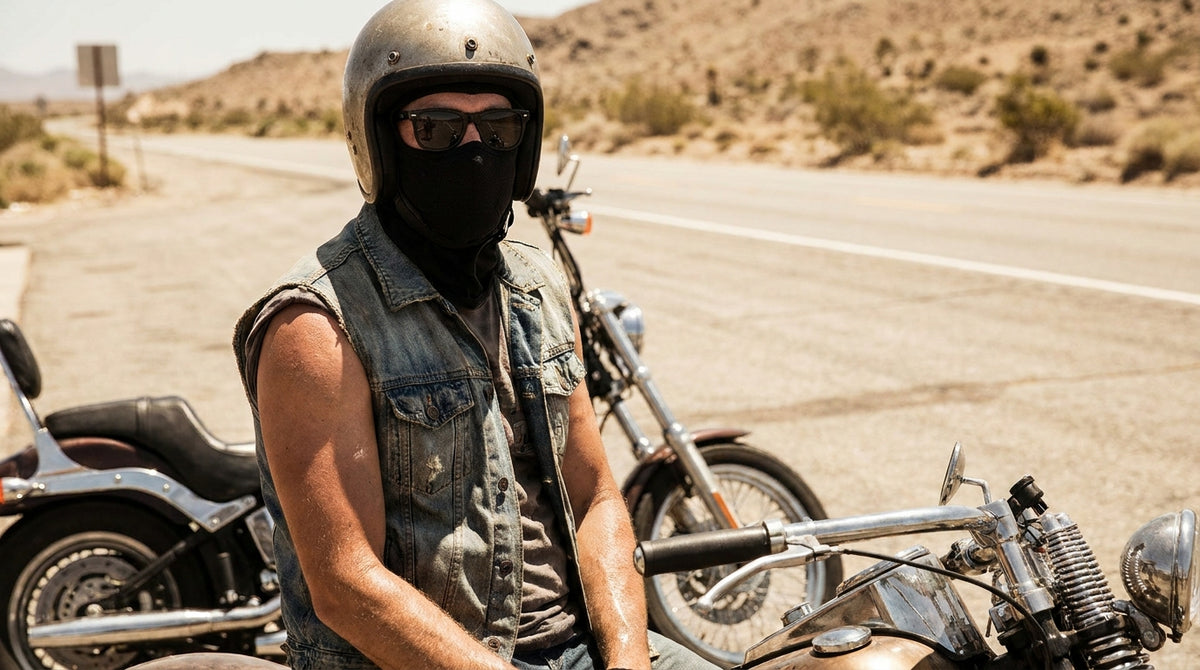
Stop at a light on a 92 degree afternoon wearing a neoprene face mask and you feel it inside four seconds. The fabric goes damp, your own breath bounces back off it, and your sunglasses fog from the bottom up. That mask was built to block 40 degree wind, so it does exactly that job at the worst possible time.
A breathable full face mask solves it with the opposite design brief: move air through the fabric instead of sealing it out. This guide covers which fabrics actually breathe, how to judge a mask before you buy it, ten breathable masks we stock with real prices, and the five mistakes that make riders think every face mask is hot. By the end you will know exactly which weight to run in July and which to leave in the saddlebag until October.
What makes a full face mask breathable
Breathability is not a marketing word, it is a measurable property of the knit. Three things decide it.
- Fabric weight. Measured in grams per square meter. A summer riding mask sits around 90 to 130 gsm. A winter fleece balaclava runs 220 to 320 gsm. That is a 2x to 3x difference in material between your mouth and the air.
- Knit structure. A four way stretch polyester and spandex knit has open loops that pass air. Neoprene is a closed cell foam, so air has to go around it, never through it.
- Moisture transport. Polyester and nylon do not absorb water, they wick it to the outer surface where airflow evaporates it. Cotton absorbs it and holds it against your skin, which is why a cotton bandana feels soaked after 20 minutes.
The quick shop test: hold the mask against your mouth and exhale hard. If you feel the air pass through the fabric onto your palm on the other side, it breathes. If the air escapes around the edges instead, it does not.
Face mask fabrics ranked by airflow
Here is how the common materials compare for warm weather riding. Temperature ranges assume highway speed with air moving over you.
| Fabric | Typical weight | Airflow | Comfort range | Best use |
|---|---|---|---|---|
| Ice silk (nylon and spandex) | 85 to 110 gsm | Highest | 80F and up | Peak summer, sun cover |
| Lycra or spandex blend | 110 to 140 gsm | High | 65F to 95F | All round summer mask |
| CoolMax polyester | 130 to 160 gsm | High | 60F to 90F | Half mask under an open face lid |
| Microfiber polyester | 150 to 190 gsm | Medium | 50F to 80F | Spring and fall shoulder season |
| Cotton bandana | 140 to 180 gsm | Medium, then poor once wet | Short rides only | Style, dust, not heat |
| Fleece | 220 to 320 gsm | Lowest | Below 50F | Winter only |
Notice the pattern. Everything that breathes well is thin, synthetic, and stretchy. If you want the other end of that chart for January, our fleece balaclava guide covers the heavy end properly.
10 breathable face masks and balaclavas, with prices
Every one of these is a live product in our catalog. Prices are current at publish time.
1. Breathable Motorcycle Full Face Mask, $24.95
This is the default pick if you want one mask to cover May through September. Full head and neck coverage, thin four way stretch knit, and a seamless front panel so there is no ridge pressing into the bridge of your nose under a helmet. It pulls down to a neck gaiter at a gas stop without coming off your head.

2. Ice Silk Balaclava with UV Protection, $17.95
The lightest full face option on this list at roughly 90 gsm. Ice silk is a nylon and spandex knit that feels cold to the touch because it moves heat away from your skin fast. The UV block matters more than riders expect: a forearm gets burned through a thin cotton tee in about 90 minutes of open road sun, and your face catches more of it than your arms do.

3. Breathable Summer Helmet Liner Balaclava, $26.95
Built as a liner first. The payoff is that it keeps sweat out of your helmet padding, which is the part you cannot throw in the wash every week. A full face helmet absorbs sweat into the comfort liner and starts to smell within a season. A $26.95 mask is a cheap way to protect a $200 lid.

4. Glasses Friendly Quick Dry Ice Silk Balaclava, $18.99
Cut with a wider eye opening so the top edge sits below your glasses frame instead of under the lens. That single detail kills most mask fogging, because fog comes from your breath being pushed up behind a lens, not from the mask itself. If you ride in prescription glasses or wrap arounds, start here.

5. Vance CoolMax Half Face Mask, $59.95
The premium pick, and the only one here using genuine CoolMax. CoolMax is a DuPont engineered polyester with a flattened fiber cross section, which gives it more surface area to evaporate from than round fiber polyester. It is a half mask, so it covers nose down and leaves your forehead open. Pair it with an open face or a German style lid and you get real airflow across your scalp.

6. Breathable Lycra Full Face Mask, $29.95
Lycra sits between ice silk and microfiber on the airflow chart. The advantage is shape retention. Ice silk is so thin it can slide down your nose at 70 mph, while a Lycra blend holds its cut after 30 or 40 washes. Good choice if you ride every day and the mask gets used hard.

7. Ice Silk Cooling Neck Gaiter, $19.95
Not a full face mask, and that is the point. A tube gaiter gives you sun and wind cover from the collarbone to the nose and leaves the rest open. On a 95F day in traffic that is often the right call, because a full face mask covers your whole scalp and your head is where you dump the most heat. Our balaclava vs gaiter vs half mask breakdown walks through when each shape wins.

8. Breathable Balaclava 3 Pack, $17.99
Three masks for under eighteen dollars works out to about $6 each, which changes how you use them. One lives in the saddlebag, one in the jacket, one in the wash. Thin masks get grimy fast because they sit against a sweating face, and riders who only own one mask end up riding in a dirty one.

9. Breathable Skull Cap Balaclava, $14.99
The budget entry at $14.99 and the thinnest profile under a tight helmet. If your helmet already fits snug and a normal balaclava makes it feel a size too small, this is the one that still goes on. It also doubles as a skull cap under a half helmet when you do not need the face panel.

10. Summer Windproof Breathable Balaclava, $16.99
A hybrid for riders who start at 55F and finish at 85F in the same day. It has a slightly denser front panel to cut morning wind chill and an open knit at the sides and back to vent once the sun is up. Not the coolest mask on this list, but the widest useful temperature window.

Full face, half mask, or gaiter: picking the shape
Airflow is only half the decision. Coverage is the other half, and the shape you pick should match your helmet.
Full face balaclava
Covers head, ears, face, and neck as one piece. Best under a full face or modular helmet, where it works as a sweat liner and stops the chin bar padding from rubbing. Worst choice under a half helmet in August, because your whole scalp stays covered with no airflow over it.
Half mask
Nose down only. The right answer with an open face or German style helmet, which is what most cruiser riders run. Your forehead and scalp stay exposed to moving air, and you still get sun and bug protection where it counts.
Neck gaiter
A tube you can wear low on the neck or pulled up over the nose, switching in about two seconds at a light. The most flexible option for days where the temperature swings 30 degrees between the morning ride and the afternoon one.
Why your breathable mask still fogs your glasses
Fogging is a mask fit problem nine times out of ten, not a fabric problem. Warm breath holds a lot of moisture, and when it hits a lens that is cooler than the dew point of that breath, it condenses instantly. A thin mask does not change that physics, it only changes where the breath goes.
- Mask edge over the lens. If the top hem of the mask sits above the bottom of your lens, every exhale is routed straight up the inside of the glass. Tuck the mask edge under the frame instead.
- Nose seal too tight. Riders pull the mask high to stop it sliding, which seals the nose and forces all airflow upward. Leave a gap at the cheekbones.
- Stopped and idling. No airflow means no evaporation. Fog at a red light that clears at 25 mph is normal and not a gear fault.
If it keeps happening with goggles rather than glasses, the lens coating is the usual culprit. We covered the actual fixes in anti fog goggles and visor film, and riders in prescription frames should read motorcycle goggles over glasses before buying either.
Sun protection is the underrated reason to wear one
Riders buy summer masks for heat and keep them for sun. Your face takes direct overhead sun plus reflected glare off the tank and the road for the entire ride, with no shade. A tight synthetic knit blocks most of it, and the ice silk masks here are rated for UV protection by design.
The spots that burn first are the ones a helmet does not cover: the bridge of the nose, the tops of the cheeks, the back of the neck under the helmet line. A full face balaclava covers all three. On a 300 mile day that is roughly six hours of exposure, which is well past where unprotected skin starts to burn in summer sun. The National Weather Service heat index chart is worth a look too: 90F air at 70 percent humidity feels like 105F, and that is the condition where a heavy mask turns from uncomfortable into a real problem.
5 mistakes that make riders hate face masks
- Running one mask all year. A 280 gsm fleece balaclava in July is not a gear failure, it is the wrong tool. Two masks, a summer and a winter, cost less than $45 together and solve it permanently.
- Buying neoprene for summer. Neoprene is closed cell foam. It is excellent at 35F and genuinely bad at 90F, and no amount of perforation fixes the base material.
- Sizing up for comfort. A loose breathable mask flaps and slides at highway speed, then you pull it tight at the nose and seal your own airflow. These knits stretch, so buy them snug.
- Cotton bandanas on long rides. Cotton holds sweat against your skin instead of wicking it out. Fine for a run to the store, poor past an hour.
- Washing with fabric softener. Softener coats the fibers and kills the wicking that makes a technical mask work. Cold wash, no softener, hang dry, and it keeps performing.
How to keep a thin mask lasting
A thin synthetic mask takes more abuse than a winter one because it is against a sweating face in heat. Three habits keep them alive.
- Rinse it in cold water at the end of a hot ride day even if you are not doing a full wash. Salt from dried sweat is what breaks down spandex.
- Hang dry out of direct sun. A dryer will cook the elastic and the mask stops holding its shape in a season.
- Own at least two so neither one gets worn dirty. At $15 to $27 each this is the cheapest gear upgrade on your bike.
Heat management is a whole kit question, not a mask question. Perforated gloves matter just as much, and our summer glove picks cover the mesh and perforated options. For riders who want pattern instead of plain black, the camo balaclava roundup has the same fit advice applied to camo knits.
Where we stand on cheap marketplace masks
You can find a three dollar balaclava on a marketplace listing with no stated fabric, no gsm, and no UV rating. Sometimes it is fine. Often the knit is a loose polyester that pills after four washes and the seam runs straight across the bridge of the nose, which is the one place a seam cannot go under a helmet.
The structural reason to pay $15 to $30 instead is the seam placement and the elastic content. A mask built for riding has a flat or seamless front panel and enough spandex to stay put at 70 mph. That is not a premium feature, it is the thing that makes the mask wearable under a helmet at all. Budget synthetic masks work for occasional riders who use them a few times a summer. If you ride weekly, the better knit pays for itself in a single season.
The short version
Pick by weight and shape. Under 110 gsm ice silk for peak summer heat, a 110 to 140 gsm Lycra blend as your one mask all season, and a half mask or gaiter if you ride an open face lid. Buy it snug, keep the top hem under your glasses, skip the fabric softener, and own two so you are never riding in the dirty one.
If you are shopping for a breathable full face mask, the motorcycle face masks collection is where I would start, and the wider balaclava collection has the full weight range from 90 gsm summer knits up to winter fleece.
No comments yet. Be the first rider to weigh in.