
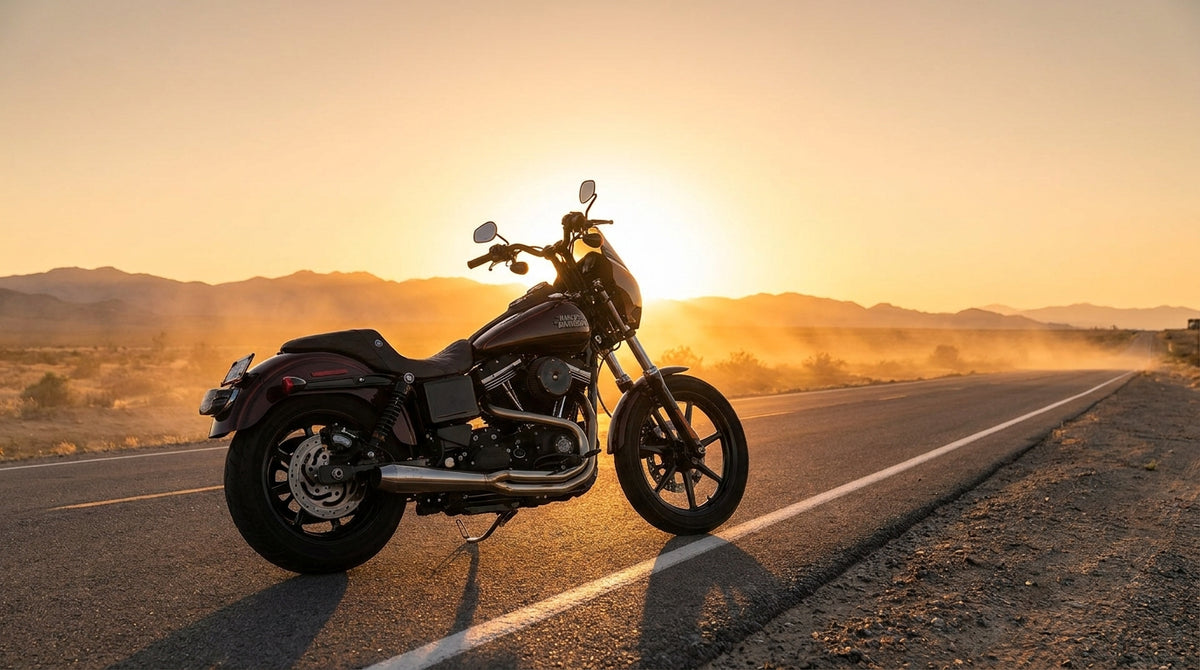
Every Sons of Anarchy fan has typed "jax teller bike" into Google at least once. The motorcycle Charlie Hunnam rode through seven seasons of SAMCRO became one of the most recognizable bikes on television. It was not a one-off custom show piece. It was a production Harley-Davidson that the show's crew modified season by season, and most of those parts are still available today. Here is exactly what Jax Teller rode, what changed each season, and what you need to know if you want to build one yourself.
This guide covers the exact Jax Teller bike model, the engine specs, every major modification from season 1 through 7, and the differences between the show bikes and what you can actually buy. You will also get the real specs on John Teller's Knucklehead, the prices these bikes sell for today, and the most common mistakes fans make trying to replicate the build.
What Bike Does Jax Teller Ride in Sons of Anarchy
The Jax Teller motorcycle is a 2003 Harley-Davidson Dyna Super Glide Sport, model code FXDX. Harley produced the FXDX from 1999 to 2005 as a sportier version of the Dyna platform, with adjustable cartridge-style front forks and gas-charged rear shocks. The show's transportation department picked this model because it looked raw and aggressive without the touring bulk of a Road King or the chrome-heavy styling of a Softail.
The FXDX came stock with a Twin Cam 88 engine displacing 88 cubic inches (1,449 cc). It made roughly 67 horsepower at the crank. That is not a big number by modern standards, but the Dyna's lighter frame (around 617 lbs wet) makes it feel quicker than it looks on paper. The 88 cubic-inch Twin Cam has a distinctive low-end torque curve that pulls hard from 2,000 RPM, which is why the riding scenes in SOA look and sound the way they do.
Multiple FXDX units were used during production. The show kept several stunt bikes, hero bikes (for close-up shots), and tow bikes (for scenes where the actor is filmed sitting on a non-running motorcycle towed behind a camera vehicle). The hero bike received the most attention to custom detail. If you look carefully across episodes, you can spot minor differences in exhaust routing and paint depth between the hero bike and the stunt doubles.

Jax Teller Bike Season by Season
The Jax Teller Harley did not stay the same across all seven seasons. The show's crew evolved the bike to match the character's arc, from a young VP riding a clean Dyna to a hardened club president on a blacked-out, faired machine.
Seasons 1 through 3: The Clean Dyna
In the early seasons, the Jax Teller bike was close to a stock FXDX with a handful of changes. It ran drag bars instead of the stock buckhorn handlebars, forward controls instead of mid-controls, and a 2-into-1 exhaust that gave it a deeper, single-pipe growl. The paint was a simple gloss black with minimal graphics. No fairing, no windshield. This version of the bike looked like something any Harley rider might own, which was the point. Jax was still proving himself in the club.
Seasons 4 and 5: The Quarter Fairing
Starting in season 4, the crew added a quarter fairing (sometimes called a T-Sport fairing) to the front end. This is a small, frame-mounted fairing that covers the headlight and provides minimal wind protection. It changed the visual profile of the Jax Teller motorcycle significantly, giving it a more aggressive, street-fighter look. The exhaust also changed to a 2-into-2 setup with slash-cut tips, and the engine covers were blacked out. These upgrades signaled Jax's growing authority in SAMCRO.
Seasons 6 and 7: The Full Custom
By the final two seasons, the bike had a larger custom fairing, new pipes, and a fully blacked-out aesthetic. The drag bars were swapped for slightly taller mini-apes on the later builds, and the forward controls were upgraded. This version of the Jax Teller bike looked the most aggressive, matching the show's darker storyline. The complete Sons of Anarchy bike guide covers how each character's motorcycle evolved alongside the plot.
Jax Teller Harley Engine and Frame Specs
Here is what the stock 2003 FXDX delivered before the show's crew made any changes.
| Spec | 2003 Harley-Davidson FXDX |
|---|---|
| Engine | Twin Cam 88, 88 ci (1,449 cc) |
| Horsepower | ~67 hp at crank |
| Torque | ~82 lb-ft at 3,500 RPM |
| Transmission | 5-speed |
| Frame | Steel, twin-tube Dyna chassis |
| Wet Weight | ~617 lbs |
| Seat Height | 26.9 inches |
| Fuel Capacity | 4.9 gallons |
| Front Suspension | 49mm cartridge forks (adjustable) |
| Rear Suspension | Gas-charged shocks (adjustable preload) |
| Brakes | Single front disc, single rear disc |
| MSRP (2003) | $14,200 |
The FXDX's adjustable suspension was unusual for Harley at the time. Most Dyna models used basic non-adjustable forks. The cartridge setup let the show's stunt riders dial in stiffer compression for the high-speed chase scenes, then soften it for the low-speed parking lot shots where the bikes needed to look smooth and stable at walking pace.

Custom Parts on the Jax Teller Motorcycle
Fans trying to replicate the Jax Teller bike need specific parts. Here is what the show used across all seasons.
- Handlebars: Drag bars (seasons 1-5), transitioning to low mini-ape hangers (seasons 6-7). The drag bars were roughly 28 inches wide with about 2 inches of rise.
- Controls: Forward controls with highway pegs. The stock FXDX came with mid-controls, so this was one of the first changes the show made.
- Exhaust: 2-into-1 collector pipe (seasons 1-3), switching to 2-into-2 slash-cut pipes (seasons 4-7). The 2-into-1 gave a deep, single rumble. The 2-into-2 was louder and raspier.
- Fairing: None in seasons 1-3. Quarter fairing (T-Sport style) in seasons 4-5. Larger custom fairing in seasons 6-7.
- Seat: Low-profile solo seat with a pillion pad. The seat height was dropped about an inch from stock using a lowered seat pan.
- Paint: Gloss black base throughout the series. The reaper and club logos were applied as vinyl decals, not airbrushed, which made it easy to swap panels between stunt bikes and hero bikes.
- Engine covers: Blacked out from season 4 onward. The early seasons showed polished aluminum covers.
The total cost to convert a stock Dyna into a close replica of the Jax Teller bike runs roughly $2,500 to $4,500 in parts, depending on whether you buy aftermarket or Harley-branded components. That does not include the base motorcycle. A used 2003 FXDX in running condition sells for $5,000 to $9,000 in 2026, depending on mileage and condition.
John Teller's Knucklehead
Jax's father, John Teller, rode a vintage Harley-Davidson Knucklehead that appeared in flashbacks and garage scenes throughout the series. The bike is identified as a 1946 Harley-Davidson FL Knucklehead, one of the last model years before Harley replaced the Knucklehead engine with the Panhead in 1948.
The 1946 FL ran a 74 cubic-inch (1,200 cc) Knucklehead V-twin producing about 48 horsepower. It weighed around 515 lbs and had a springer front end with no rear suspension (hardtail frame). Authentic 1946 Knuckleheads in running condition sell for $40,000 to $80,000 at auction in 2026. Show-quality restorations with matching numbers have crossed $100,000. The Sons of Anarchy helmets guide covers the headgear each character wore, including the open-face half shell Jax wore through most of the series.
The Knucklehead symbolized the club's founding era in the show. John Teller started SAMCRO in the 1960s, and the FL was his original ride. The contrast between that vintage springer and Jax's modern Dyna was a visual shorthand for the generational gap between father and son, old-school outlaw idealism versus modern club realities.
Jax Teller Bike for Sale: What They Cost in 2026
Finding an actual screen-used Jax Teller motorcycle is nearly impossible. The production company retained most of the hero bikes, and the few that surfaced at charity auctions sold for $50,000 to $75,000. A Profiles in History auction in 2015 listed one of the screen-used FXDX bikes with an estimate of $30,000 to $50,000.
The practical option is building a replica. Here is what the base bikes cost today.
| Bike | Year Range | Avg Price (2026) | Notes |
|---|---|---|---|
| Dyna Super Glide Sport (FXDX) | 1999-2005 | $5,000-$9,000 | Exact model Jax rode. Discontinued 2005. |
| Dyna Super Glide (FXD) | 2006-2017 | $6,000-$11,000 | Same frame, non-adjustable forks. |
| Dyna Street Bob (FXDB) | 2006-2017 | $7,000-$12,000 | Similar look, drag bars from factory. |
| Dyna Low Rider (FXDL) | 2014-2017 | $8,000-$14,000 | Lower seat, mid-controls (swap to forward). |
The Dyna Street Bob is the easiest replica base because it already comes with drag bars and a blacked-out look. You skip the handlebar swap and focus on adding the fairing, exhaust, and forward controls. Total build cost on a Street Bob base: roughly $9,000 to $16,000 all in, depending on the condition of the base bike and the parts you choose.

5 Mistakes Fans Make Building a Jax Teller Bike Replica
- Buying a Softail instead of a Dyna. The Softail has a hidden rear suspension that looks like a hardtail. The Dyna has visible twin shocks under the seat. Jax's bike was unmistakably a Dyna. A Softail build will look wrong to anyone who knows the difference, and you will spend more money fighting the frame geometry instead of matching it.
- Using ape hangers instead of drag bars. Ape hangers are taller than the rider's shoulders and are associated with a different riding style. The Jax Teller bike ran drag bars (low and flat) in most seasons, with a slight switch to low mini-apes in the final two seasons. High apes change the entire silhouette of the bike and miss the aggressive, forward-leaning riding posture Jax had on screen.
- Skipping the forward controls. The stock FXDX has mid-controls, with the foot pegs directly below the rider. Jax's bike had forward controls, pushing the pegs about 6 inches ahead. This changes the riding position from upright to laid-back, which is a huge part of how the bike looked on camera. The skull helmets collection has SOA-inspired gear that pairs with the Dyna build aesthetic.
- Getting the exhaust wrong. The early-season 2-into-1 and the later-season 2-into-2 slash-cut pipes had very different sounds and looks. Fans often install a generic aftermarket exhaust that does not match either configuration. If you are replicating a specific season, match the exhaust to that era of the show.
- Adding too much chrome. The Jax Teller motorcycle was deliberately blacked out, especially in the later seasons. Chrome engine covers, chrome exhaust tips, and chrome mirrors all work against the look. The show used satin black powder coat on the engine covers and matte black on the frame accents. Less chrome, more black. If you are unsure, look at screen grabs from season 6 and match the finish on every visible component.
If you are looking for riding gear that fits the SOA and biker lifestyle, the cool motorcycle helmets collection has half shells, open-face lids, and retro styles that match the Dyna build.
No comments yet. Be the first rider to weigh in.