
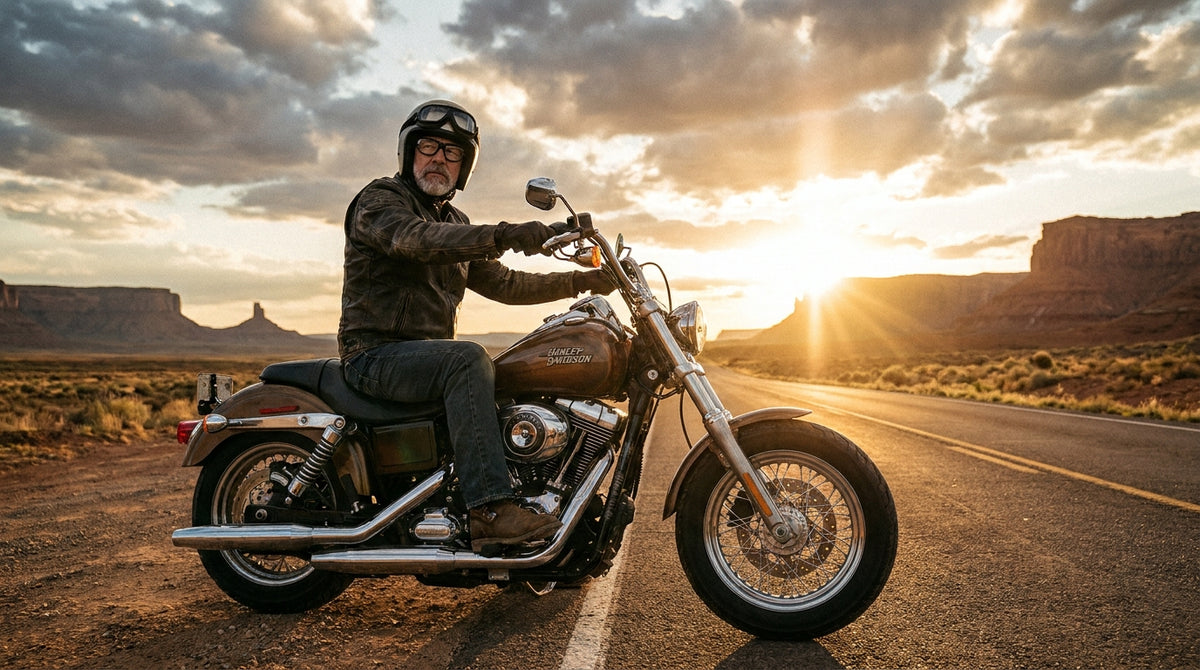
Most riders who wear glasses find out the hard way. You pull a pair of goggles over your head, the foam catches the temple arms of your frames, and the whole thing sits crooked an inch off your face. Wind pours straight through the gap. By the second mile your eyes are watering and your lenses have fogged solid at the first red light.
The fix is not a bigger strap. It is a goggle built with enough internal depth and a foam channel cut for temple arms. That category has a name in the eyewear world: OTG, short for over the glasses. This guide covers the motorcycle goggles over glasses that actually clear prescription frames, the four measurements that decide fit before you buy, and the venting trick that kills fogging at stoplights.
What OTG actually means on a goggle
OTG is not a safety rating and nobody certifies it. It describes two physical design choices. First, the goggle body has extra internal depth, usually around 15mm to 20mm more than a standard frame, so your lenses are not pressed against the inside of the goggle lens. Second, the face foam has a notch or a softer channel at each temple so the arms of your glasses pass through without breaking the seal.
Plenty of goggles sold as OTG only have the first half. They are roomy but the foam is one solid strip, so the temple arms lift the foam off your cheekbone and open a wind channel right where you least want one. When you are comparing pairs, the foam matters more than the headline measurement.
Worth knowing: goggles are not covered by DOT, which only rates helmets. The relevant eye protection standard in the US is ANSI Z87.1. Most polycarbonate riding lenses block around 99% of UVA and UVB regardless of tint, so a clear lens protects your eyes from UV just as well as a dark one.
The 4 measurements that decide whether goggles fit over glasses
Take two minutes with a ruler and your own glasses before you spend anything. These four numbers settle it.
| Measure | How to take it | What you want |
|---|---|---|
| Frame total width | Hinge to hinge across the front of your glasses | Most adult frames run 130mm to 145mm. The goggle opening needs to beat your number. |
| Lens height | Top to bottom of one of your lenses | Under 40mm clears almost any goggle. Over 45mm rules out slim vintage shapes. |
| Temple arm thickness | Thickness of the arm where it passes your temple | Thin wire arms slip through any foam. Thick acetate arms need a notched channel. |
| Nose bridge to cheek | How far your lenses sit off your face | The deeper your glasses sit forward, the more internal goggle depth you need. |
If your frames measure wider than 145mm, skip the narrow aviator shapes and go straight to the oversized or face mask style bodies further down this list. No strap adjustment fixes a frame that is physically too wide for the goggle opening.
The 6 goggles worth riding with glasses underneath
These are the live pairs in the American Legend Rider lineup, ranked by how much room they give a prescription frame. Note that we do not publish an internal depth figure for every pair, so measure your own glasses with the table above and match it to the frame shape described here. Honest guidance beats a spec sheet number you cannot verify.
1. Vintage Aviator Motorcycle Goggles with Adjustable Strap
The adjustable strap version is the one I would hand a rider who wears glasses and has never owned goggles. The aviator body is the deepest shape in the range, and the adjustable strap lets you set tension low enough that the foam seals around your temple arms instead of crushing them. At $29.95 it is the safest first buy in this list.

2. Motorcycle Face Mask Goggles, Windproof Anti Fog UV Protection
This is the widest opening of the six, because the body is built as a combined mask and goggle rather than a slim retro frame. If your glasses measure past 145mm hinge to hinge, start here. The anti fog treatment and the larger air volume behind the lens also make it the best pick for cold morning commutes, where fogging is worst.

3. Vintage Aviator Motorcycle Goggles, Yellow Lens
Same roomy aviator body, with a yellow lens. Yellow and amber tints raise contrast in flat grey light, which is why shooters and pilots have used them for decades. They are a genuinely useful choice for dawn, dusk and overcast days, and they are the wrong choice for bright midday sun. At $29.95 it works best as a second lens option rather than your only pair.

4. Vintage Motorcycle Goggles, Aviator Style Copper Frame
The copper frame is the style pick of the group and it suits an open face or three quarter helmet better than anything else here. The multicolor mirrored lens cuts glare well. Measure carefully before buying this one, because decorative metal frames tend to run slightly shallower than the plain ABS bodies. If your glasses are on the large side, pick number 1 or 2 instead.

5. Vintage Aviator Motorcycle Goggles
The base aviator pair at $26.95 is the cheapest way into the category and the most classic look. The tradeoff against number 1 is the fixed strap setup, which gives you less room to fine tune tension around temple arms. For thin wire frames it is fine. For chunky acetate glasses, the adjustable strap version is worth the extra three dollars.

6. Polarized Riding Sunglasses
Not a goggle, and included deliberately. Plenty of riders chasing motorcycle goggles over glasses would be better served by swapping to a polarized riding lens and skipping the double layer entirely. Polarization kills glare off wet tarmac and car bodies in a way no tinted goggle lens does. At $29.97 this is the honest answer for riders whose prescription is mild enough to ride without, on a bike with a screen.

Side by side: which pair for which rider
| Pair | Price | Frame room | Best for |
|---|---|---|---|
| Aviator with adjustable strap | $29.95 | Deep | First goggle for a glasses wearer |
| Face mask goggles | $29.95 | Widest | Large frames, cold weather commuting |
| Aviator, yellow lens | $29.95 | Deep | Dawn, dusk and overcast riding |
| Copper frame aviator | $29.95 | Medium | Open face helmet style, smaller frames |
| Vintage aviator, base | $26.95 | Deep, fixed strap | Thin wire frames on a budget |
| Polarized riding lens | $29.97 | Not applicable | Glare, mild prescriptions, faired bikes |
If you want to see the full range of shapes side by side, the aviator goggles collection is where the deeper bodies live. For a broader look at retro shapes and lens tints, our rundown of aviator goggle styles goes deeper on looks than fit.
Foam, venting and why your glasses fog
Fogging is condensation, and it has one cause: warm moist air from your breath and skin hitting a lens that is colder than the dew point. Riding at speed solves it by itself because air moves through the goggle. Fog appears when you stop, and it appears twice as fast with glasses inside, because you now have two cold surfaces and a dead pocket of trapped air between them.
Three things genuinely help. Vent foam, which is open cell foam that lets a trickle of air pass at a standstill. An anti fog coated lens, which spreads condensation into a thin even film instead of droplets. And routing your breath away from the goggle, which is where a lot of riders get it wrong by pulling a neck tube up over the nose and venting every exhale straight up into the lens.
That last one matters more than the goggle you buy. If you ride in cold weather with a face covering, pick one with a shaped nose bridge that directs breath down and out. Our guide to choosing a riding mask for each type of ride covers which shapes work under goggles, and the face mask collection has the vented options.
5 mistakes riders make buying goggles over glasses
- Buying on strap length instead of internal depth. Every strap on this list adjusts. None of that helps if the goggle body is 10mm too shallow for your lenses. Depth is fixed at the factory and it is the measurement that actually decides fit.
- Cranking the strap tight to close the wind gap. Tightening a goggle that does not clear your frames just transfers pressure into the temple arms. You get a headache behind the ears within 20 minutes and the gap stays open anyway.
- Assuming vintage shapes are roomy. Slim retro frames look right with an open face helmet and are the tightest bodies in any lineup. The authentic 1940s silhouette was designed for a face, not for a face wearing glasses.
- Picking a dark lens for all conditions. A mirrored or smoke lens over prescription glasses stacks two tinted layers. On a dusk ride home that is genuinely unsafe. Clear lenses block the same UV, so own a clear or yellow pair if you ride after sunset.
- Going with an unrated marketplace pair. A no-name goggle with unknown lens material is the one piece of gear where cheap has a real cost. Acrylic lenses crack into sharp pieces on impact, where polycarbonate deforms. You are putting it directly in front of your eyes.
Where ALR sits on this
Straight answer on quality tiers. Genuine polycarbonate lenses, real leather or solid ABS frames, and foam that holds its shape after a season are worth paying for once, and that is the standard we build to. Budget synthetic goggles do work for an occasional fair weather rider, and they flatten out and lose their seal faster, usually inside a riding season. Unrated marketplace knockoffs are the one option to avoid outright, for the structural reason above: you cannot find out what the lens is made of until it fails.
If you are shopping for motorcycle goggles over glasses and you want one pair to get right first time, measure your frames, then start with the adjustable strap aviator or the face mask body. Those two clear the widest range of prescription glasses in the lineup.
Getting them on and off without knocking your glasses
Order of operations matters and almost nobody is told this. Put the goggles on first with the strap over your forehead, then slide your glasses in from below, temple arms last. Doing it the other way round drags the foam across your lenses every single time, which is how goggle wearers end up with fine scratch rings on a $300 pair of prescription lenses.
On a helmet, set the strap outside the shell rather than under it. A strap trapped between your head and the liner shifts every time you turn to check a blind spot, and on an open face lid it will work its way down onto the bridge of your glasses within about 10 miles. Outside the shell it stays put, and you can lift the goggles up onto the helmet at a fuel stop without removing your glasses at all.

No comments yet. Be the first rider to weigh in.