
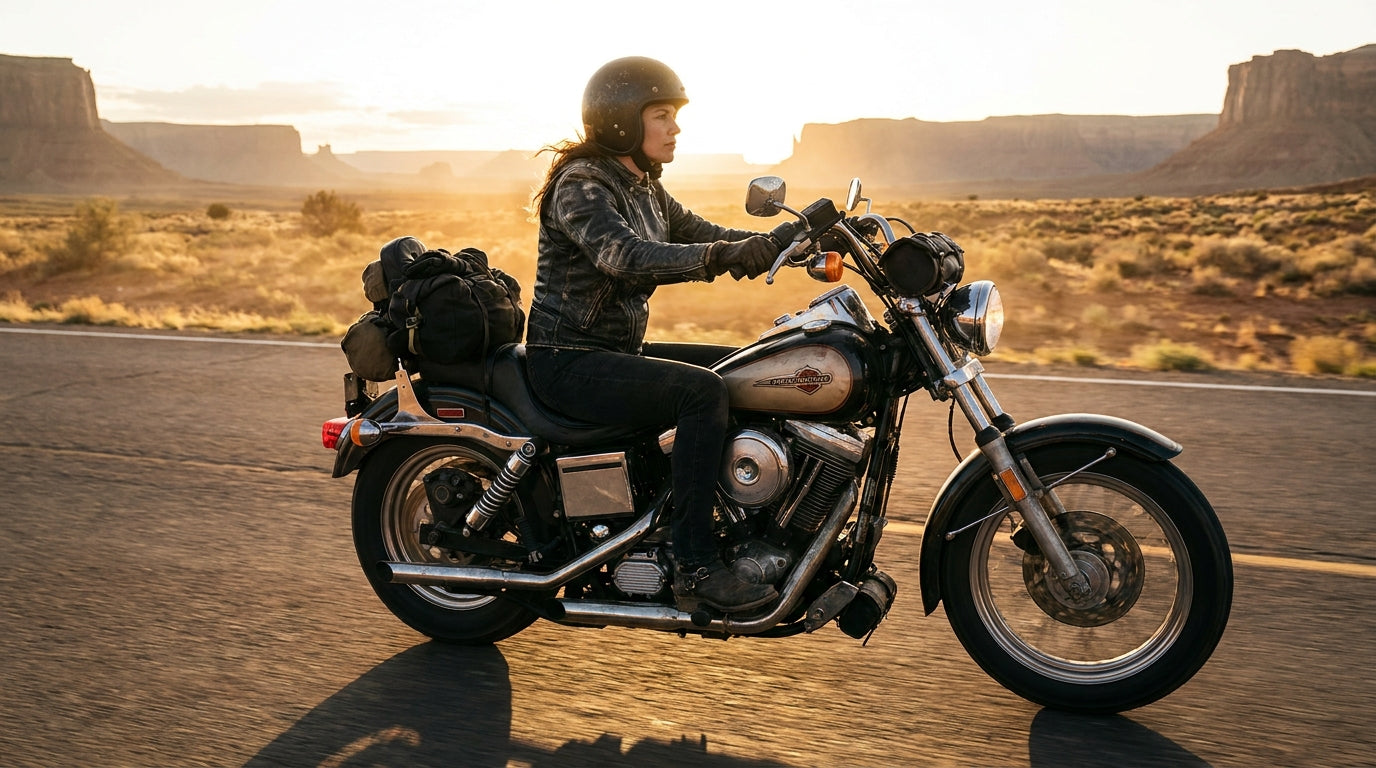
Most women buy their first leather jacket based on how it looks on a mannequin. That works for fashion. It does not work for riding. A jacket that looks perfect in a fitting room can bunch at the shoulders, ride up above the waist, or leave your elbows exposed the moment you lean forward over handlebars. The difference between a leather jacket for ladies built for riding and one built for a night out is the difference between a 7-second slide and a trip to the ER.
This guide covers everything you need to pick the right leather jacket for ladies who actually ride. You will learn which leather types hold up, how fit should feel on a bike (not just standing up), what price ranges are worth it, and which mistakes cost riders the most money.
Why Leather Still Outperforms Textile for Women Riders
Textile jackets have come a long way. Cordura, ballistic nylon, and laminated mesh all have their place. But leather does one thing no textile can match: it slides instead of catching.
A 1.0 to 1.2mm cowhide jacket can handle roughly 7 to 8 seconds of asphalt slide before wearing through. That is enough to cover most low-side crashes at city speeds. A comparable textile jacket in Cordura 600D starts fraying at around 3 to 4 seconds. That gap matters when your shoulder is the first thing hitting the pavement.
Leather also molds to your body over time. A well-broken-in cowhide jacket fits like nothing else after 15 to 20 wears. Textile keeps its stiff shape forever. For women who ride regularly, that custom-fit feeling is a real advantage on longer highway rides where stiffness turns into fatigue.
The trade-off is ventilation. Leather runs hotter in summer. If you ride exclusively in 95-degree heat, a perforated leather jacket or a mesh textile is the practical choice. For three-season riding, leather wins on every other metric.
Leather Jacket Styles for Ladies: Which One Fits Your Ride
Not every leather jacket is built the same. The style you pick should match how you sit on the bike and where you ride most.
Classic Cruiser
The most common style for Harley and Indian riders. These jackets sit at the waist or just below, have a wider cut through the torso, and usually feature snap-down collars and zippered vents. They work best in an upright riding position. A solid cruiser jacket is built on a 1.1mm cowhide shell with a removable thermal liner for year-round use.
Cafe Racer
Slimmer, shorter in the body, with a band collar instead of a lapel. Cafe racers weigh less too. A typical lambskin cafe jacket comes in around 3.0 to 3.5 lbs compared to 4.5 to 5.0 lbs for a classic cruiser in cowhide. The leaner cut works well on standard and sport-standard bikes where you lean slightly forward.
Sport and Racing
Pre-curved sleeves, hard armor pockets at the elbows and shoulders, and a longer back panel that tucks into riding pants. These jackets are designed for an aggressive forward lean. If you ride a Kawasaki Ninja 400 or a Yamaha R3, this is the style that stays in place at speed.
Crossover and Casual
Fashion-forward cuts that look right off the bike. They skip armor pockets and use thinner leather (0.6 to 0.8mm). Fine for short commutes at moderate speeds. Not recommended for highway riding, because the thinner hide has roughly half the abrasion resistance of a proper 1.0mm+ motorcycle jacket.
How to Find the Right Fit in a Women's Leather Jacket
Fit is where most women go wrong with motorcycle gear. The jacket needs to fit in riding position, not standing in front of a mirror.
Here is the test: put the jacket on, sit on your bike or mimic the position on a chair with your arms forward and slightly down. Check three things:
- Sleeves. They should cover your wrists completely when your arms are extended toward the grips. If they ride up and expose skin, the jacket is too short in the arms. Most women's motorcycle jackets run size S (bust 32 to 34 inches) through 3XL (bust 46 to 48 inches).
- Back length. The jacket should overlap your belt line by at least 2 inches when you lean forward. Kidney exposure on a cold highway ride is miserable, and exposed skin in a slide is worse.
- Shoulder seams. They should sit at the edge of your shoulder, not drooping onto your upper arm. If the jacket has armor pockets, the armor should sit centered on your actual shoulder and elbow joints.
One note on women's vs. unisex sizing: unisex jackets are cut for male proportions. They run wider in the shoulders, narrower in the hips, and shorter in the torso relative to arm length. A women's-specific cut accounts for a narrower shoulder, longer torso, and more room through the hip and bust. The difference is noticeable on anything longer than a 30-minute ride. If a jacket is labeled "unisex," try one size down and check the shoulder seam position.
Pair the jacket with proper riding gloves and boots built for the bike to complete the setup.
Leather Types: Cowhide, Goatskin, Lambskin and Buffalo
The leather itself matters as much as the jacket design. Here is how the four most common hides compare for women's motorcycle jackets.
| Leather Type | Typical Thickness | Weight (Size M) | Abrasion Rating | Break-In Time | Best For |
|---|---|---|---|---|---|
| Cowhide | 1.0 to 1.3mm | 4.5 to 5.5 lbs | Highest | 15 to 25 wears | Highway, all-season |
| Goatskin | 0.8 to 1.1mm | 3.5 to 4.5 lbs | High | 8 to 12 wears | Three-season touring |
| Lambskin | 0.6 to 0.9mm | 2.5 to 3.5 lbs | Moderate | 3 to 5 wears | Casual, cafe style |
| Buffalo | 1.2 to 1.6mm | 5.0 to 6.5 lbs | Highest | 25 to 40 wears | Heavy touring, cold |
Cowhide is the workhorse. It is the most common leather used in women's motorcycle jackets because it balances protection, cost, and durability. A 1.1mm cowhide jacket from a quality maker will last 10 to 15 years with basic care.
Goatskin is the sweet spot for riders who want lighter weight without giving up much protection. It breaks in faster and has a natural grain that hides scratches well. Roland Sands Design uses goatskin in several of their women's riding jackets for exactly this reason.
Lambskin is the softest and lightest option but offers the lowest abrasion resistance. It is a solid choice for riders who stick to surface streets at moderate speeds. Not ideal for highway touring or spirited riding.
Buffalo leather is thick, heavy, and nearly indestructible. It is overkill for most riders but holds up well in cold, wet conditions where thinner hides would stiffen and crack.
What a Quality Leather Jacket for Ladies Should Cost
Price tells you a lot about what you are getting. Here is a rough breakdown of the women's leather motorcycle jacket market in 2026.
Budget: $80 to $150
Thin leather or bonded leather (ground-up leather fibers glued together). Limited stitching reinforcement. Often no armor pockets. These jackets look the part but will not hold up in a slide or last more than a season or two. The leather is typically 0.5 to 0.7mm and feels papery after a few months of wear.
Mid-Range: $150 to $300
Genuine full-grain cowhide at 1.0 to 1.2mm. Reinforced stitching at stress seams. Armor-ready pockets at the shoulders and elbows, with armor often sold separately. Removable liners in some models. This is where quality riding jackets start. A $200 jacket in this range should last 5 to 10 years with regular conditioning.
Premium: $300 to $600+
Top-grain or hand-dyed leather, CE-rated armor included, perforated panels for airflow, YKK zippers, and double stitching on every stress point. Brands like Rev'It, Alpinestars, and Klim operate in this range. If you ride 5,000+ miles a year, the investment pays for itself in longevity and protection.
One rule of thumb: if a jacket costs under $100 and claims to be "genuine leather," check the thickness. Anything under 0.8mm will not provide meaningful slide protection. The word "genuine" on a label is actually the second-lowest grade of leather, below full-grain and top-grain.
5 Common Mistakes When Buying a Women's Leather Jacket
These are the errors that waste money or leave riders underprotected.
- Buying based on standing fit. A jacket that fits perfectly while standing can bunch at the back and ride up in riding position. Always test in the riding posture with your arms forward on the grips. The sleeves should fully cover your wrists.
- Ignoring armor compatibility. A leather jacket without armor pockets is a fashion jacket. CE Level 1 armor adds maybe 8 oz per pocket and can reduce impact force by up to 50%. If the jacket has no pockets for shoulder, elbow, and back armor, you are paying for style without protection.
- Choosing bonded leather. "Bonded leather" is to real leather what particle board is to oak. It is ground-up scraps laminated onto fabric. It cracks, peels, and offers almost zero abrasion resistance. If the tag says bonded, reconstituted, or PU leather, skip it for riding.
- Sizing down for a tight look. A jacket that is too tight restricts arm movement and pulls the back panel up, exposing your lower back. The jacket should feel snug but allow full arm extension and shoulder rotation. If you cannot reach forward comfortably, go up one size.
- Skipping the liner. A removable thermal liner turns a single-season jacket into a three-season jacket. Without one, you are stuck layering bulky clothes underneath, which changes the fit and can restrict movement. Look for zip-out quilted liners that add warmth without adding bulk.
How to Break In and Care for Your Leather Jacket
New leather is stiff. That is normal and expected. A full-grain cowhide jacket needs about 15 to 20 wears before it softens enough to feel like yours. Here is how to speed up the process without damaging the hide.
Wear the jacket around the house for an hour at a time. Sit, stretch, reach overhead. Your body heat and movement will work the fibers loose naturally. Avoid soaking it in water or putting it in a dryer. Both can warp the leather and ruin the fit permanently.
For conditioning, use a leather-specific product like Lexol or Bickmore every 3 to 4 months. Apply a thin coat, let it absorb for 20 minutes, then buff off the excess with a soft cloth. This keeps the leather supple and prevents cracking at the flex points.
Store the jacket on a wide, padded hanger in a cool, dry space. Never fold it. Never leave it in direct sunlight for extended periods. UV breaks down the dye and dries out the leather over time. A breathable garment bag works well for long-term storage between riding seasons.
If you ride in rain, let the jacket air-dry at room temperature after you get home. Stuff the sleeves with newspaper to hold their shape while drying. Once dry, apply conditioner to put the moisture back in. Leather that dries stiff after rain just needs rehydration.
The same care principles apply to leather riding chaps and motorcycle boots if you are building out a full leather kit.
Picking the Right Leather Jacket for Ladies Who Ride
A good leather jacket is the single most versatile piece of riding gear you can own. It protects in a crash, blocks wind on cold mornings, and looks right whether you are pulling into a rally or a restaurant. The key is buying one built for the bike, not the runway.
Stick with 1.0mm+ full-grain cowhide or goatskin, get the fit right in riding position, and make sure it has armor pockets at minimum. Take care of it with regular conditioning, and it will take care of you for a decade or longer.
If you are shopping for one now, the women's riding gear collection is where to start.

No comments yet. Be the first rider to weigh in.