
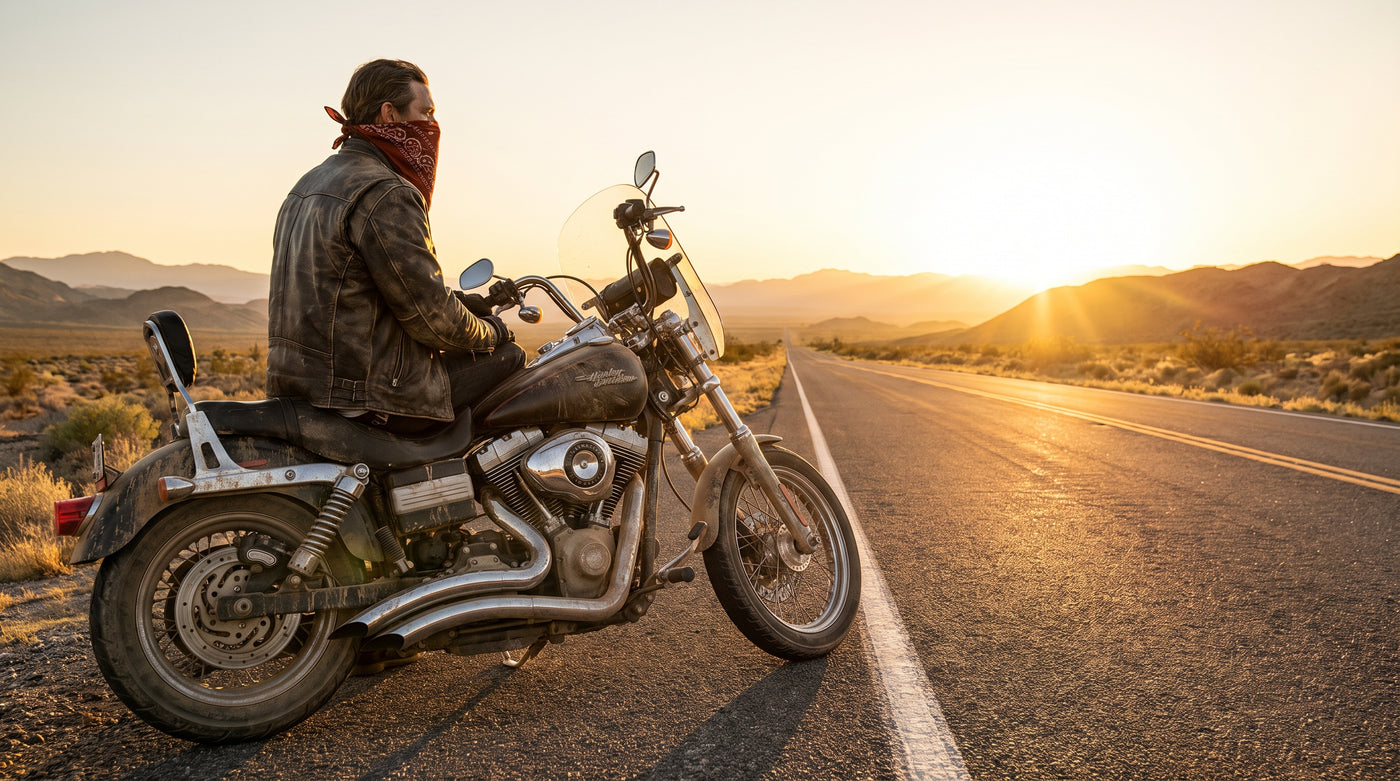
A cotton bandana bought from a gas station starts slipping the second you hit 55 mph. Two miles later, it bunches around your neck like a loose collar, doing nothing for bugs, sun, or wind. Riders who get the tie method right and pick the right fabric keep their motorcycle bandana locked in place for 200-mile rides without adjusting it once. The difference is not the price. It is the fold, the knot, and the thread count.
This guide covers everything about motorcycle bandanas: why riders wear them, how to tie one that stays put at highway speed, which fabrics actually work, and what styles match different riding setups. Whether you are looking for a biker bandana for under your helmet or a standalone head wrap for cruiser rides, you will know exactly what to buy and how to wear it.
Why Riders Wear Motorcycle Bandanas
Bandanas started as a practical fix. Open-face helmets and no windshields meant bugs, dust, and road grit hitting riders directly in the face. A folded square of cotton over the nose and mouth filtered out the worst of it. That function has not changed. Riders on cruisers with no fairings still deal with the same wind, dust, and sun exposure that riders dealt with 60 years ago.
Beyond protection, a motorcycle bandana wicks sweat off the forehead and keeps hair from whipping into your eyes. On hot rides above 90 degrees, a wet bandana around the neck drops your skin temperature by 5 to 10 degrees through evaporative cooling. Soak a standard 22x22 inch cotton bandana in water, wring it out, fold it into a neck wrap, and that moisture keeps you cooler for roughly 45 minutes before it dries out completely.
Bandanas also work as a comfort layer under helmets. A thin bandana under a half-shell or three-quarter helmet prevents the helmet liner from soaking up sweat and oils from your hair. That extends the liner life and cuts down on helmet odor. Some riders swap bandanas mid-ride instead of washing a helmet liner every week.
The style factor is real too. Bandanas have been part of biker culture since the 1950s, when riders wore them in club colors and custom prints. Today, skull prints, American flag designs, and solid black are the most common motorcycle bandana styles on the road. A bandana is also the cheapest piece of riding gear you can own. A quality cotton bandana runs $5 to $8, lasts a full riding season, and solves three problems at once: sweat, dust, and sun.
How to Tie a Motorcycle Bandana That Stays Put
The standard biker fold takes about 30 seconds. Lay the bandana flat, fold it corner to corner into a triangle. Place the long edge across your forehead, just above the eyebrows. Pull the two side points behind your head and tie them over the rear point in a double knot. Tuck the rear point under the knot or let it hang. That triangle fold is what most cruiser riders use without a helmet, and a double knot holds at speeds up to 80 mph without loosening.
For wearing a bandana under a helmet, the flat fold works better. Fold the bandana into a 2-inch wide strip, about 4 folds. Wrap it around your head so it covers the forehead and the area where the helmet padding sits. Tie it in the back, flat against the skull. This keeps sweat off your face and prevents the helmet from rubbing a raw spot on your forehead during long rides. A folded bandana adds roughly 1mm of padding, which does not affect helmet fit if you sized the helmet correctly.
The face cover fold is the third option. Start with the triangle fold, but pull the bandana higher so the top edge sits just below your eyes and the triangle drapes down over your nose and chin. Cross the two side points behind your neck and tie them at the back. This works as a face bandana for motorcycle riding at lower speeds, but above 50 mph the bottom flaps start catching wind. A tubular bandana (buff-style) solves that problem by eliminating loose ends entirely.

Best Fabrics for Biker Bandanas
Not all bandanas handle road conditions the same way. The fabric determines how well the bandana breathes, how fast it dries, and whether it stays in place or slips at speed.
100% cotton is the classic choice. A standard 22x22 inch cotton bandana weighs about 1.5 oz, absorbs sweat well, and gets softer with each wash. The downside: cotton holds moisture. Once it soaks through, it stays wet and heavy against your skin. Drying time in open air runs 2 to 3 hours, which means a sweat-soaked cotton bandana stays damp for the rest of a day ride.
Polyester microfiber dries roughly 4x faster than cotton. A microfiber bandana weighs under 1 oz, wicks sweat away from the skin, and dries in 30 to 45 minutes. The tradeoff is feel. Microfiber slides more against the skin, so it shifts under a helmet more easily. Adding a silicone grip strip along the headband area fixes this, but not every brand includes one.
Cotton-poly blends (60/40 or 50/50) split the difference. They absorb less moisture than pure cotton but feel more natural against the skin than full polyester. For most riders doing 1 to 3 hour rides, a 50/50 blend is the practical all-around pick.
Silk bandanas look sharp but do not belong on a motorcycle. Silk is too slippery under a helmet, too fragile for road dust, and too expensive to replace after one ride in the rain.
Motorcycle Bandana Fabric Comparison
| Fabric | Weight (22x22) | Dry Time | Grip Under Helmet | Best For |
|---|---|---|---|---|
| 100% Cotton | ~1.5 oz | 2-3 hours | Good | Cruiser rides, classic style |
| Microfiber Polyester | ~0.8 oz | 30-45 min | Low (slides) | Hot weather, long rides |
| 50/50 Cotton-Poly | ~1.2 oz | 1-1.5 hours | Good | All-around use |
| Silk | ~0.6 oz | 45 min | Very low | Off the bike only |

Motorcycle Bandana Styles That Work on the Road
Solid black is the most popular biker bandana color and the easiest to match with any riding setup. It hides road grime, does not show sweat stains, and pairs with every jacket and helmet combination. About 40% of biker bandanas sold online are solid black, based on bestseller rankings across major motorcycle retailers.
Skull print bandanas are the second most common. Most use white or gray skulls on a black background. The skull design has been tied to biker culture since the 1960s when outlaw clubs adopted it as a symbol. Today, it is mainstream motorcycle style with no specific club affiliation implied.
American flag bandanas show up often on cruiser and touring bikes, especially during rally season. Sturgis alone draws over 500,000 riders each August, and flag bandanas are one of the top-selling accessories at vendor booths every year. The red-white-blue prints run on cotton almost exclusively. The flag pattern does a solid job hiding wear and road stains compared to a plain single-color bandana.
Paisley is the original bandana pattern, dating back to the 1700s. On a motorcycle, paisley reads as classic Americana. The busy print hides dirt and sweat stains better than solids because the pattern breaks up any discoloration.
Tubular bandanas (also called buffs or neck tubes) are the newer format. Instead of a flat square, they are a tube of stretch fabric that pulls over the head. No tying, no knots, no loose ends flapping in the wind. The Buff brand Original model weighs 1.3 oz and covers the entire neck-to-nose area with a single pull. For riders who dislike the fold-and-tie process, a tubular bandana is the simpler, more secure option at highway speed. Most tubular bandanas use 4-way stretch polyester that holds its shape after hundreds of washes.
Motorcycle Bandana vs Face Mask vs Balaclava
Riders use bandanas, face masks, and balaclavas for overlapping reasons, but each covers a different use case. Here is how they compare side by side.
| Feature | Flat Bandana | Tubular Bandana | Neoprene Face Mask | Balaclava |
|---|---|---|---|---|
| Coverage | Forehead + nose or neck | Neck to nose | Nose to chin | Full head + neck |
| Breathability | High | High | Medium | Low to medium |
| Fits Under Helmet | Yes (folded flat) | Yes | Yes (half-face only) | Yes |
| Wind Block | Low | Medium | High | High |
| Best Temp Range | 70-100 F | 60-100 F | 30-60 F | 20-50 F |
| Typical Price | $3-$8 | $12-$20 | $15-$30 | $15-$35 |
A motorcycle bandana works best in warm weather above 65 F when you need light dust protection and sweat management without overheating. Below 50 F, a bandana alone does not block enough wind. That is where neoprene face masks and balaclavas built for riding take over. For hot weather riders who want more face coverage than a flat bandana provides, a tubular bandana gives full neck-to-nose protection without the bulk of a rigid mask.
Many riders own all three and rotate by season. A cotton bandana from April through September, a tubular bandana for shoulder-season rides in March and October, and a fleece-lined balaclava from November through February. That rotation costs under $50 total and covers every temperature you will ride in.

5 Mistakes Riders Make with Motorcycle Bandanas
- Tying a single knot. A single knot loosens within 10 minutes of riding. Highway wind pulls on the trailing ends and gradually unworks the knot. Always use a double knot or a square knot, and tuck the loose ends under the fold to stop them from catching air.
- Buying thin gas station cotton. Most gas station bandanas are 20x20 inch lightweight cotton, about 30% thinner than a standard riding bandana. They rip at the knot point within a few washes and fade after two rides in direct sun. A heavier 22x22 bandana with 60x60 thread count costs $2 more and lasts the whole season.
- Wearing it too loose under a helmet. A bunched bandana creates a pressure point between your forehead and the helmet pad. After an hour, that pressure point turns into a headache. Fold the bandana into a flat strip, pull it snug, and make sure there are no wrinkles under the helmet contact area.
- Using the wrong fabric for the weather. Cotton in August soaks through in 20 minutes and stays wet. Microfiber in January blocks zero wind at 40 degrees. Match the fabric to the temperature: microfiber or cotton-poly above 70 F, heavier cotton or fleece-lined options below 50 F.
- Never washing it. Sweat, sunscreen, and road oils build up fast. An unwashed bandana becomes stiff, loses its grip on the skin, and starts smelling after 3 to 4 rides. Machine wash on cold after every 2 to 3 rides, air dry, and it stays soft and functional all season. Avoid the dryer on cotton bandanas because high heat shrinks them by up to 10%, and a shrunken bandana will not tie properly around your head.
A good motorcycle bandana costs less than a tank of gas and does more work than most riders expect. The right fabric and the right fold keep you comfortable for hundreds of miles without fussing with it at every stoplight. If you are shopping for biker bandanas for men or need a face bandana for motorcycle riding, the face masks and bandanas collection has options built for the road, not costume shops.

No comments yet. Be the first rider to weigh in.