
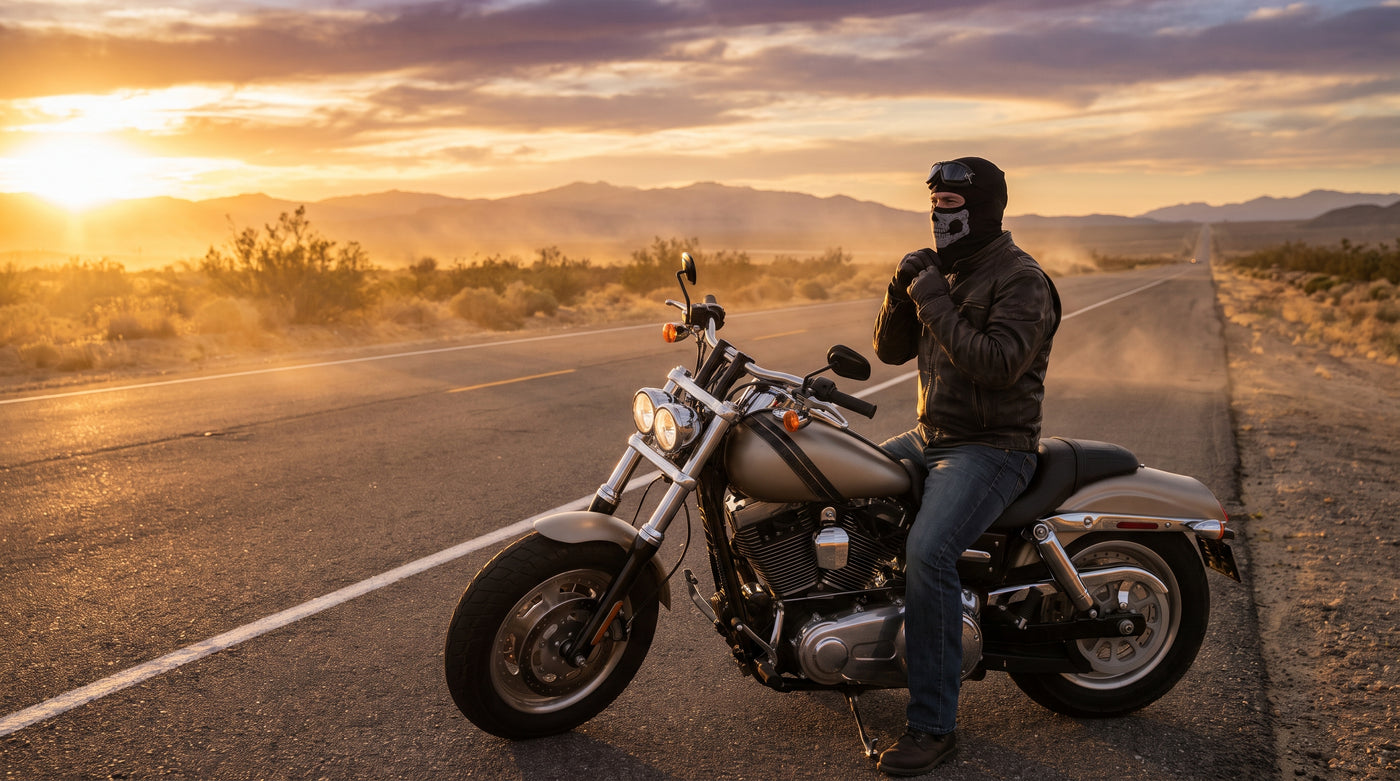
You pull onto the highway, click into fifth gear, and within two minutes your eyes are watering, your cheeks are numb, and a june bug just hit your chin at 65 mph. A skull balaclava fixes all three problems while looking better than a plain black tube. But most riders grab the cheapest one on Amazon, and it fogs their visor, bunches under the helmet, or falls apart after a single wash.
This guide breaks down fabric types, fit under a helmet, full-face versus half-coverage styles, and the specific skull balaclava designs worth buying in 2026. By the end you will know exactly what to look for and what to skip.
Why Riders Wear a Skull Balaclava (Beyond the Look)
At 60 mph, wind pushes against your face with roughly 25 pounds of force. That constant pressure dries out your eyes, cracks your lips and turns a two-hour cruise into an endurance event. A balaclava blocks all of it.
The skull design part is cultural. Skull imagery in biker culture traces back to WWII bomber crews who painted skulls on leather flight jackets. Riders picked up the tradition in the 1950s and it stuck. Wearing a skull balaclava nods to that history, and it beats a plain solid-color alternative every time.
The practical case is just as strong. A good balaclava keeps bugs out of your mouth, shields your neck from UV rays, and slows down how fast your helmet liner absorbs sweat. Without one, your helmet padding soaks up moisture directly and starts smelling within weeks. If you already run a full face motorcycle helmet, a thin balaclava underneath adds comfort without adding bulk.
There is also a practical cost argument. Replacing a helmet liner costs $30 to $50 depending on the brand. A balaclava that absorbs the sweat instead of your liner extends that liner's usable life by months. At $12 to $18 for a decent skull balaclava, the math works out fast.
Fabric Breakdown: Polyester, Microfiber and Neoprene
The fabric determines comfort, breathability and how long the print holds up. Here is what you are choosing between.
Polyester is the most common material. It dries fast, weighs almost nothing and holds sublimation prints well. Most skull balaclavas priced under $15 are 100% polyester. The downside: thin polyester can pill after 20 to 30 washes and offers minimal insulation in cold weather.
Microfiber is finer-denier polyester, woven tighter. It feels softer against skin and wicks moisture slightly better than standard poly. Brands like SA Company use microfiber for their tube-style masks. Expect to pay $2 to $5 more than basic polyester for a noticeable comfort upgrade.
Neoprene is the warmest option. Neoprene skull balaclavas run 2 to 3mm thick, which blocks wind completely but traps heat fast. They work well below 50 degrees F but become unbearable in summer. Neoprene also adds enough bulk to change how your helmet fits, so try one on with your helmet before committing.
| Fabric | Weight | Best Season | Breathability | Print Durability |
|---|---|---|---|---|
| Polyester | Light (1-2 oz) | Spring / Summer / Fall | High | Good (sublimation) |
| Microfiber | Light-Medium | Year-round | High | Very good |
| Neoprene | Heavy (3-5 oz) | Winter only | Low | N/A (solid colors) |
How a Skull Balaclava Should Fit Under Your Helmet
A balaclava that bunches at the jawline creates pressure points that turn painful after 30 minutes. One that is too loose slides around and pulls the skull print off-center, which defeats the purpose.
The right fit is snug against your skin without compressing your cheeks. Breathing holes (the nose and mouth cutout) should line up cleanly so you are not inhaling fabric. A thin polyester balaclava adds roughly 1mm to your head circumference, which is almost undetectable inside a properly sized helmet. Neoprene adds 2 to 3mm and can turn a comfortable helmet into a tight one.
If your helmet already fits on the snug side, go with a single-layer polyester balaclava. If you have a little room, microfiber gives you better moisture wicking without the bulk penalty. Size your helmet with the balaclava on whenever possible. Most helmet fitment guides assume bare-head measurements, and that extra millimeter matters on long rides.
For riders pairing a balaclava with a novelty or cool motorcycle helmet, check whether the balaclava's neck coverage tucks into your jacket collar. Gaps between balaclava and collar let cold air funnel straight down your chest.
Full Face vs. Half Coverage Skull Balaclavas
Full-face balaclavas wrap your entire head, neck and face in one piece. They offer the most wind and UV protection but can trap warm breath against your visor. If your helmet does not have good ventilation, fogging becomes a real issue on cool mornings.
Half-face styles (sometimes called skull tubes or gaiters) cover from the bridge of your nose down to your neck. They are easier to pull down when you stop for gas, and they never fog a visor because your exhaled air escapes upward freely. Most half-face skull tubes measure about 9 to 10 inches wide when laid flat, which stretches enough to fit heads from 21 to 24 inches in circumference.
If you want full skull artwork across your whole face, go with the full balaclava and pair it with an anti-fog visor insert (Pinlock-style inserts run about $20 and solve the problem). If you mainly ride in warm weather and care more about the jaw and neck art, a half-face skull face mask is the better pick.
Can You Wear a Skull Balaclava in Summer?
Yes, but fabric choice matters more in heat than it does in cold. A thin polyester skull balaclava rated UPF 50+ blocks about 98% of UV rays, which is real protection on a four-hour ride under direct sun. Sunburned necks and ears are common with open-face helmets, and a balaclava solves that without sunscreen reapplication.
For summer, stick with single-layer polyester or microfiber. Avoid anything thicker than 1mm. Look for mesh breathing panels over the mouth area. These panels let cool air flow in while still displaying the skull design across your jaw and cheeks. Some riders wet their balaclava with cold water before putting it on, which drops the perceived face temperature by several degrees through evaporative cooling. That trick works with polyester but not neoprene, since neoprene does not absorb water.
5 Skull Balaclava Styles Worth Wearing
Not every skull print is the same. Some are photorealistic, some are geometric, and some lean into horror or Day of the Dead themes. Here are five styles that hold up on real rides.
| Style | Coverage | Fabric | Best For | Price Range |
|---|---|---|---|---|
| Classic jawbone skull | Full face | Polyester | Highway cruising, cool weather | $12-$18 |
| Half-skull gaiter | Nose to neck | Microfiber | Summer rides, easy on/off | $10-$15 |
| 3D mesh skull | Full face | Poly + mesh panel | Anti-fog, year-round | $15-$22 |
| Neoprene skull mask | Half face | 2mm neoprene | Cold weather below 50 F | $14-$20 |
| Day of the Dead sugar skull | Full face | Microfiber | Rally events, group rides | $13-$20 |
The classic jawbone skull is the best seller for a reason. The design lines up with your actual jaw, which creates a convincing look when the balaclava sits properly. The 3D mesh version solves the fogging problem by adding a breathable panel over the mouth and nose. It costs a few dollars more but saves you from the visor-wipe routine every two miles.
Day of the Dead sugar skull prints work best at rallies and meetups where you want to stand out in a crowd. They tend to use more colors than standard skull designs, so check that the print uses sublimation (dye infused into the fabric) rather than screen printing. Sublimation prints do not crack, peel or fade after washing.
How to Wash a Skull Balaclava Without Ruining the Print
Sweat, sunscreen and road grime build up fast. Washing your balaclava after every two or three rides keeps it from developing a permanent funk. But washing it wrong destroys the print.
Use cold water and a gentle cycle. Machine washing above 140 degrees F can shrink polyester by up to 5%, which throws off the fit and distorts the skull artwork. Skip fabric softener entirely. Softener coats the fibers and kills the moisture-wicking properties that keep your face dry on the road.
Air dry only. Tumble drying creates friction and heat that degrade sublimation prints faster than anything else. Hang it over a doorknob or towel rack and it will be dry in a couple of hours. If you ride with motorcycle helmet covers, the same cold-wash and air-dry rules apply to keep those prints looking clean too.
Screen-printed skull balaclavas (the kind where you can feel the ink sitting on top of the fabric) will crack and flake no matter how carefully you wash them. If you want a print that survives 50 or more washes, buy sublimation-printed only.
5 Common Mistakes When Buying a Skull Balaclava
1. Buying cotton
Cotton absorbs sweat and holds it against your skin. On a hot day, a cotton balaclava turns into a wet towel strapped to your face. It also takes hours to dry. Polyester and microfiber wick moisture away from your skin and dry in minutes.
2. Ignoring helmet fit
A thick balaclava under a tight helmet creates pressure points at the temples and forehead. Those pressure points cause headaches within 30 minutes of riding. Always try on the combo before a long ride.
3. Picking neoprene for summer
Neoprene traps body heat. Wearing a 3mm neoprene skull mask above 70 degrees F turns your face into a sauna. Save neoprene for rides below 50 degrees and use polyester or microfiber the rest of the year.
4. Choosing screen-printed over sublimation
Screen-printed designs sit on top of the fabric and crack after a few washes. Sublimation infuses the dye directly into the polyester fibers, so the skull design becomes part of the fabric itself. The price difference is usually $2 to $3, and the print lasts ten times longer.
5. Buying generic marketplace brands with no reviews
No-name skull balaclavas from random marketplace sellers often use low-grade elastic that loses stretch after a month. The stitching around the eye and mouth openings frays quickly. Stick with brands or shops that specialize in rider gear, where returns and quality control actually exist.
Picking the Right Skull Balaclava
A skull balaclava is one of the cheapest pieces of riding gear you can buy, but a bad one is worse than none at all. Go with sublimation-printed polyester or microfiber for warm weather, and save neoprene for winter-only rides. Make sure it fits snug under your helmet without bunching, and wash it cold to keep the skull artwork intact.
Most riders end up owning two or three balaclavas: a lightweight polyester for summer cruising, a microfiber for spring and fall, and possibly a neoprene for January rides. At $12 to $20 each, rotating between them keeps each one fresher longer and means you always have a clean one ready when the last ride's balaclava is still drying.
If you are shopping for one, the skull balaclava collection has the styles covered in this guide. All sublimation-printed, all built for under-helmet use.


No comments yet. Be the first rider to weigh in.