
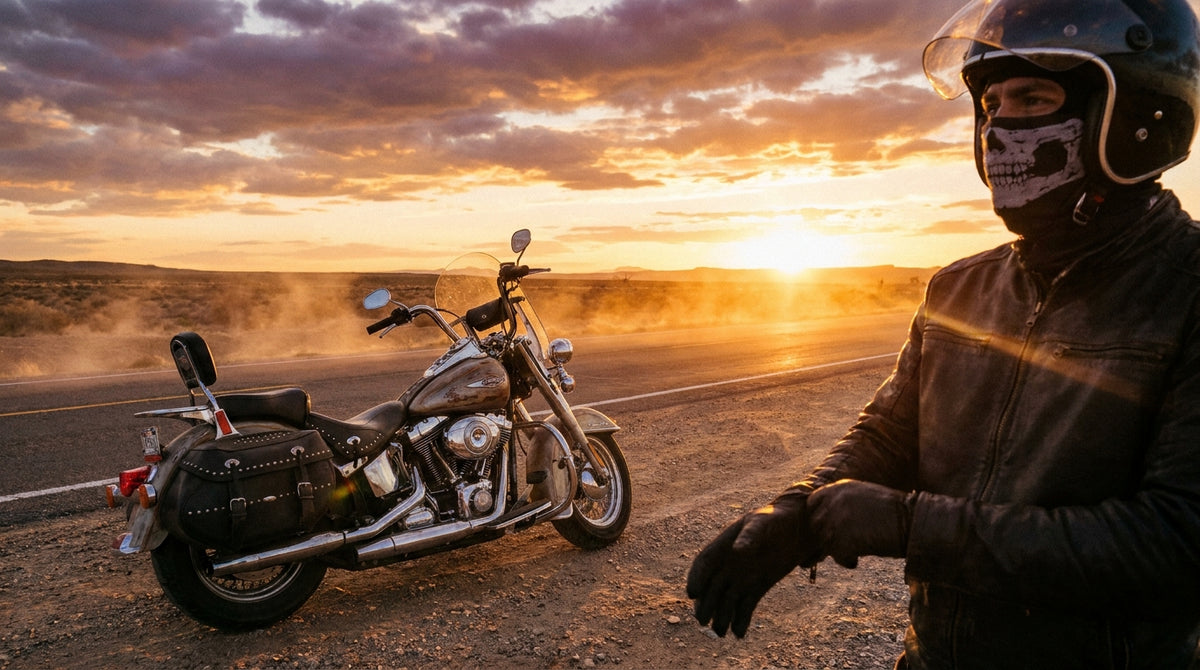
Most riders buy the wrong skull mask on the first try, and it is not a taste problem. It is a build problem. Search skull balaclava mask and you get three completely different pieces of gear on one results page: a thin full head balaclava, a thick neoprene half face mask, and a seamless tube. Pull a full face helmet over the wrong one and the fabric bunches at your cheekbones until you stop at the next gas station to tear it off.
This guide sorts the three builds, shows the one fit test that tells you in ten seconds whether a mask will work under your lid, and walks through 10 skull masks that are live right now with real prices. There is also a price trap worth knowing before you shop: in our own range the mask with the least coverage costs the most.
What a skull balaclava mask actually is
A balaclava covers your whole head. One piece of stretch fabric goes over the skull, down past the jaw and onto the neck, with an opening cut for the eyes or the full face. A skull balaclava is that same garment with a skeleton print across the front, so the jaw of the print lines up with your jaw and you get the ghost rider look without adding a second layer.
That matters because the other two things people call a skull mask are not balaclavas at all. A neoprene half face mask covers your nose, mouth and chin only, hooks behind the ears or around the head, and leaves your scalp bare. A tube mask is a seamless cylinder with no shaped eye hole, which you push up over the nose and down over the neck.
Same four words in the search bar. Three different purchases.
The three builds side by side
| Build | Covers | Full face helmet | ALR price |
|---|---|---|---|
| Full balaclava | Head, ears, face, neck | Yes, designed for it | $24.95 |
| Neoprene half face | Nose, mouth, chin | No, too thick at the cheek pads | $63.95 |
| Seamless tube | Neck plus nose if pulled up | Workable, slips down at speed | $17.95 |
Read the right hand column twice. Coverage goes down as the price goes up, which is the opposite of what you would guess.
1. The full coverage pick: Skull Balaclava Full Face Mask, $24.95
This is the one to buy if you ride in a full face or modular helmet. It is a thin stretch print that shields head, face and neck in a single layer, so there is no seam stack under the cheek pads. It comes in 15 styles, and all 15 are in stock today, which almost never happens across a print range this wide.
One quirk worth knowing before you order: the styles are named Style 1 A through H and Style 2 A through G rather than by colour, so you have to look at the photos. Eight designs sit in the Style 1 family and seven in Style 2.

2 and 3. The price trap: the $63.95 neoprene skull masks
Here is the finding that surprises most shoppers. The Neoprene Half Face Skull Riding Mask runs $63.95 in Grey and Black, Sky Blue and Black, or Red and Black. The Neoprene Full Face GR Riding Mask is the same $63.95 in Neo Green and Black, Black and Blue, or Black and Grey. Both cost more than twice the $24.95 full balaclava that covers more of you.
Neoprene is the reason. It is the thick closed cell rubber used in wetsuits, and it prices nothing like printed stretch jersey. You are paying for a windproof panel that holds its shape, not for extra fabric.
So when is it worth it? Open face and half helmet riders in cold wind. Neoprene blocks air in a way thin print never will, and with no shell wrapping your cheeks there is nothing for the thickness to fight. In a full face helmet it is the wrong tool.


4. The budget skull face mask: USA Flag Skull Motley Tube, $17.95
At $17.95 this is the cheapest way into the look, and it is the most versatile piece on the list because it has no shaped eye opening. One seamless polyester tube works as a face mask, a neck scarf, a headband or a beanie, which is four jobs from one purchase. The print is anti UV treated so it does not wash out after a summer of direct sun.
The trade is sealing. With nothing cut for your eyes, a tube will not sit tight under goggles, and it creeps down off the nose above highway speed. One size only, so there is no sizing decision to get wrong.

5. The open face answer: Half Face Dual Color Biker Mask, $17.95
A simple soft half face cover at 9.4 by 9.8 inches, in Red, Blue or Black. It does the single job an open face rider needs, which is keeping cold air, grit and bugs off the lower face, and it does it for a third of what the neoprene version costs. No skeleton print here, so pair it with a skull half helmet if the look is the point.

6. The statement piece: Leather Face Mask with Punk Rivets, $34.95
Rows of metal rivets across black leather, covering the lower half of the face. It is built for open face helmets, half helmets and goggles, which is exactly where it belongs, and it comes in Black only. This is a meet and bar night piece more than a 400 mile piece. Leather does not breathe like jersey, and rivets plus a full face shell is a scratched visor waiting to happen.

7. The one piece that does everything: Cotton Skull Bandana, $19.45
A cotton square with more than 30 skull and biker designs, priced at $19.45. Tie it as a classic bandana, lay it flat as a head wrap under the helmet, pull it up as a light dust balaclava, or fold it into a headband. Cotton beats synthetic for soaking up sweat on a hot day, and it is the only item here you can knot to adjust the tension yourself.

8, 9 and 10. Cold weather and hot weather layers
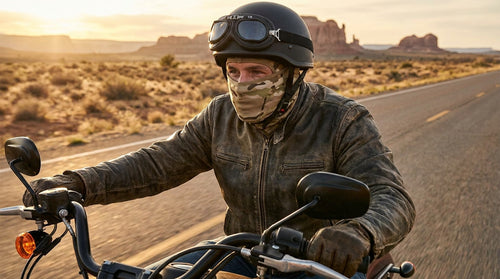
A skull print balaclava is a three season piece. Below roughly 45F you want fleece, and above 85F you want something that moves air.
The ALR Winter Thermal Fleece Balaclava at $22.95 is the cold end. Polar fleece, windproof cut, and worth ordering soon because Gray is already sold out while Black and Black 01 are still live. For summer, the Black MultiCam Balaclava at $22.95 uses breathable nylon instead of fleece, so air keeps moving under the shell. The ALR Outdoor Balaclava at $24.49 sits in the middle with nine styles in stock and is the all season default if you only buy one.


Skull face mask vs skull ski mask vs skull balaclava
These three phrases get searched as if they were three products, and they are mostly one. A skull ski mask and a skull balaclava are the same garment. Ski catalogues say ski mask, motorcycle catalogues say balaclava, and the only real difference is fabric weight, because a ski version is usually cut heavier for standing still on a chairlift. A skull face mask is the loosest term of the three and gets used for half face masks, tubes and balaclavas alike.
Practical takeaway: when you shop, ignore the noun and read the coverage line. If a listing does not tell you whether it covers the scalp, it is not telling you what you are buying. Our skull ski mask guide goes deeper on the fabric weights, and the camo balaclava roundup covers the same builds in pattern instead of print.
The ten second fit test for a full face helmet
Do this before you ride anywhere, at home, over a sink.
- Pull the balaclava on and smooth it flat across the forehead and cheeks with both palms.
- Put the helmet on normally. Do not stretch the cheek pads apart to make room.
- Open and close your jaw five times as if you are chewing.
- Reach in at the chin bar and feel for a ridge of folded fabric at either cheekbone.
A ridge means the mask is too thick or too long for that shell. Thin print balaclavas pass this test. Neoprene almost never does. The chewing step matters because the fold usually appears from jaw movement after a few miles, not the moment the helmet goes on, and that delay is why so many riders think the mask was fine in the mirror.
Is a skull balaclava mask DOT approved?
No, and no face mask is. The Department of Transportation standard FMVSS 218 rates helmets, not masks, liners or balaclavas, so any listing claiming a DOT approved face mask is selling you a certification that does not exist for that category. You can read the standard scope at NHTSA.
What a mask does affect is how your rated helmet fits. Add enough thickness between your head and the EPS liner and you change the fit that the rating assumes, which is the real safety argument for a thin balaclava over a bulky one. Legality is a separate question and varies by state, so check your own rules on face coverings while operating a vehicle.
A real skull balaclava mask vs the marketplace knockoff
The gap is not the print, it is the three things you cannot see in a photo.
- Seam placement. A riding balaclava puts its seams at the back of the head. A repurposed costume mask puts them along the cheek, which is precisely where the helmet pad presses.
- Print method. Sublimated print sits in the fibre and survives wash cycles. Surface printing cracks along the jaw line where the fabric flexes most.
- Stated coverage. A real listing names what it covers and how it layers. A knockoff shows a model and says nothing, because saying nothing is how it avoids returns.
Heat, sweat and vibration undo cheap seams and cheap print in that order. Buy once from a seller that tells you the build, and the $24.95 piece outlasts three $9 ones.
Five mistakes riders keep making
- Buying neoprene for a full face helmet. The $63.95 half face is excellent gear in the wrong shell. It fails because closed cell rubber cannot compress where the cheek pads need it to.
- Judging fit without moving the jaw. The fold forms from chewing and talking. A static mirror check misses it every time.
- Treating a tube as a winter mask. A single layer of polyester at $17.95 has no wind resistance. At 50 mph in 40F air it moves cold straight through.
- Wearing fleece in July. Polar fleece traps heat by design. Under a helmet in summer it turns into a sweat sponge against your forehead.
- Ignoring the eye opening shape. If you ride in goggles, a tube with no cut opening will not seal, and you get a cold draft line right across the cheekbones.
Which one should you buy
Full face or modular helmet, any season: the $24.95 skull balaclava, 15 styles live. Open face or half helmet in cold wind: the $63.95 neoprene, and the half face version if you want to feel air on your scalp. Tight budget or you want one piece that also works as a scarf and a beanie: the $17.95 tube. Hot climate: the $22.95 breathable nylon camo. Deep winter: the $22.95 fleece, in Black while it lasts.
If you are shopping now, the skull mask collection is where I would start, and the wider balaclava range covers the same builds without the skeleton print. Buy for the helmet you actually ride in, run the chewing test the day it arrives, and you will not be tearing a skull balaclava mask off at a gas station in January.
No comments yet. Be the first rider to weigh in.