
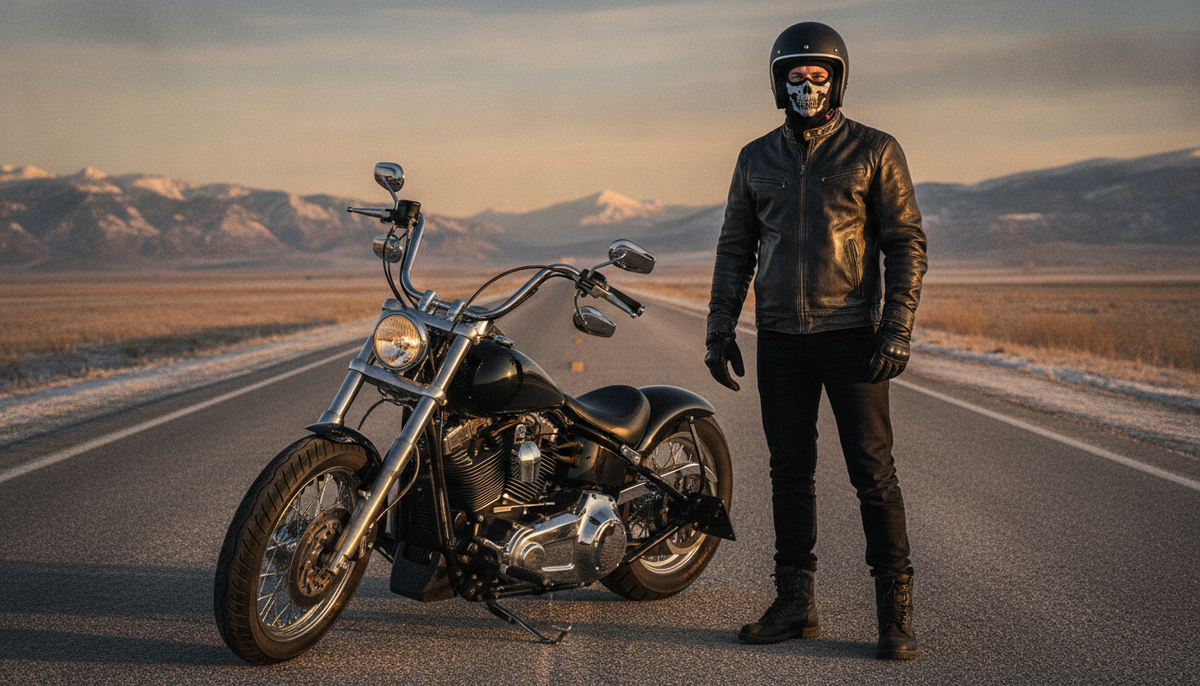
Thirty miles into a 38 degree morning, cold stops being a nuisance and becomes a safety problem. Your jaw clenches. Your eyes water behind the shield. You stop scanning mirrors because every thought you have is about your face. A skull ski mask costs less than a tank of premium and fixes that completely, as long as you buy the right one.
Buy the wrong one and you get a soaked rag under your helmet by the second exit, or a fabric bridge across your nose that funnels every breath straight onto your visor. This guide covers what separates a skull ski mask that works at 70 mph from one that fails in ten minutes: fabric by season, how to size it to your helmet, the real difference between a skeleton print and a skull print, and the specific styles riders keep going back to.
Skull Ski Mask vs Balaclava: Is There Actually a Difference?
Not really. Ski mask is the American retail word. Balaclava is the technical and military word. Both describe the same thing: a stretch hood that covers your head, ears, neck and most of your face. If a listing says one and a rider says the other, they are talking about the same garment.
What does matter is the opening. Three broad cuts exist, and only two of them belong under a helmet.
- Three-hole cut (separate eye holes plus a mouth hole). Built for standing still on a ski lift. It puts a strip of fabric across the bridge of your nose, which is exactly where your visor or goggle needs to seal. That strip lifts the seal and routes warm breath up onto the shield. Fog, every time.
- Open eye port (one wide horizontal opening). The rider's cut. Nothing crosses the nose bridge, so the visor seats flat and breath vents down and out.
- Half face or tube. Covers nose down, leaves the skull exposed. Best in mild weather or under an open face helmet where you still want the skull graphic visible.
The reason riders need more coverage than skiers comes down to speed. At 40 degrees ambient and 60 mph, the National Weather Service wind chill works out to roughly 25 degrees on exposed skin. A skier standing in 40 degree air feels 40 degrees. You are riding in a different climate than the thermometer says you are.
Fabric Decides Everything: Match the Mask to the Season
Most riders own one mask and then complain that it fails half the year. It is not a bad mask. It is one fabric asked to do four seasons of work. Fabric weight is the single biggest variable in whether a skull ski mask works on a given ride.
| Fabric | Best range | What it does well | Where it fails |
|---|---|---|---|
| Lycra / spandex blend | 60 to 85°F | Thin enough to act as a true helmet liner, wicks and dries fast | No warmth at all below 50°F |
| Ice silk / cooling knit | 75 to 100°F | UV coverage on long summer slabs, feels cool on contact | Zero insulation, thin at highway wind |
| Polyester tube | 55 to 85°F | Reconfigures into a neck gaiter, bandana or half mask | Slides down at speed if worn loose |
| Microfleece | 35 to 55°F | Real warmth for shoulder season commutes | Adds bulk a snug helmet will not forgive |
| Thermal fleece with windproof panel | Below 40°F | Stops wind penetration, not just cold air | Heaviest option, fogs visors if worn too high on the nose |
Here is the number that catches people out. Microfleece adds roughly 2 to 3 mm of loft at each cheek pad. In a helmet that already fits correctly snug, that is enough to feel a full size small after 45 minutes, and pressure on the temples turns into a headache you will blame on the helmet. If you ride below 40 degrees regularly, size your winter mask and your helmet together, or keep a thin lycra liner for the rest of the year. The full balaclava lineup is split along exactly these fabric lines.

7 Skull Ski Mask Styles Riders Actually Wear
These are the working categories, not a ranking. Pick by the temperature you actually ride in most often, then add a second one for the other end of the year.
1. The classic skull print full face
The one people picture when they say skull ski mask. Full head coverage, open eye port, printed jaw and teeth across the lower face. It reads as intentional at a stoplight instead of looking like you are hiding, which is the practical reason riders prefer a printed mask over a plain black one in traffic. Works as a three-season mask in a mid-weight knit.

2. Windproof winter thermal
Thermal lining plus a wind-blocking face panel. This is the only category that genuinely handles sub-40 riding, because the failure below 40 degrees is not cold air sitting on fabric, it is 60 mph air pushing straight through it. A plain fleece mask stops feeling warm the moment you merge onto the highway.

3. Breathable summer lycra liner
Thin lycra that disappears under the helmet. Two jobs: it wicks sweat off your forehead before it reaches your eyes, and it keeps your helmet liner from absorbing that sweat all season. A mask is far easier to wash than a helmet. Riders who commute year round usually own two of these and rotate them.

4. Cooling neck gaiter in ice silk
For 90 degree days when a full mask is unbearable but sunburn on the neck is worse. Ice silk knits feel cool against the skin and add UV coverage on the part of you that gets the most direct sun on a long slab ride: the back of the neck, right under the helmet edge. Not a warmth product at all.

5. Camo fleece
Winter warmth without the flat-black tactical look. Same fleece behavior as any other winter mask, which means the same bulk warning applies. Popular with riders who also hunt or ride dual sport and want one mask that covers both.

6. MultiCam black tactical
Full coverage with a clean pattern and no graphic. If your helmet already carries loud artwork, a busy skull print underneath fights it. This is the option that finishes the look instead of competing with it.

7. Skull tube and half mask
The most versatile shape you can own. A polyester tube wears as a neck gaiter, a pirate wrap, a half face mask or a headband, and it packs down to nothing in a jacket pocket. ALR's half face biker mask measures 9.4 by 9.8 inches flat, which is enough material to cover nose to collarbone without bunching. Ideal under an open face or half helmet where the skull is meant to be seen. More options sit in the motorcycle face mask collection.

How to Size a Skull Ski Mask for a Motorcycle Helmet
Almost every skull ski mask sells as one size. That is honest for most heads and misleading for the rest. A typical stretch one-size mask fits head circumferences of roughly 21 to 24 inches measured around the brow, which covers hat sizes up to about 7 5/8.
If you measure past 24 inches, the fix is fabric choice rather than a bigger label. Lycra and spandex blends keep stretching. Fleece runs out of give and starts pulling the eye port down over your line of sight, which is the real complaint behind most "ski mask for big heads" searches.
Four fit checks worth doing before your first real ride:
- Eye port position. Put the helmet on over the mask, then look. The port should sit clear of your eyebrows. If the mask tugs the port down when you turn your head, it is too small.
- Nose line. The top edge of the face panel belongs at or just below the tip of your nose. Higher than that and every exhale goes up your visor.
- Ear seams. If you run helmet speakers, check that no seam lands directly on the speaker pocket. A seam under a speaker becomes a hot spot in about an hour.
- Neck skirt. Tuck it inside the jacket collar. Outside the collar it becomes a funnel that routes cold air down your chest, which defeats the entire purpose.
For a deeper breakdown of fit and material, our guide to skull balaclava fit and fabric goes further on sizing.
Skeleton Ski Mask vs Skull Print: Not the Same Thing
Riders use these interchangeably and then get surprised by what shows up.
- Skull print puts the graphic on the front face panel only. Viewed from behind, it reads as a plain mask. Most full face riding masks are built this way because the back of your head is inside a helmet anyway.
- Skeleton print wraps the artwork around the whole head, including the cranium and the back. It only pays off with an open face or half helmet, where people actually see the back of your head.
The detail that decides how long either one lasts is the printing method. Sublimated dye printing bonds ink into the fibers, so the graphic stretches with the fabric and survives repeated washing. Screen printing sits a layer of ink on top, and that layer cracks along every stretch line, usually across the jaw first. Once a screen-printed jaw starts flaking, it does not recover.
This is also where cheap marketplace masks fall down. A no-name skull ski mask is almost always screen printed on thin single-jersey polyester, so it looks right in the listing photo and looks wrong after four washes. American Legend Rider stocks sublimated prints on rider-weight knits for one structural reason: the graphic and the fabric stretch together instead of fighting each other. A budget mask is fine for occasional use, but it is a consumable, not a keeper.

5 Mistakes That Ruin a Skull Ski Mask
- Buying the three-hole ski lift cut. The nose bridge strip lifts your visor seal and sends warm breath onto the inside of the shield. You will spend the ride cracking the visor to clear fog, which lets in the cold you bought the mask to stop.
- Wearing fleece under a correctly fitted helmet. Two to three millimeters per cheek pad does not sound like much until minute 45, when the pressure across your temples turns into a headache. Either size up the helmet for winter or switch to a thin windproof panel instead of full fleece.
- Choosing cotton. Cotton holds sweat instead of moving it, and wet cotton against skin at 60 mph pulls heat out of you faster than no mask at all. It is the one fabric that makes you colder the harder you work.
- Leaving the neck skirt outside the jacket. An untucked skirt scoops air at speed and pushes it down your chest. Tuck it in and the same mask suddenly feels two fabric grades warmer.
- Hot washing and machine drying. Heat destroys elastane. One hot cycle can take a mask from snug to loose permanently, and a loose mask slides down your nose at highway speed. Cold wash, hang dry, and it will outlast the bike.
What to Actually Buy
If you ride in one climate, buy one mask matched to it. If you ride through a real winter and a real summer, buy two: a thin lycra liner for the warm half of the year and a windproof thermal for the cold half. That pair covers roughly 35 to 95 degrees and costs less than most single pieces of riding gear.
Look for the open eye port, a sublimated print rather than a screen print, and a neck long enough to tuck. Skip anything that specifies three separate holes, and skip cotton entirely. If you are shopping for a skull ski mask right now, the skull mask collection is where I would start. It covers the seasonal fabrics side by side.


No comments yet. Be the first rider to weigh in.