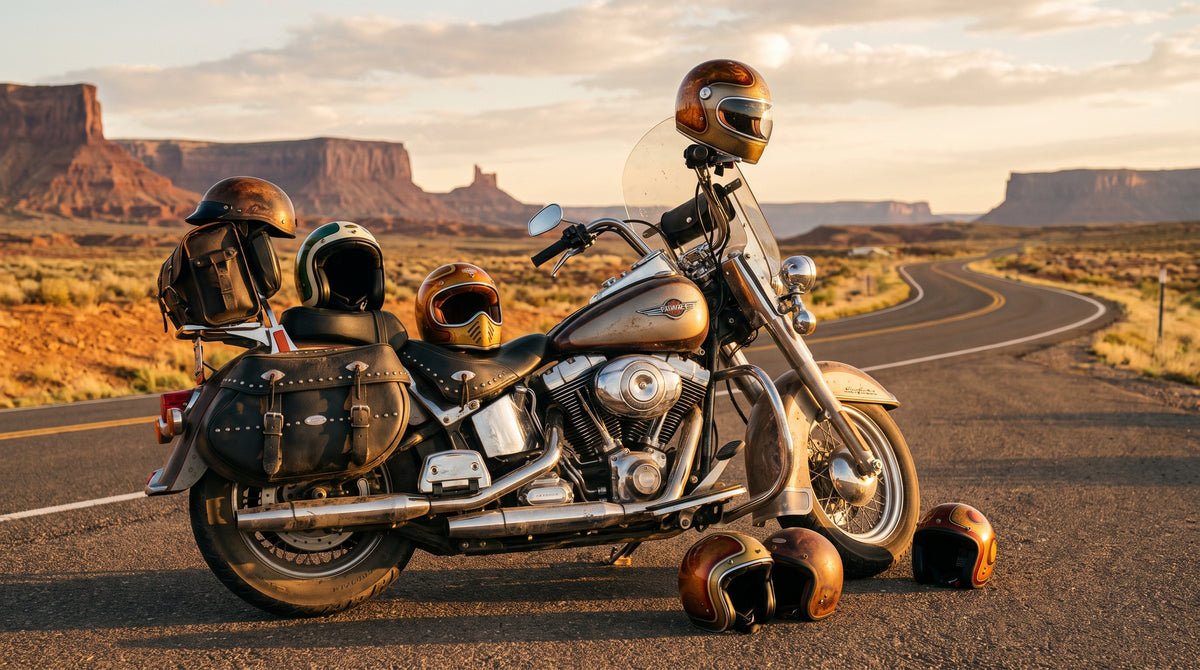
Most motorcycle helmets are shaped for sport bike riders. The aerodynamics assume a forward lean, a tucked chin, and wind coming from straight ahead. Then you throw a leg over a Road King, sit bolt-upright at 70 mph, and realize your helmet is fighting you the whole way. Cruiser riders deal with wind, noise, and comfort problems that sport-focused helmets were never designed to solve.
This guide covers the best Harley helmets across every major style: half shells, German-style lids, skull designs, and full face options. Every pick here is DOT-certified and built for the upright riding position that Harleys and cruisers demand. Whether you ride a Softail, a Street Glide, or a Sportster, you will find a lid that fits the bike and fits your head.
Why Cruiser Riders Need a Different Helmet
Riding position changes everything about how a helmet performs. On a Harley Fat Boy or Road King, your torso sits vertical and your chest catches the full blast of highway wind. A helmet designed for a sport bike tuck creates neck strain at cruiser speeds because the aerodynamic shape channels airflow the wrong way when you are sitting upright.
Weight matters more than most riders think. A Shoei RF-1400 weighs 3.4 lbs, which is fine for a 30-minute canyon carve. But on a 350-mile rally day, every extra ounce grinds on your neck muscles. The best cruiser helmets run lighter. Many DOT half shells come in at 1.5 to 2.2 lbs, and some German-style lids weigh under 2 lbs.
Style is the third factor. Nobody wants a fluorescent sport lid sitting on top of a blacked-out Softail. Harley riders tend toward matte black finishes, low-profile shells, and designs that complement chrome and leather rather than clash with it. The good news: you do not have to sacrifice safety for style. Every helmet below carries a DOT FMVSS 218 certification.
Half Shell Helmets: The Classic Harley Look
The half shell (also called a beanie or skull cap helmet) is the most popular choice among Harley riders. It covers the top and back of the head, meets the DOT standard, and leaves your face and ears open for maximum airflow and road awareness.
A quality DOT half shell weighs between 1.5 and 2.2 lbs. The Daytona Skull Cap is one of the best-selling models in this category because it uses a fiberglass composite shell that comes in at just 1.7 lbs. It also sits low on the head without the mushroom-top look that cheap expanded polystyrene liners create. The low profile matters: riders who have tried a bulky half shell know how much it catches the wind at speed.
The trade-off is straightforward. Less coverage means less protection in a crash. Half shells guard against skull fractures and road rash on the crown, but they leave the face, jaw, and ears exposed. For warm-weather cruising, rally runs, and shorter rides around town, a half shell gives you legal protection without the bulk or heat buildup.

German-Style Helmets: Old-School Meets DOT
The German-style helmet (sometimes called the Wehrmacht style) has been a cruiser and chopper staple since the 1970s custom bike scene. The flat, low-profile design sits tight to the skull, adds almost no visual bulk, and carries an unmistakable old-school silhouette that pairs perfectly with ape hangers and forward controls.
Here is the critical detail most riders miss: many German-style helmets sold online are NOT DOT-certified. If the helmet does not have a permanent DOT sticker molded or riveted to the back shell, it is a novelty item. Novelty helmets use thin foam that will not absorb impact energy in a crash. A real DOT German-style helmet uses a thicker EPS (expanded polystyrene) liner, which makes the shell slightly taller than the paper-thin novelty versions, but that extra half-inch is what actually saves your head.
When shopping, look for the letters "DOT FMVSS No. 218" on a sticker that cannot be peeled off. Some sellers put a removable sticker on a novelty shell just to make the sale. If you can peel it off with your fingernail, walk away. For real DOT options, check our German motorcycle helmet guide for tested picks.

Skull Design Helmets: Standing Out on the Highway
Skull motorcycle helmets sit at the crossover between safety and self-expression. A matte black shell with a hand-painted skull graphic or 3D-molded jawbone turns an ordinary DOT lid into a conversation starter at every gas stop and rally parking lot.
The two most popular formats are full face skull helmets (where the entire shell is shaped or painted like a skull) and half-shell skull caps with skull graphics on the sides or back panel. Full face skull helmets from manufacturers like WCL and 1Storm typically weigh around 3.2 lbs and carry DOT certification. The skull helmet collection at ALR covers both styles.
One thing to watch: some 3D skull helmets use heavy resin add-ons to create protruding jaw features or horns. That extra weight shifts the helmet's center of gravity forward, which creates neck fatigue at highway speeds. The helmet slowly pulls your chin down over a long ride. Painted or vinyl-wrapped skull designs avoid this problem entirely while looking just as aggressive. If you do go with a 3D design, check the listed weight and make sure it stays under 3.5 lbs.

Full Face Options That Do Not Kill the Cruiser Vibe
Full face helmets offer the most protection of any style. The chin bar guards against jaw fractures, which account for 19.4% of all motorcycle helmet impacts according to the Hurt Report from USC. That single statistic is why a lot of experienced riders switch to full face after their first close call.
The problem for Harley riders has always been the look and feel. A high-vis Arai sport helmet on a Heritage Classic looks wrong. It also performs wrong, because sport helmet aerodynamics create turbulence and buffeting when your head is upright instead of tucked behind a windscreen.
Cruiser-friendly full face helmets solve both problems. The Bell Qualifier DLX weighs 3.3 lbs and uses a rounder, more neutral shell shape that handles upright wind without pulling your head sideways. The flat black finish blends with any cruiser. Modular (flip-up) helmets are another strong option: you get full face protection on the highway, then flip the chin bar up at a traffic light or parking lot so you can talk, drink water, or just breathe.
If you commute on the highway daily, the noise reduction alone makes a full face worth considering. Wind noise at 65 mph on a Harley with a half shell can exceed 100 dB, which causes permanent hearing damage over time. A full face drops that by 10 to 15 dB. Pair it with foam ear plugs and you can ride all day without the ringing.

How to Size a Harley Helmet the Right Way
A helmet that does not fit right is a helmet that will not protect you. Worse, it will be uncomfortable enough that you stop wearing it. Sizing is the single most common reason riders end up with a helmet they hate.
Grab a soft tape measure (or a piece of string and a ruler). Wrap it around your head about one inch above your eyebrows, across the widest part of the back of your skull. That number is your head circumference. A 22-inch measurement is typically a size Medium in most brands, 23 inches is a Large, and 23.5 inches is an XL. But every brand runs slightly different, so always check the specific size chart.
The helmet should feel snug when new. Not painful, not pinching, but firm enough that it does not shift when you shake your head side to side. Liner foam compresses 15 to 20% in the first few weeks of wear, so a helmet that feels "just right" in the store will be loose on the road within a month. Start snug. It breaks in.
For half shells and German-style lids, pay attention to how far the helmet sits on your head. It should cover the top of your forehead down to about one inch above your eyebrows. If it rides up and exposes your forehead, it is too small or the wrong shape for your head.
Harley Helmet Styles Compared
| Style | Weight | Protection | Wind Noise | Best For |
|---|---|---|---|---|
| Half Shell | 1.5 - 2.2 lbs | Crown only | High | Warm weather, short rides, rallies |
| German-Style | 1.8 - 2.4 lbs | Crown + rear | High | Custom bikes, old-school style |
| Skull Design | 2.0 - 3.5 lbs | Varies by type | Medium-High | Rallies, custom builds, self-expression |
| Full Face | 3.0 - 3.6 lbs | Full coverage | Low | Highway commuting, touring, cold weather |
5 Mistakes Harley Riders Make When Buying a Helmet
1. Buying a novelty helmet thinking it is DOT. This is the most dangerous mistake. Novelty helmets look identical to real DOT lids from the outside, but they use thin decorative foam instead of impact-absorbing EPS. In a crash, they crack like an eggshell. Always verify the permanent DOT sticker on the back.
2. Picking a sport helmet and fighting wind buffeting. A Shoei or Arai sport helmet works brilliantly at 150 mph on a track with your chin on the tank. At 65 mph sitting upright on a bagger, the aerodynamic shape catches wind like a sail and yanks your head around. Get a helmet designed for the riding position you actually use.
3. Ignoring weight on long rides. That extra pound does not feel like much in a store. After 200 miles on the interstate, it feels like a bowling ball hanging off your neck. If you ride long distances, weight should be near the top of your priority list.
4. Buying too large because "it feels comfortable." A new helmet should feel snug, almost tight. The cheek pads and liner compress within the first few weeks. A helmet that feels perfect in the store will be sloppy on your head after a month. When in doubt, size down.
5. Skipping hearing protection. No helmet, not even a full face, blocks all wind noise at highway speeds. Foam ear plugs cost $3 for a 10-pack and can prevent permanent hearing damage. Riders who skip them end up with tinnitus after a few years of highway miles. It is the cheapest safety gear you will ever buy.
Picking the Right Harley Helmet for Your Riding Style
Every Harley rider has a different priority. If you ride short distances in warm weather, a DOT half shell is hard to beat for comfort and simplicity. If you are into the custom chopper scene, a German-style helmet matches the build. Skull designs work for riders who want their helmet to be part of the look, not just a legal requirement.
For daily highway commuters and touring riders who log serious miles, a full face or modular helmet pays for itself in comfort, noise reduction, and protection. The style trade-off is real, but modern cruiser-oriented full face helmets have closed the gap.
Whatever style you choose, the non-negotiables are the same: real DOT certification, proper fit, and a weight you can live with on your longest ride day. If you are ready to shop, ALR's helmet collection has DOT-certified options across every style covered here.



No comments yet. Be the first rider to weigh in.