
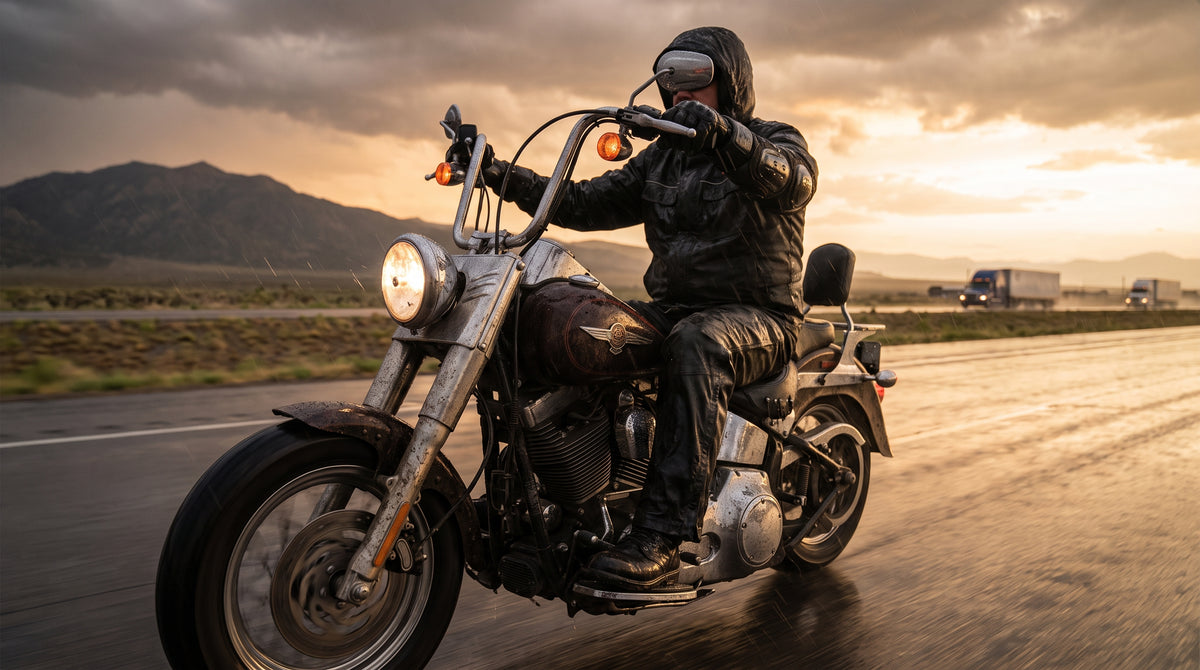
You are 40 miles from home, the sky cracks open, and inside your gloves your fingers go from warm to soaked in about 90 seconds. Every rider knows that feeling. Cotton-lined touring gloves that felt great on a dry June morning turn into cold, slippery rags the moment real rain hits. The problem is not that you got caught in a storm. The problem is the gloves.
This guide covers what makes waterproof motorcycle gloves actually waterproof, which membrane technologies hold up after 10,000 miles, and which styles work best for touring, commuting, and cold weather riding. No filler. Just what keeps your hands dry on the road.
Why Standard Motorcycle Gloves Fail in Rain
Most motorcycle gloves are built to block wind and absorb impact, not repel water. A typical leather touring glove uses 0.8 mm cowhide with a textile liner. Leather by itself is porous. Once water saturates the outer shell (usually within 5 to 10 minutes of steady rain), it wicks straight through to your skin.
Textile gloves with a basic water-resistant coating, often marketed as "water repellent," perform slightly better on the surface. The coating sheds light drizzle. But coatings wear off after washing or extended UV exposure, and they do nothing against sustained downpour. The Motorcycle Safety Foundation notes that wet hands lose roughly 30% of grip strength on brake and clutch levers. That is not just discomfort. It is a safety problem.
The fix is a waterproof membrane sandwiched between the outer shell and the liner. Not a coating. Not a spray. A physical barrier that blocks water molecules while letting sweat vapor escape.

Waterproof Membrane Technologies: Gore-Tex vs Hipora vs OutDry
Three membrane technologies dominate the waterproof motorcycle glove market. Each works differently, and the differences matter when you are choosing gloves for your riding style.
Gore-Tex (ePTFE Membrane)
Gore-Tex uses an expanded polytetrafluoroethylene membrane with roughly 9 billion pores per square inch. Each pore is 20,000 times smaller than a water droplet but 700 times larger than a water vapor molecule. That ratio is what makes it breathable and waterproof at the same time. Brands like Alpinestars and REV'IT use Gore-Tex in their premium touring gloves. Expect to pay $120 to $200 for a well-built Gore-Tex glove. They are the gold standard for multi-season riders who log serious miles in unpredictable weather.
Hipora
Hipora is a polyurethane-based membrane that costs manufacturers about 40% less than Gore-Tex. You will find it in mid-range gloves from brands like Tourmaster and Joe Rocket. Hipora is genuinely waterproof and performs well in moderate rain. Where it falls short compared to Gore-Tex is breathability. On humid days, your hands sweat more inside a Hipora glove. For commuters and weekend riders who hit rain a few times a season, Hipora offers solid protection at a lower price point ($60 to $100).
OutDry (Laminated Construction)
OutDry, used by Columbia and some motorcycle brands, laminates the waterproof membrane directly to the outer shell. There is no gap between layers, so water never gets trapped between the shell and the membrane. The result is a glove that stays lighter in rain because the outer material does not absorb water. The downside: fewer motorcycle-specific options exist, and laminated gloves tend to feel stiffer until broken in.
| Membrane | Waterproof Rating | Breathability | Price Range | Best For |
|---|---|---|---|---|
| Gore-Tex | 28,000 mm | High | $120 - $200 | Touring, all-season |
| Hipora | 10,000 mm | Moderate | $60 - $100 | Commuting, weekend rides |
| OutDry | 20,000 mm | Moderate-High | $80 - $150 | Sport-touring, wet climates |

Best Waterproof Motorcycle Gloves by Riding Style
For Touring and Long Distance
Touring riders need gloves that handle 8 or more hours of mixed weather without becoming a distraction. Look for Gore-Tex or equivalent membranes, a long gauntlet cuff that overlaps your jacket sleeve, and Thinsulate insulation (150g or more) for shoulder-season rides. Knuckle armor should be CE-rated hard shell, not just foam padding. A visor wipe on the left index finger is a small feature that becomes essential at mile 200 in steady rain. Alpinestars Apex V2 Drystar and REV'IT Stratos 3 GTX are two options that hold up on cross-country trips.
For Commuting
City commuters need fast on/off and good lever feel more than heavy insulation. A short-cuff waterproof glove with Hipora membrane, pre-curved fingers, and a secure Velcro closure works well. Shorter cuffs slide under jacket sleeves more easily when you are gearing up at a stoplight. The Held Rain Cloud II is a popular option in this category at around $70. It runs tight, so size up if you are between sizes.
For Cold Weather Rain
Riding in rain below 45F is a different challenge. You need both thermal insulation and waterproofing without making the glove so thick you lose throttle sensitivity. Heated waterproof gloves solve this with battery-powered elements across the back of the hand and fingers. The Gerbing Vanguard runs on a 12V harness or its own rechargeable battery pack (4-hour runtime on medium heat). At $180 to $220, heated gloves are not cheap, but they extend your riding season by two months on either end.

Insulated vs Unlined Waterproof Gloves: When Each Makes Sense
One mistake riders make is buying insulated waterproof gloves for year-round use. On a 75F day, insulated gloves turn your hands into a swamp. On a 35F day, unlined waterproof gloves leave you frozen. Here is how to decide.
- Unlined waterproof gloves work best from roughly 55F to 80F. They keep rain out without trapping excess heat. Look for mesh venting on the back of the hand for additional airflow on warm, humid rides.
- Insulated waterproof gloves (100-200g Thinsulate) work from about 35F to 55F. Below 35F, even insulated textile gloves struggle without heated elements.
- Heated waterproof gloves handle everything below 45F. They are the nuclear option: heavier, more expensive, and battery-dependent, but nothing else keeps your fingers functional in a 38F rain.
Riders who commute year-round often keep two pairs: a light unlined waterproof for spring and summer rain, and an insulated or heated pair for October through March. Two good pairs cost less than one pair of all-season motorcycle gloves that compromises in every temperature range.
How to Check If Your Gloves Are Really Waterproof
Marketing labels can be misleading. "Water-resistant" is not waterproof. "Weather-ready" is not waterproof. Here is how to verify before you buy or after you receive a pair.
- Check the waterproof rating. Look for a hydrostatic head measurement in millimeters. Anything below 5,000 mm is splash-resistant at best. For motorcycle use in real rain (not a light mist), you want 10,000 mm or higher. Gore-Tex gloves typically exceed 28,000 mm.
- Look for sealed seams. Turn the glove inside out. If you can see needle holes along the seams without tape or welding over them, water will find its way through. Quality waterproof gloves use heat-sealed or taped seams.
- Do the sink test at home. Fill a sink with water, put the glove on, submerge your hand to the wrist, and hold for 60 seconds. If you feel moisture inside, return them. A truly waterproof glove stays dry for well over a minute of full submersion.
- Check the gauntlet seal. Water enters through the cuff as often as through the membrane. A snug gauntlet with an adjustable cinch strap prevents rain from running down your forearm into the glove.
If you already own leather motorcycle gloves that are not waterproof, you can treat them with a beeswax-based waterproofing compound like Sno-Seal. This buys you 30 to 60 minutes of light rain protection, but it is not a substitute for a membrane glove in sustained wet conditions.

5 Mistakes Riders Make with Waterproof Motorcycle Gloves
- Buying oversized gloves for "comfort." A waterproof glove that is too loose lets rain pool in the fingertips and reduces lever control. Fit should be snug with fingers reaching the end of each finger stall without bunching. Most brands publish hand circumference charts accurate to the centimeter.
- Machine washing membrane gloves. Agitation and detergent break down waterproof membranes fast. Hand-wash with a mild soap, rinse thoroughly, and air dry away from direct heat. Never use a tumble dryer.
- Ignoring cuff length. Short-cuff gloves worn OVER jacket sleeves create a gap where water pours in. If you ride short-cuff, tuck the cuff UNDER your jacket sleeve so water runs over the jacket and off, not into your glove.
- Expecting leather to stay waterproof. Even treated leather absorbs water over time. Leather waterproof gloves rely on the internal membrane, not the hide. Once the leather shell is soaked, the glove gets heavier and takes hours to dry. If weight matters, go with a textile shell.
- Riding with worn-out DWR coatings. The Durable Water Repellent (DWR) coating on the outer shell makes water bead and roll off. After 20 to 30 washes or a season of UV exposure, DWR fades. Re-apply it with a spray-on product like Nikwax TX.Direct every 6 months, or water will soak the outer shell and make the glove feel clammy even though the membrane still works.
What to Pair with Your Waterproof Gloves
Dry hands only help if the rest of you is dry too. A cold weather motorcycle face mask keeps rain off your neck and chin. Waterproof boots with sealed zippers prevent the other major wet-weather complaint: soaked feet. And if you are riding in sub-50F rain, a full protective gear setup with a rain jacket or dedicated rain suit over your leather keeps everything underneath dry.
The point of waterproof gear is not comfort alone. Wet, cold hands cramp. Cramped hands squeeze levers harder than they should. That delay, even a quarter-second on a clutch pull or brake grab, matters at highway speed in reduced visibility. Waterproof gloves are safety gear.
If you are looking for a solid pair to start with, the motorcycle gloves collection has options built for real riding conditions. Pick the pair that matches your climate and your commute, and keep a second pair in your saddlebag for the rides where the forecast lies.


No comments yet. Be the first rider to weigh in.