
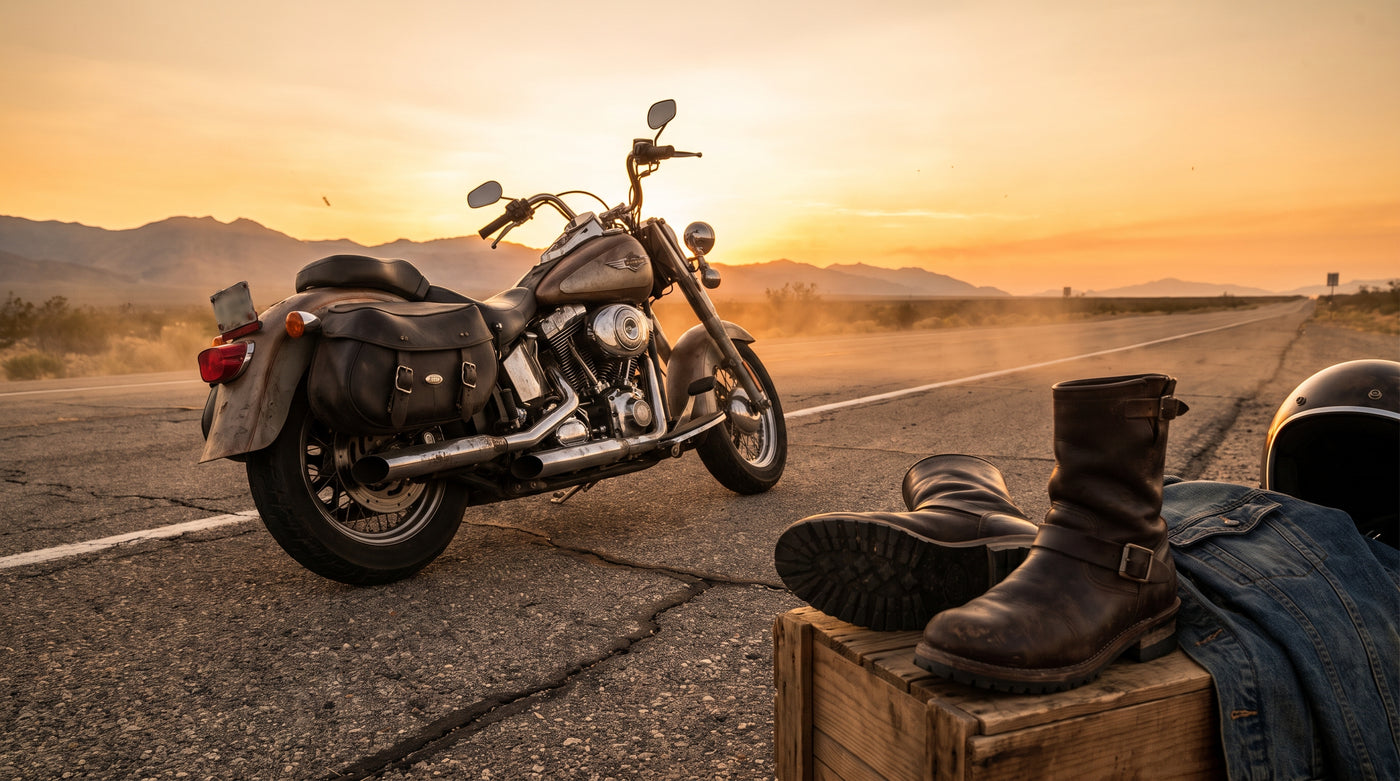
You walk into a dealer, try on a pair of motorcycle boots, pace around the showroom for two minutes, and decide they fit. Forty-five minutes into a highway ride, your pinky toes go numb and the balls of your feet burn. The boots aren't too small. They're too narrow. Standard D-width boots squeeze wide feet on every ride, and sizing up just makes the heel slip.
This guide breaks down motorcycle boots for wide feet. You'll learn how width sizing works (D vs. EE vs. 4E), what features actually matter for a roomy fit, and which boot styles give wide feet enough space without losing ankle support or shifting on the pegs.
Why Most Motorcycle Boots Don't Fit Wide Feet
The majority of motorcycle boots ship in D width. That's the default for men's footwear in the U.S. A size 10D measures roughly 4.1 inches across the ball of the foot. If your foot measures 4.4 inches or wider at the ball, a D-width boot will compress your forefoot from the first mile.
European brands tend to run even narrower. Sidi, Gaerne, and most Italian-made race boots are cut on slimmer lasts that fit great on a narrow foot but create pressure points on a wide one. The reinforced ankle cups and thick leather panels in moto boots don't stretch the way a canvas sneaker does. What feels snug in the store becomes painful at highway speed, when your foot swells slightly from heat and vibration.
The fix isn't buying a size up. Going from a 10 to an 11 adds length (about 1/3 of an inch) but barely changes the width. Your toes get extra room at the front while the heel sits loose, which causes blisters and makes shifting sloppy. The real solution: buy the correct width.
How Motorcycle Boot Width Sizing Works
Boot width uses a letter system. Each step up adds roughly 3/16 to 1/4 inch across the ball of the foot. Here's how the sizes break down for a men's size 10:
| Width | Letter | Ball Width (Size 10) | Who It Fits |
|---|---|---|---|
| Standard | D | ~4.1 in | Average-width feet |
| Wide | E / EE (2E) | ~4.3–4.5 in | Wide feet, common for riders |
| Extra Wide | EEE (3E) | ~4.6 in | Notably wide feet or high arches |
| Extra-Extra Wide | EEEE (4E) | ~4.8 in | Very wide feet, high-volume forefeet |
Not every boot maker offers all widths. Most motorcycle-specific brands stop at D. Brands with heritage in work boots (Thorogood, Chippewa, Red Wing) are more likely to offer EE and wider, and many of those work-boot styles double as solid riding boots. If you need wide motorcycle boots, looking beyond moto-only brands opens up better options.
What to Look for in Wide Motorcycle Boots
Width sizing matters, but it's not the only thing. These four features determine how a boot actually fits a wide foot:
Toe Box Shape
A round or square toe gives the forefoot more volume than a pointed or snip toe. Traditional biker harness boots with a round toe offer about 15% more forefoot room than a pointed engineer-style toe. If your toes splay naturally, round toe is the move.

Leather vs. Synthetic Upper
Full-grain leather molds to your foot shape over 40 to 60 hours of wear. It's the reason a leather boot that felt tight on day one can fit perfectly by week three. Synthetic uppers keep their factory shape permanently. For wide feet, real leather is a clear advantage.
Lacing vs. Harness vs. Zipper
Lace-up boots give the most adjustability. You can loosen the lower eyelets across the instep while keeping the ankle snug. Harness and pull-on styles are faster to get on, but they offer zero width adjustment. Side-zip boots split the difference. If your instep is high on top of being wide, a lace-up boot with speed hooks is the most forgiving design.

Insole and Arch Support
Wide feet often come with lower arches. A removable insole lets you swap in a wider, flat-profile insert. Boots with non-removable insoles lock you into whatever the factory provided.
Best Wide Motorcycle Boots by Riding Style
Different riding styles need different boot features. Here's what to look for based on how you ride, along with brands that offer wide motorcycle boots in each category:
| Riding Style | Boot Type | Width Options | Key Feature |
|---|---|---|---|
| Cruiser / Harley | Harness or engineer | D, EE, some 4E | Oil-tanned leather, round toe, Goodyear welt |
| Touring | Tall lace-up or zip | D, EE | Waterproof liner, arch support, shift pad |
| Sport / Street | Short riding shoe | D, rarely EE | Ankle armor, toe slider, low profile |
| Adventure / Dual-Sport | Tall ADV boot | D, some EE | Shin guard, pivot system, wide toe box |
| Casual / Daily | Low-cut moto sneaker | D, some wide | Hidden armor, walkable sole |
Cruiser and touring riders have the most wide-width options. Sport boots are the hardest to find in wide sizes because the slim, aerodynamic profile is part of the design. If you ride sport and have wide feet, a short riding shoe with a wider last (like the TCX Street 3 Air, which runs a half-size wide) is usually the best compromise.
Wide Toe Box Motorcycle Boots vs. Wide Width
"Wide toe box" and "wide width" sound like the same thing. They're not.
A wide toe box means extra room in the forefoot area only. The heel cup and ankle stay standard-width. This works if your heel and ankle are average-sized but your toes spread wide when you stand. Most traditional harness and Western-style motorcycle boots naturally have a wider toe box because of the rounded toe shape.
A wide width (EE, 4E) means the entire boot is cut wider: forefoot, instep, and sometimes the heel. This is what you need if your whole foot is proportionally wide. Harley-Davidson's FXRG line, for example, runs about half a size wider than their standard models and uses a wider last from heel to toe.
Measure both: stand on a piece of paper, trace your foot, and measure at the widest point of the ball and across the heel. If only the ball is wide, a wide toe box will work. If both measurements are wide, go EE or wider.
Extra Wide Motorcycle Boots for 4E Feet
Finding motorcycle-specific boots in 4E width is tough. Most moto brands don't make them. Here are the realistic options:
- Heritage work boots in 4E: Thorogood's American Heritage line (model 814-4200) comes in 4E widths up to size 15. The 6-inch moc-toe version has a wedge sole that works well on floorboard pegs. No dedicated shift pad, but the leather toe cap handles shifting fine.
- Wide-cut biker boots: Some makers offer boots labeled "wide" that fit closer to 3E or 4E even without the letter rating. Quality leather motorcycle boots with a round toe and pull-on design often accommodate extra-wide feet, especially after a proper break-in period.
- Custom or made-to-order: Companies like Wesco and Nick's Boots will build to your exact foot measurements. These cost $400 to $700, but the fit is perfect. Worth it if you ride daily and nothing off the shelf works.
If 4E boots are the only option that fits you, do not settle for a standard-width boot in a bigger size. A size 12D is not the same as a size 10 4E. The shape is completely different.

5 Mistakes Riders Make Buying Wide Motorcycle Boots
These are the errors that lead to returns, blisters, and sore feet on long rides:
1. Sizing Up Instead of Going Wider
A size 11D gives you more toe length but almost no extra width. Your forefoot still gets squeezed, and now your heel slides. Buy the right length in a wider width instead.
2. Ignoring the Instep
Wide feet often have a high instep (the top of your foot between the ankle and toes). A boot might be wide enough at the ball but crush the top of your foot. Lace-up boots solve this. Pull-on boots don't.
3. Buying Synthetic Uppers
PU leather and textile panels won't stretch or mold. If the boot is tight on day one, it will be tight on day 100. Full-grain cowhide adapts to your foot shape. For wide feet, leather isn't optional.
4. Skipping the Break-In
Even a properly sized wide boot needs 30 to 50 hours of break-in before it feels right. Wear them around the house first. Use leather conditioner to soften the flex points. Don't judge a leather boot on the first ride.
5. Trusting Online Size Charts Alone
Size charts vary by brand, by model, and sometimes by production batch. Read reviews that mention width specifically. A review that says "runs narrow" is worth more than any chart.
Finding the Right Fit
Wide feet don't have to mean painful rides. The right boot in the right width, with a round toe box and real leather, makes a real difference on long trips. Measure your feet, know whether you need a wide toe box or a full EE/4E width, and look for boots built from materials that will mold to your foot over time.
If you're shopping for wide motorcycle boots, the leather motorcycle boots collection has options built with roomy fits and full-grain leather that breaks in properly. For more on boot types and construction, the complete motorcycle boots buying guide covers everything from sole types to protection ratings.



No comments yet. Be the first rider to weigh in.