
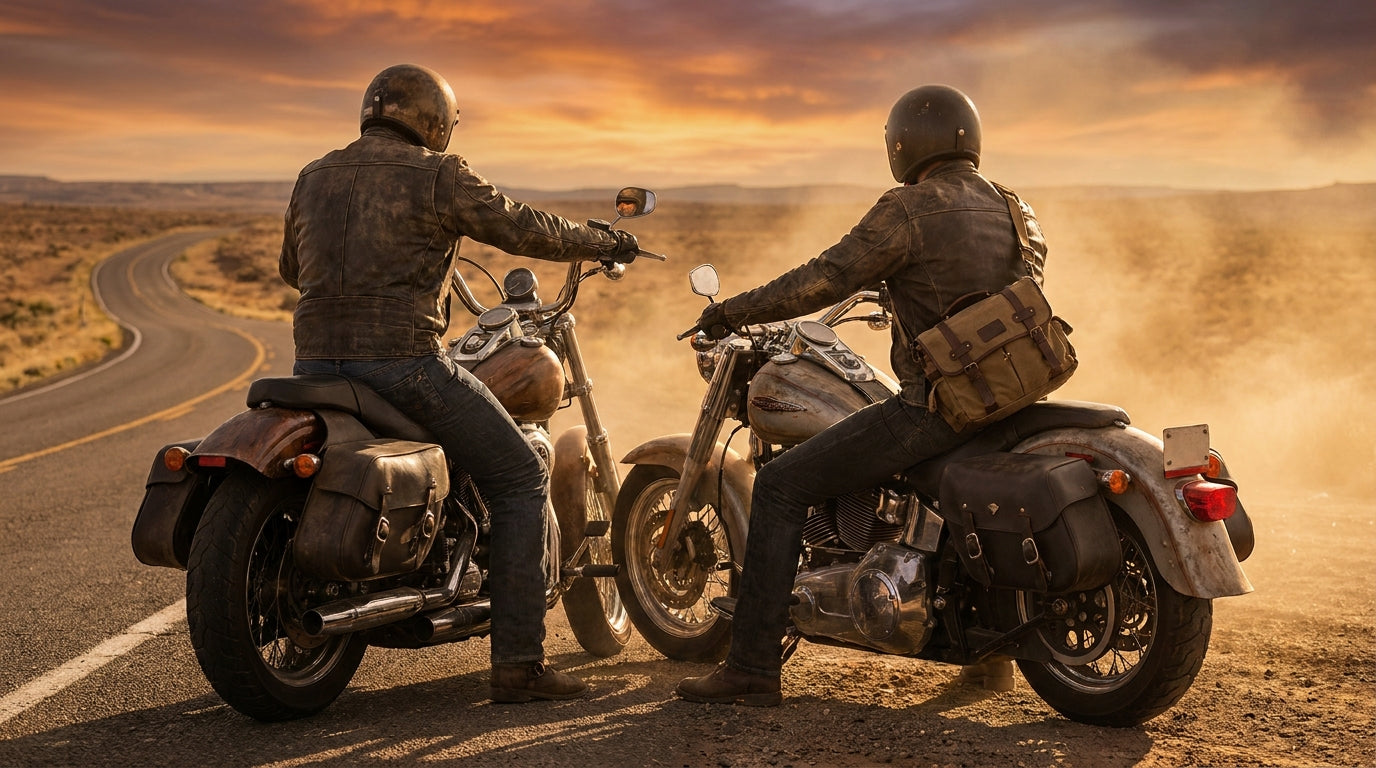
A rider grabs a regular crossbody bag, throws it on, and hits the highway. By 50 mph the bag starts swinging. The strap digs into the neck, the bag body bounces off the hip, and at every lean the whole thing shifts forward toward the gas tank. One hard stop and the bag is hanging by the elbow. A motorcycle crossbody bag is built to prevent all of that, and the difference comes down to three design choices most riders never think about.
This guide covers what separates a motorcycle crossbody bag from a streetwear one, which styles stay put at highway speed, and what materials and strap systems matter. You will know what to look for, what to skip, and which common mistakes waste money before you spend anything.
What Makes a Motorcycle Crossbody Bag Different
A motorcycle crossbody bag and a regular crossbody bag look similar on a shelf. Both have a single strap that crosses the chest and a bag body that sits at the hip or back. The difference shows up at 60 mph.
A standard crossbody bag uses a flat nylon or cotton strap that sits on top of clothing. At highway speed, wind catches the bag body and pushes it forward, backward, or sideways depending on rider position. The strap slides across the jacket, and the bag migrates with every lean. After 20 minutes of riding, the strap has worked its way up the chest and is pressing against the throat.
A motorcycle-specific crossbody bag fixes this with three features. First, a stabilizer strap. This secondary strap clips from the main bag body around the waist or under the opposite arm, locking the bag against the torso. The Kriega Sling WP is one example that uses a wide chest strap plus a hook-and-loop stabilizer wrapping around the waist. The bag stays planted even above 80 mph.
Second, a low-profile bag shape. Motorcycle crossbody bags are usually thinner and wider than regular ones. A typical motorcycle crossbody measures 4 to 6 inches deep, compared to 6 to 10 inches for a regular messenger bag. That shallower profile catches less wind and sits closer to the body.
Third, the strap is wider and padded. A 2-inch padded strap distributes weight better than a 1-inch flat strap. The padding prevents the strap from digging into the collarbone during long rides, and the width keeps it from rolling or folding under a jacket collar.

Motorcycle Crossbody Bag Styles Compared
Not all crossbody bags are the same, and picking the wrong style for your riding position wastes money. Here is how the main types compare.
| Style | Capacity | Best For | Wind Profile | Strap System | Price Range |
|---|---|---|---|---|---|
| Sling Bag | 5-10L | Quick rides, phone/wallet/keys | Low | Single strap + stabilizer | $25-$80 |
| Chest Pack | 3-6L | Sport/adventure riding | Very low | Dual chest straps | $30-$90 |
| Messenger Bag | 10-20L | Commuters, laptop carry | High | Single wide strap | $40-$120 |
| Tactical Crossbody | 5-12L | EDC + riding | Medium | Single strap + MOLLE | $20-$65 |
Sling bags are the most popular motorcycle crossbody style. They swing around from back to front for easy access and sit between the shoulder blades while riding. The compact size means they do not interfere with a backrest or passenger. The motorcycle sling bag guide covers this format in more detail if a compact sling is what you need.
Chest packs mount on the front of the torso using a two-strap chest mount system. Riders who lean forward on sport bikes prefer this setup because the bag sits against the chest instead of hanging off one shoulder. The Kriega chest pocket system uses this format and holds about 3L of gear directly on the sternum. Chest packs also keep your back clear for a hydration bladder in a separate pack.
Messenger bags offer the most cargo space but catch the most wind. If you commute and need to carry a 15-inch laptop, a messenger bag works, but only at city speeds. On the highway, a messenger bag acts like a sail unless it has a stabilizer strap holding it tight to the body.
Tactical crossbody bags use MOLLE webbing on the exterior so riders can attach pouches, tools, or accessories. These are popular with ADV riders who want quick access to a multitool or flashlight without digging through a main compartment. Capacity varies, but most sit in the 5 to 12 liter range.

Materials That Hold Up on the Road
The material of a motorcycle crossbody bag determines how long it lasts and whether your gear stays dry when rain shows up unannounced.
1000D Cordura nylon is the standard for purpose-built motorcycle bags. It resists abrasion from rubbing against riding jackets and does not tear if the bag scrapes pavement in a slide. Cordura's tight weave also provides a base level of water resistance, though it is not fully waterproof without a coating or liner. A Cordura crossbody bag typically lasts 4 to 6 years of regular riding before showing significant wear.
PVC-coated polyester or welded TPU fabric makes a bag fully waterproof. Brands like Kriega and SW-Motech use roll-top closures with welded seams that keep water out completely. These bags survive hours in heavy rain without any moisture reaching the contents. The trade-off is weight. A waterproof crossbody bag typically weighs 30 to 50 percent more than a non-waterproof bag of the same size.
Leather crossbody bags exist in the motorcycle world, mostly in the cruiser and chopper scene. Full-grain leather looks great and ages well, but it is heavy, absorbs water without treatment, and costs more per liter of capacity than any synthetic option. A leather motorcycle crossbody bag from a quality maker runs $80 to $200, while a comparable Cordura bag runs $30 to $80. Leather works for short rides and shows, not for daily all-weather commuting.
Zippers and hardware matter too. YKK zippers are the industry standard for bags that see daily use. Off-brand zippers corrode, jam, and fail at the worst possible moment. Metal buckles outlast plastic ones, but add weight. For a crossbody bag under 10L, the weight difference between metal and plastic hardware is about 2 to 3 oz, which is barely noticeable on the body.
How to Fit a Crossbody Bag for Riding
A crossbody bag that fits well on foot may not fit well on a motorcycle. The riding position changes where the bag sits and how the strap loads against your body.
Start by adjusting the strap so the bag body sits at your lower back, not at your hip. On a motorcycle, hip-level bags swing forward during acceleration and slide backward during braking. A bag positioned at the lower back stays more stable because the rider's body blocks movement in both directions.
Next, tighten the strap more than you would for walking. The bag should sit snug against your body with no gap. If you can fit a fist between the bag and your back, the strap is too loose. At highway speed, any slack allows the bag to oscillate side to side, which adds fatigue to the shoulder over a long ride.
If the bag has a stabilizer strap, use it every time. Riders skip the stabilizer on short trips and regret it the first time they hit a gusty crosswind. A stabilizer strap adds about 5 seconds to putting the bag on and eliminates the bag's lateral movement entirely.
Test the bag while wearing your riding jacket. A bag that fits perfectly over a t-shirt may not fit over a leather jacket with armor inserts. Add the jacket, sit on the bike in riding position, and reach for both controls. If the strap restricts shoulder movement or the bag catches on the seat, adjust or size up. The biker bags comparison guide has a section on matching bag type to jacket style that covers this in detail.
Crossbody vs Other Motorcycle Bag Types
A crossbody bag is one of several carry options for riders. Here is how it stacks up against the alternatives.
| Bag Type | Stays with Rider | Capacity | Wind Drag | Hands-Free Access | Highway Stable |
|---|---|---|---|---|---|
| Crossbody / Sling | Yes | 3-20L | Low-Medium | Yes | Good with stabilizer |
| Tank Bag | No (on bike) | 5-25L | None | No (need to stop) | N/A |
| Saddlebags | No (on bike) | 10-40L each | Low | No | N/A |
| Backpack | Yes | 15-40L | Medium-High | No | Fair |
| Hip / Leg Bag | Yes | 1-4L | Very low | Yes | Excellent |
The biggest advantage of a motorcycle crossbody bag over on-bike storage is that it stays with you. When you park and walk into a gas station or restaurant, your wallet, phone, and keys come along without removing anything from the bike. Saddlebags and tank bags require either taking the entire bag off or pulling items out before leaving the bike unattended.
Compared to a backpack, a crossbody bag is easier to access while stopped at a light. Swing it forward, grab what you need, swing it back. A backpack requires taking it off entirely or awkwardly reaching behind. The trade-off is capacity. Most crossbody bags max out around 10 to 15 liters, while motorcycle backpacks commonly hold 20 to 35 liters.
Hip and leg bags are the smallest on-body option. They carry only the essentials: phone, wallet, key, maybe a pair of sunglasses. If that is all you need, a motorcycle hip bag gives you the least wind drag and the most secure fit of any wearable bag type.

5 Mistakes Riders Make with Motorcycle Crossbody Bags
- Buying a regular crossbody bag instead of a motorcycle-specific one. A fashion crossbody bag uses thin straps, no stabilizer, and lightweight materials that catch wind. It will shift, bounce, and distract you at speed. A bag built for riding uses wider straps, stabilizer clips, and a low-profile shape. The price difference is usually $10 to $20 for a much better riding experience.
- Overloading a small sling bag. A 5-liter sling is designed for a phone, wallet, keys, and maybe a pair of sunglasses. Stuffing a water bottle, charging cables, and a rain jacket turns it into a dense ball that pulls on one shoulder. If you regularly carry more than 5 lbs of gear, size up to a 10L crossbody or switch to a small backpack.
- Wearing the bag on the wrong side. Right-hand-traffic riders should position the bag body on the left side of the torso. This keeps the bag away from the throttle hand and prevents the strap from interfering with right-arm movement. Left-hand-traffic riders should do the opposite.
- Skipping the stabilizer strap on short rides. Wind does not care how far you are going. A 5-mile ride at 55 mph puts the same aerodynamic load on the bag as a 500-mile ride. The stabilizer strap exists because single-strap crossbody bags are inherently unstable at speed. Five seconds to clip it in is worth every ride.
- Ignoring waterproofing until the first rainstorm. Most Cordura and nylon bags are water-resistant but not waterproof. A 30-minute ride in moderate rain soaks through the fabric and reaches your phone and wallet. Either buy a bag with welded seams and a roll-top closure, or carry a $5 dry bag liner inside your crossbody for wet days.
If you are looking for a motorcycle crossbody bag or sling built for real riding, the motorcycle bags collection has options in multiple sizes, from compact slings to full messenger bags.



No comments yet. Be the first rider to weigh in.