
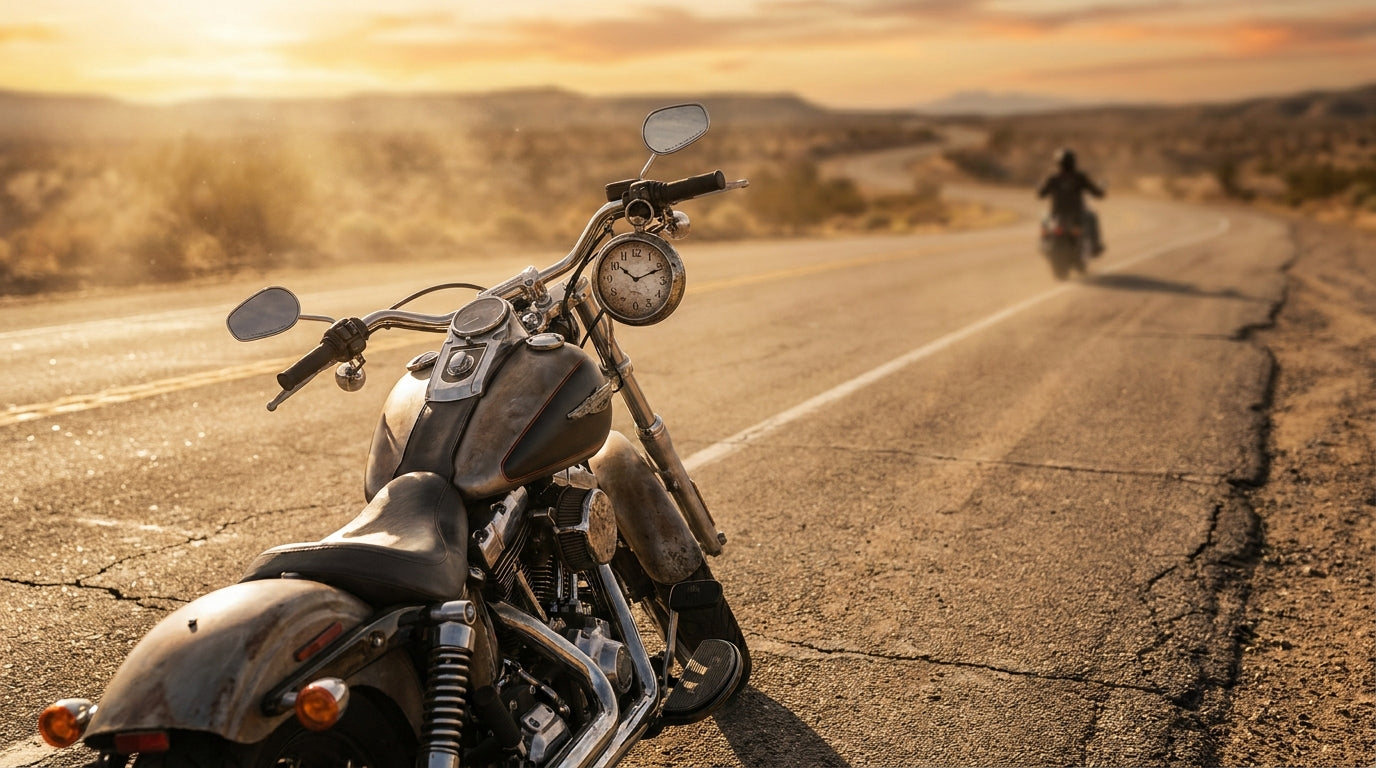
A rider bolts a $9 handlebar clock to their Sportster, rides one weekend in light drizzle, and the face fogs up permanently by Monday morning. The mounting clamp rattles loose on the highway, the clock drifts 15 minutes in a month, and by the second oil change it is sitting in a junk drawer. That clock was not built for a motorcycle. It was built for a bicycle basket.
This guide covers how to pick a motorcycle handlebar clock that actually survives real riding. You will know which mounting systems hold up to engine vibration, which housings keep water out, and which styles fit specific bar diameters from 7/8-inch Japanese standards to 1-1/4-inch Harley apes.
Why a Motorcycle Handlebar Clock Still Makes Sense
Plenty of riders check the time on their phone. That means pulling over, pulling out the phone, opening it, checking, and stowing it again. Others mount their phone on the bars and burn through the GPS battery. A handlebar clock sits in your line of sight all the time, runs on its own button cell or quartz movement, and never needs charging. It costs less than a single phone mount and never drains your bike's electrical system.
Most motorcycle clocks run on a standard SR626SW button cell battery. That one battery lasts roughly 2 to 3 years of continuous operation. Compare that to a phone mount that needs a USB connection or a battery pack on every ride. For riders who just need a quick time check at a red light, a dedicated clock is the simplest tool for the job.
British custom builders and Harley-Davidson riders have used handlebar clocks since the 1970s. The style still fits cruisers, bobbers, and cafe racers where a clean cockpit matters and a phone mount looks out of place.

Types of Motorcycle Handlebar Clocks
Handlebar clocks fall into three categories. Each works differently, fits differently, and fails differently.
Analog Dial Clocks
Analog handlebar clocks use a quartz movement behind a round dial face, usually 1.5 to 2 inches in diameter. The housing is typically chrome-plated zinc alloy or stainless steel. These are the most common style on cruisers and classic builds. Drag Specialties sells a popular 1-7/8 inch chrome analog clock (part number 2212-0726) that mounts directly to 1-inch and 1-1/4-inch handlebars with an included reducer sleeve. The quartz movement is sealed behind an O-ring gasket, and the face is covered with a mineral glass lens rather than acrylic.
The advantage of analog clocks is simplicity. No wiring, no backlight to fail, no digital display to wash out in direct sunlight. The downside: most analog clocks are not illuminated, so reading them at night means waiting for a streetlight.
Digital Clocks
Digital motorcycle clocks use an LCD or LED display and typically run on a CR2032 coin cell. Some models wire into the bike's 12V system for a backlit display. The Koso BA003B00X is a compact digital clock and thermometer combo that measures just 48mm across and mounts to any bar diameter with a universal clamp. Its backlit LCD stays readable in direct sun and at night.
Digital clocks are easier to read at a glance, especially at speed. The tradeoff is that LCD screens can fade or go blank in extreme cold (below about 14 degrees Fahrenheit), and battery-powered models need a cell swap every 12 to 18 months.
Clock and Thermometer Combos
Combo units pack a clock and a temperature gauge into a single housing or a matched pair of mini gauges. The thermometer reads ambient air temperature, which helps riders gauge road surface conditions in shoulder seasons. A sudden 10-degree drop on a mountain pass can mean frost on the pavement. The Pacific Accessory combination clock and thermometer (chrome, 7/8-inch clamp) runs about $18 and shows both readings on separate 1-inch dial faces mounted side by side. These combos answer two questions at once without adding a second clamp or a second hole in your sight line.

How to Mount a Motorcycle Handlebar Clock
Mounting method matters more than the clock itself. A poor mount turns a good clock into a rattling liability.
Clamp mounts are the most common. The clock housing sits in a U-shaped or split clamp that tightens around the handlebar tube with a single bolt. Measure your bar diameter first. Japanese-standard bars are 7/8 inch (22.2mm). Harley and Indian models commonly run 1 inch (25.4mm) or 1-1/4 inch (31.8mm). Fat bars and ape hangers can go up to 1-1/2 inch. Most aftermarket clocks ship with a clamp sized for 7/8 or 1 inch, with a rubber reducer insert for smaller bars. If your bars are 1-1/4 inch, confirm the clamp fits before ordering.
Stem mounts thread into the fork stem nut hole on the top triple clamp. These sit at the center of the bar cluster and do not take up handlebar real estate. The CRG Hindsight makes a stem-mount adapter that accepts small gauge pods, but this style only works on bikes with a standard fork stem cap.
Adhesive mounts use a VHB (very high bond) tape pad on the back of the clock housing. These stick to the top triple clamp or a flat spot on the riser. They hold well in normal conditions but can peel off in sustained heat above 150 degrees Fahrenheit, which a black triple clamp in Arizona sun can reach easily. Adhesive is a backup option, not a primary mount for highway riding.
What Makes a Waterproof Motorcycle Clock Worth Buying
Any motorcycle handlebar clock sits in direct weather. Rain, road spray, morning dew, and the occasional car wash all hit it. A clock rated IP65 or higher resists sustained water jets from any direction. IP67 means it can survive brief submersion. Anything below IP44 will fog up in moderate rain and corrode internally within a season.
The seal points to check are the crown or setting button (if it has one), the battery compartment, and the lens-to-housing joint. Chrome-plated zinc alloy housings resist surface corrosion better than bare aluminum, but the real failure point is always the gasket. A clock with a screw-down caseback and an O-ring seal around the lens will outlast a snap-fit housing by years.
Look for "waterproof" in the product spec, but confirm it lists an actual IP rating. Vague claims like "water-resistant" or "splash-proof" mean nothing measurable. A genuine IP65-rated motorcycle clock from a brand like Drag Specialties or British Customs costs $20 to $35 and holds up for 5+ years of year-round riding.
Motorcycle Handlebar Clocks Compared
| Type | Display | Power | Night Readable | Price Range |
|---|---|---|---|---|
| Analog (chrome) | Dial face | SR626SW cell (2-3 yr) | No (unless lume paint) | $10 to $35 |
| Digital (LCD) | LCD screen | CR2032 cell (12-18 mo) | Backlit models yes | $12 to $40 |
| Clock + Thermometer | Dual dial or split LCD | Button cell or 12V | Varies by model | $15 to $45 |
| Wired (12V backlit) | LED or LCD | Bike's 12V system | Yes (always backlit) | $20 to $50 |
For most cruiser and bobber riders, a chrome analog clock in the $15 to $30 range hits the sweet spot of style, durability, and simplicity. Digital makes sense if you ride at night often or want a temperature readout. Wired 12V models are the best for night riders but require basic wiring work during install.
Harley Handlebar Clock Fitment
Harley-Davidson bars come in several diameters, and picking the wrong clamp size is one of the most common fitment mistakes. Here is what fits what.
Sportster models (Iron 883, Forty-Eight) typically run 1-inch bars. Dyna, Softail, and Touring models often have 1-1/4-inch bars from the factory. Aftermarket ape hangers range from 1-1/4 to 1-1/2 inch depending on the manufacturer. The Kuryakyn 6601 handlebar clock is one of the few specifically designed for 1-1/4-inch Harley bars. It uses a split clamp with rubber inserts and a chrome housing that matches the OEM bar finish.
Measure your bars with calipers before ordering. Do not guess. A 1-inch clamp on a 1-1/4-inch bar will not tighten enough to hold, and a 1-1/4-inch clamp on a 1-inch bar will bottom out and crack the housing when you torque the bolt.
For Harley riders looking at broader accessory options, the biker accessories collection covers everything from bar-end mirrors to handlebar grips. And if you are building out a full custom cockpit, the motorcycle protective gear guide covers the must-have items beyond cosmetics.
4 Mistakes Riders Make with Motorcycle Handlebar Clocks
1. Buying a bicycle clock for a motorcycle. Bicycle handlebar clocks look identical to motorcycle versions in product photos. The difference is inside. Bicycle clocks use thinner housings, no gasket seals, and movements that are not rated for engine vibration. A motorcycle engine at 3,000 RPM produces constant high-frequency vibration that a bicycle clock's quartz oscillator cannot handle. The clock drifts, the crystal cracks, or the crown falls out within weeks. Always confirm the product listing specifies motorcycle use.
2. Over-tightening the clamp bolt. The handlebar clamp bolt only needs enough torque to prevent rotation. Most clamp bolts are M5 or M6 and should be tightened to about 4 to 6 Nm. Over-torquing crushes the rubber insert, dents the handlebar tube, and cracks the zinc alloy clamp casting. Use a small torque wrench or hand-tighten until the clock stops rotating, then add a quarter turn.
3. Ignoring the battery type before buying. Some clocks use SR626SW, others use CR2032, and a few use LR44 or AG13 cells. The battery compartment design determines how easy it is to swap. Clocks with screw-down casebacks allow battery changes without removing the clock from the bar. Snap-fit backs require prying with a tool, which scratches the finish and can break the seal. Check the battery compartment design in product photos before ordering.
4. Mounting the clock where it blocks controls. The handlebar clock needs to be visible at a glance but cannot interfere with the clutch lever pivot, brake perch, or mirror mount. The best position is on the bar between the riser clamp and the left-side controls, angled slightly toward the rider. Test the placement before tightening by gripping the bars and checking your sight line. If you have to tilt your head to read it, the position is wrong.
Picking the Right Motorcycle Clock for Your Ride
Start with your handlebar diameter. Measure it. Then decide whether you want analog or digital, and whether you need a thermometer. For daytime-only cruiser riders, a simple chrome analog clock is all you need. For riders who commute in the dark or ride through temperature swings, a digital combo unit with a backlit display earns its extra $10.
Whichever style you choose, confirm it has an IP65 or better water rating, a clamp that fits your specific bar diameter, and a screw-down caseback for easy battery swaps. Those three details separate a clock that lasts five years from one that lasts five weeks.
If you are building out your bars with accessories, the accessories collection has grips, mirrors, and bar-end gear that pairs well with a clean cockpit setup. For the full rundown on what every rider should have on the bike, the biker clothing guide covers the essentials.


No comments yet. Be the first rider to weigh in.