
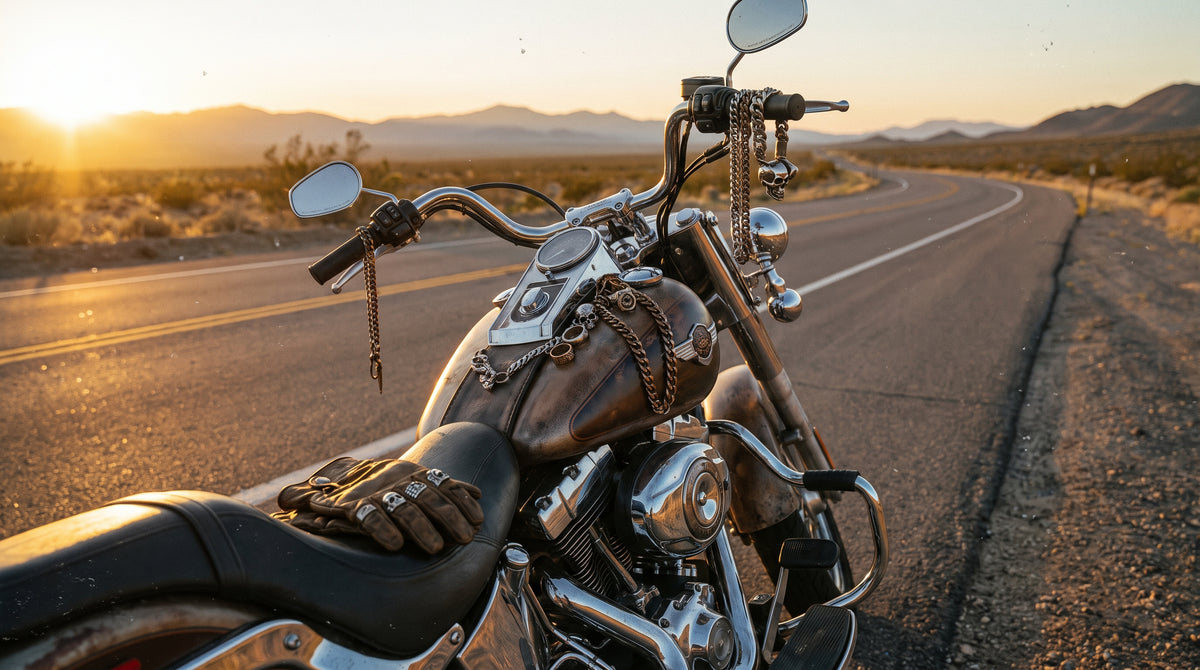
Most riders gear up with a helmet and jacket first. The jewelry shows up later. It usually happens after the first rally where every other rider on the lot has skull rings stacked on both hands, a heavy chain catching light against a black tee, and a bracelet thick enough to anchor a boat. Then you search "motorcycle jewelry" and find page after page of $8 zinc-alloy junk that turns your finger green after two wet rides. Here is how to skip the garbage and buy pieces that actually hold up.
This guide covers every category of motorcycle jewelry worth owning, from rings and chains to bracelets and pendants. You will learn which metals survive road vibration, sweat and rain, how to size a biker ring without guessing, and the specific details that separate real riding jewelry from costume accessories. By the end, you will know exactly what to buy first and what to avoid.
Types of Motorcycle Jewelry Riders Actually Wear
Biker jewelry breaks into five categories: rings, chains and necklaces, bracelets, pendants, and wallet chains. Each one has its own sizing, material and fit considerations.
Rings are where most riders start. A skull ring, Maltese cross band or wrench-motif signet is the single most common piece of biker jewelry in the riding world. Chains and necklaces come next. The standard is a Cuban link or figaro chain in silver-tone or black steel. Bracelets split between chain-link styles and leather wraps. Pendants feature skulls, crosses, daggers or Grim Reaper motifs hanging from a dedicated chain. Wallet chains connect a biker wallet to a belt loop, keeping it locked down at highway speed.
What separates biker jewelry from mainstream men's accessories is weight. A typical 316L stainless steel skull ring weighs 18 to 28 grams. That is roughly three times the weight of a standard wedding band. The heft is part of the point. If a ring feels like a toy from a coin machine, the metal is probably zinc alloy and the finish will not survive a season of real riding. For a closer look at outlaw-style biker jewelry and what the symbols mean, that breakdown covers the cultural side.

Biker Rings: How to Pick One That Lasts 5+ Years
Rings take more punishment than any other piece of riding jewelry. They contact handlebars, controls, gas caps and everything else you touch during a day on the bike. Two factors determine whether a ring survives or falls apart: the metal alloy and the casting quality.
316L surgical stainless steel is the standard for biker rings at the sub-$50 price point. It scores 6.5 on the Mohs hardness scale, resists corrosion from sweat and rain, and never needs polishing. Sterling silver (925 grade) has a richer color and more traditional look, but it scratches faster and tarnishes without regular cleaning. Titanium is lighter and harder than steel, but it costs more and cannot be easily resized.
Avoid anything listed simply as "alloy," "metal" or "fashion steel" without a specific grade number. Those labels almost always mean zinc or pot metal with a thin electroplated chrome layer. That plating chips within weeks of daily wear, especially on the inside of the band where skin contact is constant.
The most popular ring motifs in biker culture are skulls, Maltese crosses, snakes, wrenches and the Ace of Spades. Skull rings dominate rally lots and group rides because they scale well. A small skull signet fits a pinkie ring, while a full sugar-skull statement ring covers two knuckles. Crosses and Iron Crosses have roots in military and outlaw culture but have been adopted broadly across the riding community. If you are building a stack (multiple rings on one hand), mixing motifs and sizes creates a more authentic look than four matching bands.
Sizing matters more than most riders expect. Biker rings run a half to one full size larger than a plain band because the ring face is wider and heavier, which makes the band feel tighter on the finger. Measure your finger with a flexible tape or piece of string, convert to millimeters, and check the brand's size chart. A US size 10 measures 62.1 mm in inner circumference. If you land between sizes, go up. The ALR biker rings collection publishes a chart on every product page, which cuts the guesswork.

Chains and Necklaces: Length, Weight and What Works at Speed
A chain or necklace is the second piece most riders add to the rotation. Two styles dominate: the Cuban link chain worn solo for presence, and the pendant chain designed to carry a hanging motif.
Cuban link chains use interlocking oval links laid flat, creating a tight, uniform look. For the biker aesthetic, 8mm to 12mm width is standard. Anything thinner reads more like a dress chain than riding jewelry. A 24-inch Cuban link in 316L stainless steel weighs between 90 and 130 grams depending on width. That weight sits noticeably on the chest and catches light against a dark shirt or vest.
Pendant chains are thinner, usually 4mm to 6mm, built to carry a skull, cross, dagger or reaper motif. The chain should be strong enough to support the pendant weight without stretching. Box chains and rope chains distribute weight evenly across the link structure, which makes them the best fit for heavy pendants. Figaro chains (alternating long and short links) look good but can kink under a heavy pendant over time.
Length is a safety detail riders overlook. A 22 to 24-inch chain sits at mid-chest and tucks inside a jacket collar without issue. A 28 to 30-inch chain hangs lower, swings in crosswinds, and can catch on a jacket zipper at speed. For riding, shorter is safer. Save the longer chains for off-bike wear. For more detail on the best biker necklaces and chains, that guide goes deeper into specific picks.

Motorcycle Bracelets That Handle Road Vibration
Bracelets sit right next to your gloves, so they need to work with riding gear without pinching, catching or rattling against the controls. Three styles dominate among riders: chain-link bracelets, skull cuff bracelets and leather wraps.
Chain-link bracelets mirror the chain necklace look at the wrist. A standard men's bracelet runs 8 to 9 inches long. The clasp is the weak point. A lobster claw or toggle clasp in the same metal as the links is the minimum you should accept. Cheap bracelets use a spring-ring clasp that can open under vibration. One hard bump on a rough road and the bracelet is gone. At highway speed, you will not even feel it leave your wrist.
Skull cuff bracelets are open-ended bands, usually stainless steel, with skull or skeleton terminals at each end. No clasp means no clasp failure, which makes cuffs the most road-reliable option. The trade-off is fit: a cuff needs to be snug enough that it does not slide over your hand but loose enough to clear the wrist bone. Most quality cuffs flex slightly to allow adjustment.
Leather wrap bracelets use braided or flat leather strips with a snap or magnetic closure. They look the part and weigh almost nothing. The downside: leather absorbs sweat and rain, so the bracelet needs conditioning every couple of months or it stiffens and cracks. For riders in the Pacific Northwest or anywhere with regular rain, steel or the pieces in the ALR biker bracelets collection are the smarter choice.
Motorcycle Jewelry Metals Compared: What Holds Up and What Does Not
This is where most buyers get burned. The metal alloy determines everything: how long the finish lasts, whether the piece corrodes, and whether it irritates your skin. Here is how the common options stack up for motorcycle riders.
| Metal | Durability | Corrosion Resistance | Price Range (Ring) | Best For |
|---|---|---|---|---|
| 316L Stainless Steel | High | Excellent | $15 - $45 | Daily riders, all weather |
| Sterling Silver (925) | Medium | Good (tarnishes) | $40 - $120 | Fair weather, off-bike style |
| Titanium | Very High | Excellent | $30 - $80 | Lightweight preference |
| Zinc Alloy (plated) | Low | Poor | $5 - $15 | Costume, temporary |
| Brass | Medium | Fair (patinas) | $20 - $50 | Vintage look, dry climates |
For motorcycle riders specifically, 316L stainless steel wins on value and durability. It survives rain, sweat, road grime and UV exposure without losing its finish. Sterling silver looks better in photos but needs polishing after every few rides if you want it to stay bright. Zinc alloy should be treated as disposable. If the listing does not specify "316L" or "surgical steel," assume the worst.
4 Mistakes Riders Make Buying Motorcycle Jewelry Online
1. Buying plated zinc alloy without knowing it. Listings that say "high quality metal" or "premium alloy" without naming 316L, 925 silver or titanium are almost certainly zinc with chrome plating. That plating lasts 4 to 8 weeks of daily wear before it chips and reveals dull grey metal underneath. The green skin stain is zinc oxide reacting with sweat. If the price seems too good to be true on a detailed skull ring, the metal is the reason.
2. Ordering the wrong ring size based on a standard band. A biker ring with a 20mm wide face fits completely differently than a 6mm wedding band, even at the same circumference. The wider face restricts blood flow more, which makes the ring feel one size smaller. Always measure for the specific style, not just your general ring size.
3. Wearing long chains with open-collar jackets at speed. A 28-inch chain outside a jacket at 70 mph becomes a pendulum. It whips against your chest, tangles in a zipper pull, or worse, catches on something during a stop. Tuck chains inside your collar or shirt, or switch to a 22-inch length that sits flat against the collarbone.
4. Ignoring clasp quality on bracelets. A $30 chain bracelet with a $0.50 spring-ring clasp is a $30 donation to the highway. The clasp should be the same metal as the chain, and it should lock with a positive click. Lobster claw, toggle or fold-over clasps are worth the slight price increase. If the listing does not specify the clasp type, that is usually a sign the manufacturer cut corners.
Where to Start Building a Riding Jewelry Collection
Start with one piece that fits your riding style and go from there. A single skull or cross ring in 316L stainless steel is the lowest-risk first buy. It is affordable, durable and works with every outfit from a plain tee to a full vest setup. Add a chain or bracelet after you have worn the ring for a few weeks and know you are comfortable with the weight and feel.
If you want to see what other riders are buying, the ALR biker jewelry collection carries rings, chains, bracelets and pendants in 316L steel at prices that do not require much thought. Start with one piece, see how it holds up on the road, and build from there.

No comments yet. Be the first rider to weigh in.