
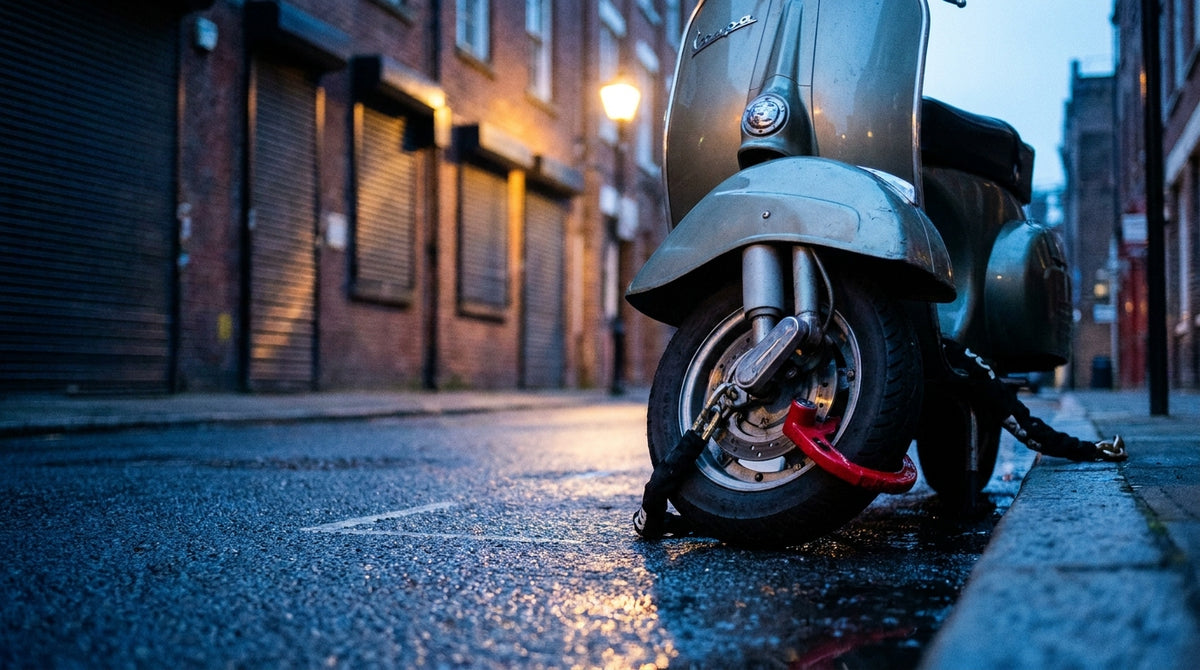
A scooter does not get hot-wired in the street any more. Two people walk up, one grabs the bars, one grabs the rear rack, and the whole bike goes into the back of a van. A 125cc scooter weighs about 265 lbs. Two average adults lift that in a few seconds, and a steering lock does nothing to stop it because the wheels never have to turn.

That is the thing most riders get wrong. Scooter theft protection is not about making the bike harder to ride away. It is about making it harder to pick up, slower to cut free, and louder than a thief is willing to tolerate. This guide walks through the nine layers that do that, which ones are worth the money, and the order to add them in. Every layer here is one I would actually bolt on, with the weak point named so you know what it does not cover.
How scooters actually get stolen
Scooters are the easiest powered two-wheeler to steal for three reasons, and they all come down to size. Wheels are small, usually 10 to 13 inches, so the bike sits low and lifts easily. The frame is light. And the ignition barrel sits exposed on the handlebar stem where a screwdriver and a hammer reach it in seconds.
The three attacks you are defending against:
- The lift. Two people, a van, 30 seconds. No tools, no noise. This is the most common method in cities.
- The grinder. A cordless angle grinder with a 4.5 inch cutting disc goes through a 10mm chain in well under a minute. Cheap grinders cost less than the lock they cut.
- The barrel pop. Forcing the ignition lock to defeat the steering lock, then riding off. Older scooters are especially open to this.
Nothing you buy stops all three. Layering is the whole point.
Layer 1: A disc lock with a built in alarm
This is the cheapest layer that changes thief behaviour, and it is where I would start. A disc lock clamps through a brake rotor hole so the wheel cannot roll. On its own that only stops a ride-away, but add the alarm and it becomes a noise problem for anyone trying to lift the bike.
The alarm version matters more than the lock version. A plain disc lock gets lifted along with the scooter. A 110dB siren going off in a quiet street at 3am gets the job abandoned. For reference, 110dB is about the volume of a chainsaw at arm's length.

Weak point: it is still a wheel lock. It does not attach the scooter to anything. Treat it as the alarm layer, not the anchor layer.
One habit to build with any disc lock: use the bright reminder cable to the bars. Riding off with a disc lock still fitted is the single most expensive mistake in this category, and it usually ends in a bent rotor.
Layer 2: A chain through something that does not move
This is the layer that defeats the lift, and almost nobody does it. Running a chain through the rear wheel only means the thieves lift the bike with the chain attached. The chain has to go around a lamp post, a railing, a ground anchor, or another bike.
Chain thickness is the spec that matters. Look for hardened links of 16mm or more. A 10mm chain is a commuter deterrent and nothing else. For a rating you can trust, check for Sold Secure Gold or Diamond (the UK standard used by most insurers) or an ART 4-star rating from the Dutch scheme. Those tests involve real attack tools on a clock, not a marketing claim.
If you want the full breakdown of chain, disc and U-lock options, our guide to motorcycle locks for 2026 compares them side by side.
Weak point: weight. A 16mm chain long enough to reach a lamp post weighs around 11 lbs. That is a home and workplace lock, not something you carry under the seat every day.
Layer 3: A ground anchor where you park at night
Most scooters are stolen from outside the owner's home, which means the overnight spot is the one worth hardening. A ground anchor is a hardened steel loop bolted into concrete, usually with four M12 expansion bolts or chemical resin anchors.
Fitted properly it turns your chain into a real obstacle, because the thief now has to cut the chain in place with the bike still attached to the floor. That is loud, slow work in a driveway.
Weak point: the install. An anchor bolted into a thin paving slab pulls out with a pry bar. It needs to go into a concrete slab at least 4 inches thick, and the bolt heads should be covered or shear-type so they cannot be undone with a socket.
Layer 4: An alarm loud enough to end the job
A standalone alarm with a remote fob covers the attacks a lock cannot. Vibration triggers fire when someone tilts the bike to lift it, rocks it off the stand, or starts cutting. The useful ones are waterproof, run off their own battery so they survive a cut loom, and sit somewhere a hand cannot reach quickly.

Weak point: alarm fatigue. Set the sensitivity too high and a passing truck sets it off, you stop trusting it, and so do your neighbours. Dial it in over the first week until a firm push triggers it and a passing bus does not.
Layer 5: A tracker you can actually hide
A tracker does not prevent theft. It recovers the bike, and it is the only layer that keeps working after the scooter is already in the van. Two types are worth knowing:
- Hardwired GPS. Wired to the battery, reports position over a SIM, usually a small monthly fee. Best coverage, needs a proper install.
- Battery tags. An Apple AirTag or similar runs about a year on a CR2032 and needs no subscription, but it only reports when another phone in that network passes near it. In a dense city that works well. In a rural barn it does not.
Whichever you pick, the hiding spot decides whether it survives. Under the seat is the first place anyone looks. Inside the front fairing or taped behind a body panel is far better. We covered how well these hold up on small bikes in do GPS trackers work on scooters and mopeds.
Weak point: signal jammers and metal. Professional crews carry jammers and park stolen bikes in a container for a few days to see if anyone comes.
Layer 6: A cover that hides what you own
This is the cheapest layer on the list and the most underrated. A plain cover removes the two things a thief scans for: the model and the condition. A covered scooter on a street of uncovered ones is slower to assess, and slow is the whole game.
Go for a dull colour with no brand logo. A cover with a big manufacturer name printed across it advertises exactly what is underneath. Look for grommets at the bottom edge so the cover itself can be locked to the chain, which stops it being whipped off in a second.

Weak point: it hides the thief too. Someone working under a cover at night is invisible. A cover works best paired with the alarm layer, not instead of it.
Layer 7: Where you park, and which way you face
Parking is free and it beats most hardware. The rules are simple:
- Park against a wall or between two cars so a van cannot pull alongside and drop a ramp.
- Choose a spot under a working light and in view of a camera, then point the scooter so the plate faces the camera.
- Turn the bars to full lock and engage the steering lock every single time, even for five minutes.
- In a parking garage, pick a bay near a manned barrier rather than a dark back corner. Thieves avoid routes where a human watches the exit.
- Vary where you leave it. A scooter in the same unwatched spot every night is a scheduled job.
Layer 8: Lock the throttle and the controls
A throttle or grip lock clamps the right grip to the brake lever so the throttle cannot be twisted and the front brake stays applied. It is a small, light layer that lives under the seat, and on a scooter it is genuinely useful because it blocks the casual ride-away that the barrel pop enables.

Weak point: it is a two minute obstacle against tools, nothing more. Use it as the everyday layer on quick stops where dragging out a chain is not realistic.
Layer 9: Paperwork that gets the bike back
Recovery depends on being able to prove the scooter is yours after the plates and stickers are gone. Do this once and store it somewhere other than the bike:
- Photograph the VIN plate and the engine number. On most scooters the VIN is stamped on the frame under the floorboard or behind a plastic cover near the steering head.
- Photograph the scooter from four angles, plus any scratch or mark unique to it.
- Register the VIN with your national stolen vehicle database and a marking scheme if one is available.
- Keep the purchase receipt and the key codes in a cloud folder, not in the top box.
If it does go missing, report it to the police the same hour and give them the tracker login immediately. Insurers routinely ask what security was fitted, and a Sold Secure rated lock can lower the premium in the first place.
The nine layers compared
| Layer | Rough cost | Stops | Weak point |
|---|---|---|---|
| Alarmed disc lock | $50 to $70 | Ride-away, quiet lifts | Not attached to anything |
| 16mm chain | $70 to $160 | The van lift | Around 11 lbs to carry |
| Ground anchor | $40 to $90 | Home theft | Only as good as the concrete |
| Standalone alarm | $30 to $60 | Tilt, cutting, tampering | False triggers if oversensitive |
| GPS tracker | $25 to $150 | Nothing, but recovers | Jammers and metal containers |
| Cover | $25 to $50 | Target selection | Hides the thief as well |
| Parking choice | Free | Van access | Needs discipline every night |
| Throttle or grip lock | $15 to $30 | Casual ride-away | Two minutes against tools |
| VIN records | Free | Nothing, but proves ownership | Useless if stored on the bike |
If you are building from zero, the order is alarm disc lock, then chain, then anchor, then tracker. That sequence covers the three attacks in the cheapest possible order.
Five mistakes that undo everything
- Chaining the scooter to itself. A chain through the rear wheel and back to the frame is a handle. Two people lift it just as fast, chain and all. The chain must pass around something fixed.
- Buying a 10mm chain because it is light. Under a cordless grinder a 10mm link is gone in seconds. A thin chain buys you noise and nothing else. If weight is the problem, keep the thin chain for quick stops and a 16mm one at home.
- Letting the chain touch the ground. A chain lying on pavement can be hit with a hammer against the concrete, which is quiet and fast. Keep it tensioned and off the floor.
- Hiding the tracker under the seat. It is the first panel opened and the first thing binned. Put it behind a fairing panel and leave the under-seat space empty.
- Trusting the factory immobiliser alone. An immobiliser stops the engine starting. It does not stop the bike going into a van, which is how most scooters leave.
The same logic applies to bigger bikes, and we went deeper on cutting resistance in our breakdown of what actually stops thieves.
Cheap kit versus gear built to be attacked
Lock buying is where marketplace bargains hurt the most. A no-name cable lock with a padlock-style barrel is often open to a bump key or a cheap pick in under a minute, and no part of it has been tested against a tool.
Budget synthetic gear has a place. For a scooter parked in a locked garage behind a door, a light cable and a cover are reasonable. The moment the bike sleeps outside, the standard changes: hardened steel, a published Sold Secure or ART rating, and a mechanism rated against drilling. That is the structural difference, and it is why American Legend Rider stocks rated hardware rather than the cheapest option on the shelf. A lock is a one-time buy you want to still trust in five years.
Where to start tonight
Pick the layer that matches how your scooter sleeps. Parked on the street in a city, start with the alarmed disc lock and a chain to a fixed point. Parked at home on concrete, fit the ground anchor first and chain to it every night. Either way, add the tracker and photograph the VIN this week, because those two cost almost nothing and they are the only things that work once the bike is already gone.
If you are shopping for the hardware, the locks and chains collection is where I would start. Buy the rated one once rather than two cheap ones in a row.


No comments yet. Be the first rider to weigh in.