
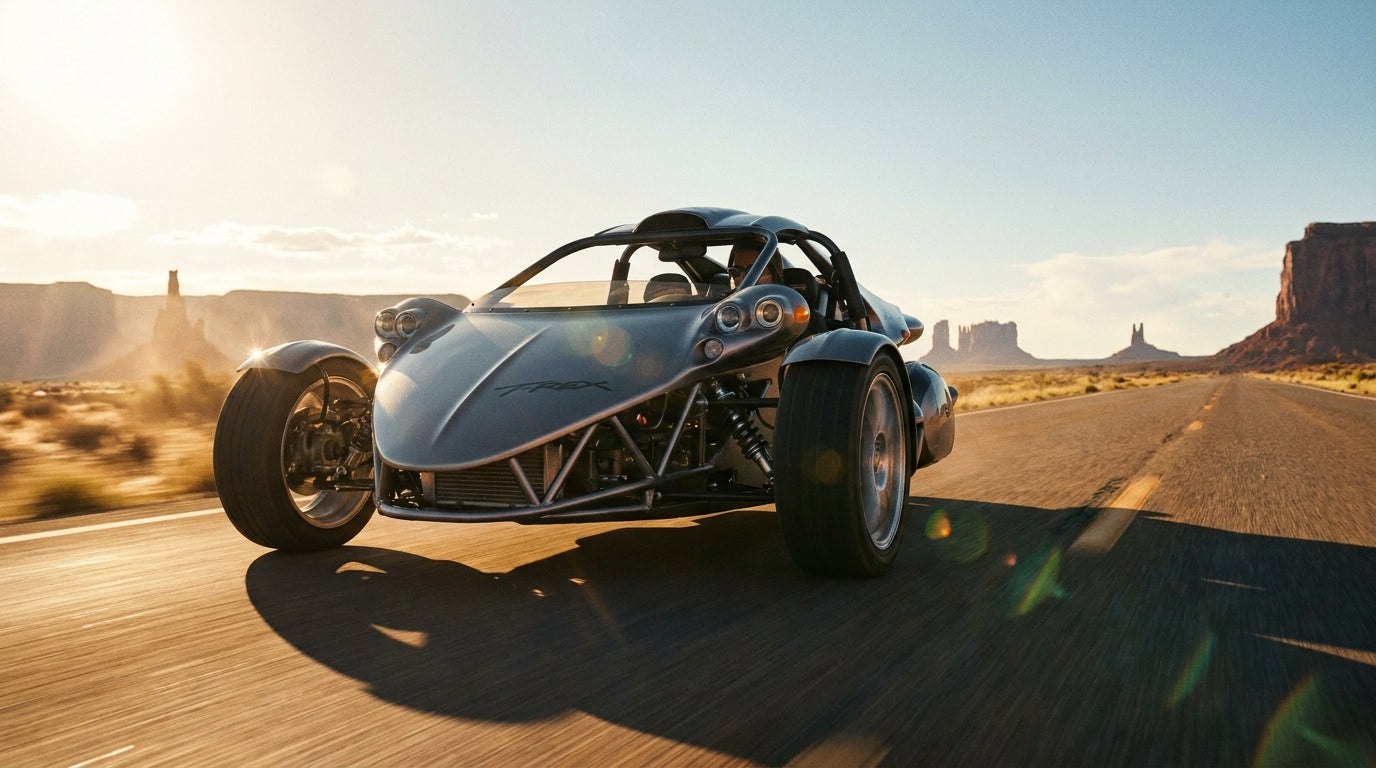
The Campagna T-Rex is the kind of machine that stops traffic in both directions. Three wheels, a BMW inline engine, and a cockpit that sits about four inches off the pavement. If you have been searching for a T-Rex motorcycle for sale, you already know two things: they are not easy to find, and they are not cheap. Production numbers are small, the dealer network is thin, and used inventory moves fast once it hits the market.
This guide covers real T-Rex pricing for both new and used models, where to actually find one, what to inspect before buying, and the ownership costs that most sellers will not mention. Whether you are shopping new from a Campagna dealer or hunting the used market online, this is the information you need before writing a check.
What Is a Campagna T-Rex, Exactly?
The T-Rex is a three-wheeled, two-seat vehicle built by Campagna Motors in Boucherville, Quebec. It has two wheels up front and one in the back, with an exposed tubular steel frame, no roof, no doors, and no windows. Think open-cockpit race car crossed with a sportbike. Campagna has been building them since 1995, but the modern versions from 2012 onward are the ones most buyers chase.
Legally, the T-Rex is classified as a motorcycle in most US states because it has three wheels and weighs under 1,500 lbs. That classification matters for registration, insurance, and licensing. In most states, you need a motorcycle endorsement on your license to ride one. A handful of states classify it as an autocycle, which only requires a standard driver's license.
The T-Rex 16S, which is the current flagship, runs a BMW K1600 inline-6 engine producing roughly 160 horsepower. At around 1,050 lbs curb weight, that works out to about 6.5 lbs per horsepower. For comparison, a Corvette Z06 sits closer to 8.5 lbs per horsepower. The T-Rex reaches 60 mph in approximately 3.9 seconds, and it does that with your back about four inches from the road surface.
The driving experience is nothing like a car and nothing like a bike. You steer with a wheel, shift with a sequential gearbox, and feel every expansion joint through the frame. Wind, rain, bugs, and gravel are all unfiltered. People who love the T-Rex describe it as the closest thing to driving an open-wheel race car on public roads. People who do not love it last about 10 minutes.
T-Rex Motorcycle Models and What They Cost
Campagna has released several T-Rex variants over the years. Here is a breakdown of the main models and their approximate pricing when new. How much is a T-Rex motorcycle? It depends on the generation and trim level.
| Model | Engine | Power | New MSRP (approx.) | Years |
|---|---|---|---|---|
| T-Rex 16S | BMW K1600 inline-6 | ~160 hp | $66,000-$78,000 | 2014-present |
| T-Rex 16SP | BMW K1600 inline-6 | ~160 hp | $72,000-$85,000 | 2017-present |
| T-Rex RR | BMW inline-4 | ~160 hp | $56,000-$65,000 | 2012-2016 |
| T-Rex (early gen) | Kawasaki inline-4 | ~150 hp | $45,000-$55,000 | 2002-2011 |
The 16SP is the premium trim with upgraded suspension, forged wheels, and a custom paint option. The RR was the most popular model before the inline-6 swap and remains in high demand on the used market because of its lower price point and proven BMW four-cylinder drivetrain. Early Kawasaki-powered models are the most affordable entry point but parts availability gets tighter every year.
Used T-Rex Motorcycle for Sale: Where to Look
New T-Rex models are available through a small network of authorized Campagna dealers, mostly concentrated in the eastern US and Canada. But the used market is where most buyers end up, both because of pricing and because new units often have waitlists or sell before they hit the showroom floor.
Here are the best places to find a used T-Rex motorcycle for sale:
- CycleTrader and AutoTrader. Both platforms list three-wheelers. Search "Campagna T-Rex" specifically. Expect 5 to 15 active listings nationwide at any given time, with inventory peaking in spring and early summer.
- Bring a Trailer (BaT). Higher-end and well-documented T-Rex builds show up here regularly. The auction format means prices can swing, but you get detailed inspection photos and buyer protection.
- Facebook owner groups. The Campagna T-Rex Owners group on Facebook is one of the most active communities. Members list their machines there before posting anywhere else. Join the group and set notifications if you are serious.
- Local powersports dealers. Dealers who sell Can-Am Spyders or Polaris Slingshots occasionally take T-Rex units on trade. Call around to three-wheeler dealers in your region.
- Craigslist and eBay. Listings are less frequent, but deals pop up. The T-Rex motorcycle for sale on Craigslist tends to be priced lower because sellers want a fast, local transaction without shipping costs.
Used T-Rex pricing depends on year, mileage, and condition. A 2012-2015 RR with 10,000 to 20,000 miles typically lists between $28,000 and $40,000. A 2016+ 16S with low miles can still command $50,000 or more. Early Kawasaki-powered models from 2002-2011 are the most affordable at $18,000 to $30,000, but mechanical parts for those drivetrains are getting harder to source.
Timing matters. Prices peak in April through June when riding season starts and every buyer is shopping at once. The best deals show up in October through January, when sellers want to clear garage space before winter storage. If you can wait for the off-season, you will save $3,000 to $5,000 on the same machine.
T-Rex Motorcycle Cost Beyond the Sticker Price
The purchase price is just the starting line. Here is what ongoing T-Rex ownership actually costs, and some of these numbers surprise first-time buyers.
- Insurance: Because the T-Rex is classified as a motorcycle in most states, insurance runs cheaper than a performance car. Expect $800 to $1,500 per year for a clean-record rider over 25. Specialty insurers like Hagerty and Grundy offer agreed-value policies that work well for limited-production vehicles.
- Maintenance: The BMW engine follows the standard BMW motorcycle service schedule. Oil changes, valve adjustments, and cooling system service are straightforward for any BMW-trained tech. Budget $500 to $1,000 per year for routine maintenance. The catch: most regular motorcycle shops will not work on the T-Rex chassis, so you need a Campagna dealer or a specialist.
- Tires: The T-Rex uses car tires up front (typically 205/45R16) and a motorcycle tire in the rear. A full set runs $600 to $900 depending on brand. The rear motorcycle tire wears fastest because it handles all the drive force at low vehicle weight.
- Storage: No roof means you need covered, dry storage. UV, rain, and humidity will destroy the exposed wiring harness, seats, and frame finish within one season. If you do not have a garage, factor in $100 to $200 per month for indoor storage.
Total annual ownership cost (excluding the purchase itself) typically runs $2,500 to $4,500 per year. That is comparable to owning a mid-tier motorcycle, not a performance car. The T-Rex cost surprises people on both sides: the sticker is high, but the ongoing costs are reasonable.
What to Check Before Buying a Used T-Rex
The T-Rex is not a mass-production vehicle. Build quality can vary between production years, and previous owners may have done modifications that affect reliability or legality. Here is a pre-purchase checklist specific to the platform.
- Frame and welds. The tubular steel frame is exposed on all sides. Inspect every weld for cracks, especially around the engine mounts and front suspension pickup points. Hairline cracks in the welds are the most expensive problem you can inherit. A cracked engine mount repair runs $2,000+ at a specialist shop.
- Front suspension bushings. The double-wishbone front end takes a beating on rough pavement. Worn bushings cause sloppy steering and uneven tire wear. Grab each front wheel at 12 and 6 o'clock and check for play. Any clunking means the bushings need replacement.
- Clutch engagement. BMW inline-6 models use a cable clutch. If the clutch grabs very high in the lever travel or slips under hard acceleration, a replacement is $1,200 to $1,800 installed.
- Corrosion. An exposed frame and components are vulnerable to road salt and moisture. If the machine spent winters in the northeast or midwest, check the frame tubes, brake lines, and fasteners for rust. Surface rust on the frame is cosmetic. Structural rust in the tubes is a deal-breaker.
- Title and VIN. Verify the VIN matches the title and that the title classifies it as "motorcycle" (not "assembled vehicle" or "kit car"). Some states have titled imported or modified T-Rex units under incorrect categories, which creates registration headaches if you move or resell.
- Electrical system. Check every light, gauge, and switch. The exposed wiring on early models is vulnerable to chafing and water damage. Electrical gremlins from corroded connections are the most common used T-Rex complaint.
Do You Need a Motorcycle License for a T-Rex?
In most US states, yes. The T-Rex is classified as a motorcycle because it has three wheels and weighs under the state threshold (usually 1,500 lbs). That means you need a Class M motorcycle endorsement on your driver's license. The road test in most states can be completed on the T-Rex itself, but it is easier to get the endorsement on a regular two-wheeler first.
A handful of states classify the T-Rex as an "autocycle" because it has a steering wheel rather than handlebars and uses a seatbelt. In those autocycle states, a standard driver's license is enough. States including Michigan, Texas, and Florida have autocycle provisions that may cover the T-Rex. Check your specific state's DMV before assuming which license class you need.
One more detail worth noting: in every state where the T-Rex is registered as a motorcycle, you need a DOT-rated motorcycle helmet. Even in states without universal helmet laws, the motorcycle classification typically triggers the helmet requirement for the operator. Open-cockpit driving at highway speed without a helmet is a bad idea regardless of the law.
4 Mistakes to Avoid When Buying a T-Rex Motorcycle
- Skipping the test drive. The T-Rex driving experience is unlike anything else on the road. The seating position, the steering feel, the raw noise, and the total lack of weather protection are not for everyone. What looks incredible in a YouTube video can feel overwhelming at 70 mph with no windshield. Always drive one before you commit.
- Ignoring maintenance history. BMW engines are reliable when serviced on schedule, but neglected maintenance shows up fast. Without records of oil changes, valve checks, and coolant flushes, you are gambling on the previous owner's habits. No records should mean a full baseline service right after purchase: $1,000 to $2,000.
- Underestimating storage needs. The T-Rex has no roof, no windows, and an exposed steel frame. Leaving it outside will damage the wiring, seats, and finish within a single season. If you do not have covered parking, add that cost to your budget before buying.
- Buying the cheapest listing. A T-Rex priced at $18,000 when comparable models sell for $30,000 is cheap for a reason. Common red flags: rebuilt titles, missing VIN plates, aftermarket engine swaps from unknown builders, and "needs minor work" descriptions that hide major issues. Buy the best example you can afford, not the cheapest one you can find.
Gear Up Before You Ride
The T-Rex puts you completely in the open air at speeds that rival sports cars. That means proper riding gear is not optional. Start with a quality DOT-rated helmet. Since you sit low with no windshield on most configurations, wind noise and road debris are a constant factor. A solid open-face or full-face helmet makes the difference between an enjoyable ride and a miserable one.
Pair that with riding gloves, a leather or textile jacket, and proper eye protection. Check out our guide on cool motorcycle helmets that pass DOT for options that look right in an open cockpit. The T-Rex delivers the speed and the experience. Your job is showing up protected.
No comments yet. Be the first rider to weigh in.