
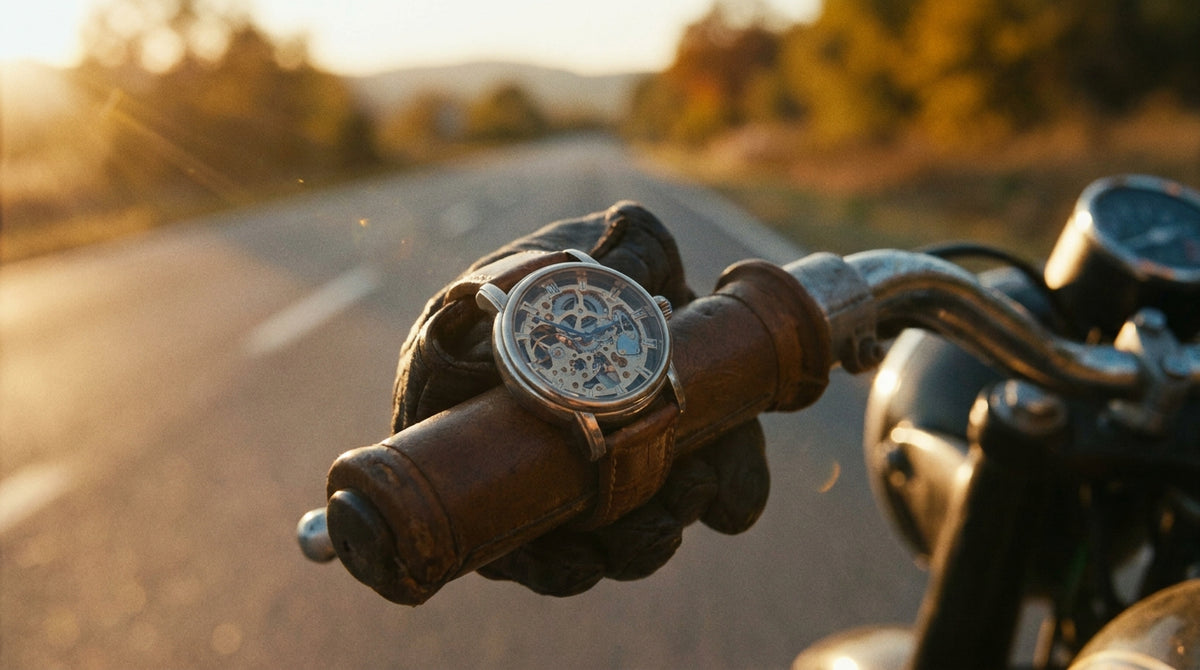
Most riders never think about their watch until they glance down at a red light and notice the cheap one they grabbed is fogging up, scratched beyond reading, or dead from vibration. A biker watch is not jewelry. It takes engine rumble, rain, sun glare, and the occasional knock against a handlebar mirror. Pick the wrong one and it barely lasts a season. Pick the right one and it outlasts your tires.
This guide covers what actually makes a biker watch hold up, the main styles worth your money, and real specs to compare before you buy. Whether you want a skeleton dial that shows the gears turning or a clean analog face on a thick leather strap, you will know exactly what to look for.
What Makes a Biker Watch Different from a Regular Watch
A biker watch is built to handle what the road throws at it. That means three things: vibration resistance, water resistance rated at a minimum of 5 ATM (enough for steady rain at highway speed), and a case tough enough to survive a bump against your tank or controls. Most fashion watches skip all three.
Case material matters. 316L surgical-grade stainless steel is the standard for any watch that claims to be rugged. It resists corrosion from sweat and rain, and it does not scratch as fast as chrome-plated alloy. If the listing does not mention the steel grade, assume it is the cheap stuff.
Band width is another tell. Biker watches typically run 22mm to 24mm wide, which keeps the watch stable on your wrist at speed. Anything under 20mm will slide around and dig into your skin when you grip the bars. Look for full-grain leather bands or heavy stainless links. Genuine leather (as opposed to full-grain) wears out in months. You will feel the difference.
If you also want something for your handlebars, take a look at our handlebar clock guide for options that mount right to the bars.
Skeleton and Transparent Biker Watches
Skeleton watches are the most popular style in the biker world, and for good reason. The dial is cut away so you can see the movement working inside. Every gear, spring, and balance wheel is visible through the crystal. It looks mechanical, raw, and a little aggressive, which fits the riding aesthetic perfectly.
The ALR Badass Transparent Watch runs a 44mm stainless steel case with a genuine leather band in brown or black. It is priced at $29.95, which puts it in the "buy it and not stress if the road beats it up" category. The transparent caseback lets you watch the automatic movement spin while you wait for traffic to clear.

At the higher end, brands like Invicta and Forsining sell skeleton watches in the $50 to $150 range with sapphire-coated crystals and Japanese Miyota movements. Those are solid upgrades if you want something that takes a harder beating. But for most riders, a sub-$50 skeleton watch does the job.
Leather Band vs Metal Bracelet: Which Survives the Ride
This is one of the biggest choices you will make, and it comes down to how you ride and what you wear on your hands.
Leather bands are comfortable, breathable, and look better with age. A full-grain leather strap develops a patina over time that matches broken-in riding gear. Expect a quality leather band to last 2 to 3 years with occasional conditioning (the same leather balm you use on your leather boots works). Genuine leather (the cheaper grade) cracks within 6 months of regular riding.
Metal bracelets are tougher and waterproof by nature, but they come with a real problem: snag risk. Wide metal links can catch on throttle grips, turn signal switches, or the edge of your gloves. Some riders file down the clasp edges to fix this. If you go metal, look for a fold-over clasp with a safety lock so it does not pop open mid-ride.
| Feature | Leather Band | Metal Bracelet |
|---|---|---|
| Comfort in heat | Breathable, absorbs sweat | Can get hot, sticks to skin |
| Durability | 2-3 years (full-grain) | 5+ years |
| Snag risk on controls | Low | Medium to high |
| Water resistance | Must dry after rain | Fully waterproof |
| Style match with gear | Perfect with leather gear | Better with modern/sport gear |
Biker Watch Dials: Skulls, Gears, and Custom Faces
The dial is where biker watches get personal. Skull-face watches are the classic choice. A well-done skull dial with lume-painted eyes that glow at night is one of those small details other riders notice at a gas stop. Companies like SOKI and Winner sell skull-dial automatics under $40.
Gear-themed dials are the next tier. These show exposed gears as part of the face design, often with an industrial or steampunk look. They pair well with chain bracelets and heavier jewelry. Some brands like Parnis and LIGE offer tourbillon-style displays where a visible cage rotates on the dial.
Custom and club-themed watches exist too, but be careful. Most "custom biker watches" sold online use generic quartz movements with a printed face. The print fades, and the movement dies within a year. If you want a custom face, look for one built on a Seiko NH35 or Miyota 8215 movement. These are the two most common reliable automatic calibers in the sub-$100 range, and any watchmaker can swap the dial on them.
Water Resistance Ratings Every Rider Should Know
Water resistance numbers on watches are confusing on purpose. Here is what they actually mean for riding in real conditions.
| Rating | What It Actually Handles | Good Enough for Riding? |
|---|---|---|
| 3 ATM (30m) | Light splashes only | No. Rain will kill it. |
| 5 ATM (50m) | Rain, hand washing, light water | Yes, for fair-weather riders |
| 10 ATM (100m) | Heavy rain, pressure washing | Yes, all-weather riding |
| 20 ATM (200m) | Submersion, diving | Overkill, but bulletproof |
One thing most sellers do not mention: water resistance ratings assume the crown (the knob you set the time with) is fully pushed in or screwed down. If the crown is even slightly pulled out, water gets in at any depth. Check yours before every ride. A single rain ride with a loose crown can fog the crystal permanently.
For year-round riders, 10 ATM is the sweet spot. Anything less and you are rolling the dice every time the sky goes grey.
How to Wear a Biker Watch with Riding Gloves
This trips up more riders than you would expect. Wearing a watch with motorcycle gloves is not the same as wearing one with bare wrists. The band needs to be loose enough to fit over or under your glove cuff without cutting off circulation, but tight enough that the watch face stays on top of your wrist where you can read it.
Most riders wear the watch over the glove on the left wrist. A 22mm or wider band handles this well. Anything thinner tends to twist sideways. If you wear gauntlet-style gloves, you will probably need to add one or two links to a metal bracelet or punch an extra hole in a leather strap.
NATO straps (the nylon pull-through type) are another solid option for riding. They sit flat, do not snag, and if one spring bar fails the watch stays on your wrist because the strap threads through both lugs. You can pick one up for under $10 and swap it in two minutes. They come in every color, though black, olive, and grey are the most popular with riders.
Common Mistakes When Buying a Biker Watch
Buying a fashion watch with no water resistance rating. If the listing says "water resistant" but does not give an ATM number, assume it handles nothing. One ride in the rain and the movement rusts from the inside.
Choosing a face smaller than 40mm. At highway speed with gloves on, you get about half a second to glance at your wrist. A 36mm or 38mm face is fine for an office, but on a bike you need at least 40mm. Most biker watches run 44mm to 48mm for exactly this reason.
Ignoring lume. Lume is the glow-in-the-dark paint on the hands and hour markers. Without it, the watch is useless on night rides. Super-LumiNova is the standard used by Seiko and Citizen. Cheap watches use zinc sulfide, which fades after 30 minutes in the dark. If night riding is part of your routine, check what lume compound the watch uses before buying.
Paying for "automatic" without checking the movement. Not all automatic movements are equal. A Chinese DG2813 movement runs about 25 seconds per day fast, which means it drifts a minute every two days. A Japanese Miyota 8215 keeps time within 5 seconds per day. The movement brand is usually listed in the specs. If it is not listed at all, it is probably a DG2813.
Getting a watch with a butterfly clasp that is not adjustable. Butterfly clasps look clean but most cheap ones have no micro-adjustment. Your wrist swells in heat and shrinks in cold. A clasp with at least 3 micro-adjust positions keeps the fit comfortable from a July highway to a November canyon run.
What to Look for Before You Buy
Narrow your search with this quick checklist. A good biker watch hits all five points. If it misses more than one, keep looking.
- Case material: 316L stainless steel minimum
- Water resistance: 5 ATM for fair-weather, 10 ATM for year-round
- Band width: 22mm or wider
- Dial size: 40mm+ for readability at speed
- Movement: named brand (Seiko, Miyota, or Seagull for budget automatics)
If you are looking for a solid starter biker watch without breaking the bank, the ALR accessories collection has a few options built for riders. A skeleton watch with a leather band and a stainless steel case is hard to beat for daily riding, and you can dress it up off the bike too.

No comments yet. Be the first rider to weigh in.