
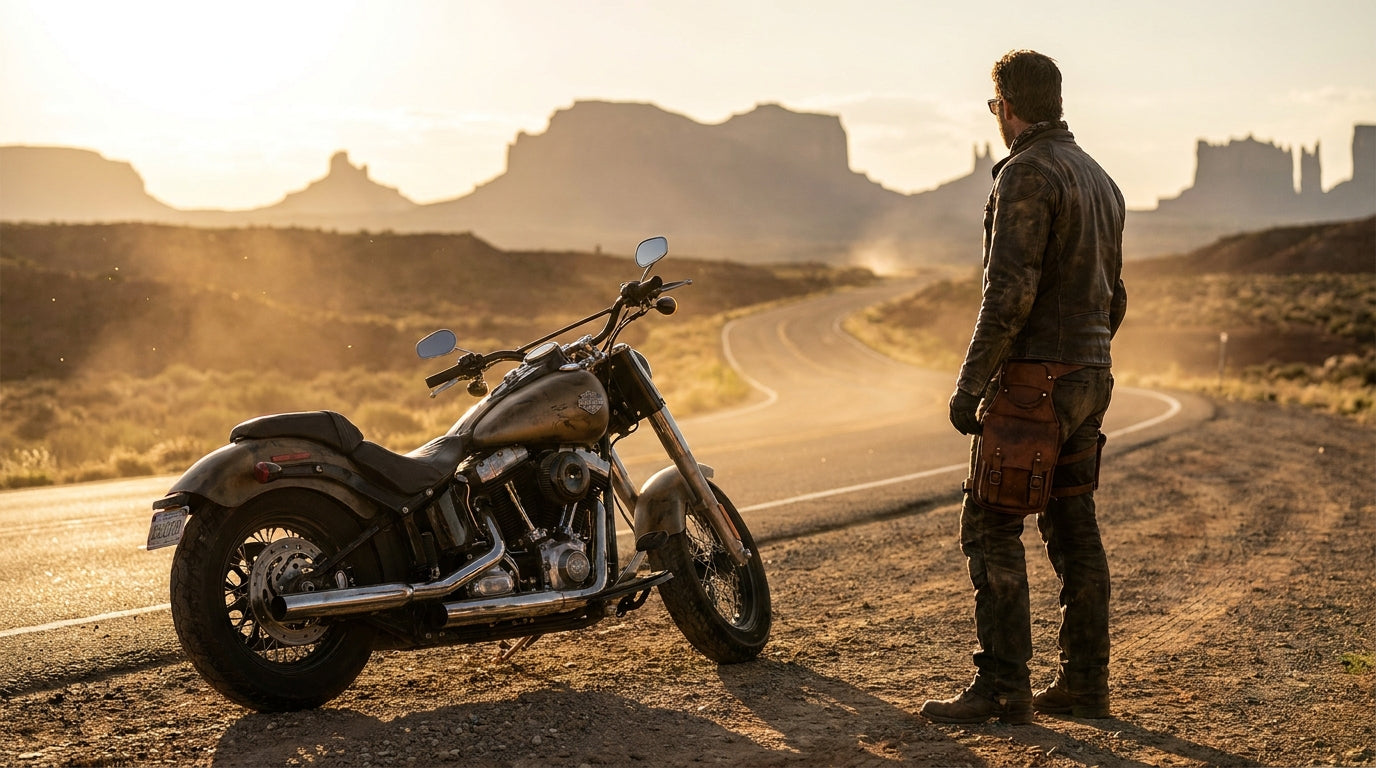
Most riders stuff their phone in a back pocket, their wallet in a jacket, and their keys somewhere they will forget about in 10 minutes. Then they pull into a gas station with gloves on and spend two minutes digging through layers. A leg bag for men solves all of that. Strap it to your thigh, and everything you need sits within arm's reach without pulling over or taking off a single piece of gear.
This guide covers the best drop leg bag styles for men who ride. You will get real sizing numbers, material comparisons between leather and tactical nylon, and the exact mounting method that keeps a leg bag locked at highway speed. No guessing, no generic advice.
Why a Leg Bag for Men Makes Sense on a Motorcycle
A loaded backpack weighs 4 to 8 lbs across your shoulders. After two hours on the highway, that weight pushes down on your lower back and pulls your posture forward. A loaded leg bag for men weighs 0.8 to 1.5 lbs, and that weight sits on your thigh instead of your spine. Over a 200-mile ride, the difference in fatigue is real.
Leg bags mount below the jacket hem, so they work with every jacket length from a short bomber to a full touring coat. They do not interfere with the tank, the seat, or your grip on the handlebars. On bikes with a forward riding position, like a Harley Sportster or a Street Glide, the bag sits flat against the outer quad where it creates zero drag.
The access speed is what converts most riders. At a fuel stop, you reach down, flip the flap, and grab your card. No unzipping a tank bag, no pulling a sling bag off your shoulder. Just reach and go. Once you ride with a drop leg bag for a weekend, going back to pockets feels slow.

What Fits Inside a Men's Drop Leg Bag
A standard men's motorcycle leg bag holds between 1 and 3 liters. In practical terms, that means a phone up to 6.7 inches (the iPhone 15 Pro Max fits in most models), a bifold wallet, a key fob, and a compact multi-tool like a Leatherman Skeletool. Some 2-liter models add room for a small tube of sunscreen or a pack of cigarettes.
Dimensions on a typical mid-size model run about 8.5 x 6 x 3 inches. That footprint covers the outer thigh without wrapping around to the front of the leg. Anything wider than 7 inches starts to feel bulky when walking at a gas station or a rally, and anything narrower than 5 inches forces you to stack items deep instead of laying them flat.
A realistic daily loadout for most male riders looks like this:
- Phone in the main compartment (padded if available)
- Wallet and a few cards in the secondary pocket
- Keys on a carabiner clipped to the internal D-ring
- One small extra, like a lighter, lip balm, or a tire pressure gauge
If you regularly carry more than that, a thigh bag with 3 to 5 liters of space is the next step up. For just the essentials, a 1 to 2 liter drop leg bag keeps you light and mobile.
Leg Bag Styles for Men: Leather, Tactical and Minimalist
Men's motorcycle leg bags fall into three main categories. Each has a clear use case.
Classic Leather Drop Leg
Full-grain cowhide with snap or buckle closures. The leather runs 2 to 3 mm thick on quality models, which is enough to resist scuffing against the bike frame. A leather leg bag weighs roughly 0.7 to 0.9 lbs empty and develops a natural patina over 6 to 12 months of riding. It pairs well with leather jackets, leather boots, and traditional biker style. The trade-off is maintenance. Leather needs conditioning with mink oil or beeswax balm every 3 to 4 months to avoid cracking at the fold lines.

Tactical Nylon with MOLLE Webbing
Made from 900D to 1680D Cordura nylon with external MOLLE loops for attaching pouches or tools. These bags weigh 0.3 to 0.5 lbs empty and handle rain, mud, and road grime without any treatment. Wipe them down with a damp cloth and they look new. The MOLLE system lets you clip a flashlight, a tourniquet pouch, or an extra phone holder to the outside. Popular with sport bike and ADV riders who want function over style. A good Cordura bag lasts 2 to 4 years of daily riding before the stitching or zippers start to show wear.
Slim-Profile Minimalist
Thin, flat pouches that hold a phone, two cards, and keys. Nothing more. These run under 1 liter of capacity and weigh under 0.3 lbs. The slim profile means the bag barely shows under a jacket, which appeals to riders who want access without the visible tactical look. Most minimalist models use a single thigh strap, which works fine given the low weight. They are ideal for short daily commutes where you carry almost nothing.

How to Size a Motorcycle Leg Bag for Men
Men's thigh circumferences typically range from 19 to 27 inches, measured at the point where the bag sits, about 3 to 4 inches below the hip bone. Most adjustable thigh straps cover 18 to 26 inches. If your thighs measure above 25 inches, check the strap max length before buying. Some budget models top out at 23 inches and leave larger riders without enough adjustment.
Here is a quick sizing reference:
| Thigh Circumference | Recommended Bag Size | Strap Notes |
|---|---|---|
| 18-21 inches | Compact (under 1.5 L) | Tighten fully, trim excess strap |
| 21-24 inches | Mid-size (1.5-2.5 L) | Standard fit, most bags work here |
| 24-27 inches | Full-size (2-3 L) | Check max strap length, look for dual-strap models |
Height matters too. Riders over 6 feet 2 inches have longer thighs, which means the bag sits further from the knee and has more clearance. Riders under 5 feet 8 inches should stick to bags under 8 inches tall to avoid the bottom edge pressing into the knee when the leg bends on the bike. Try sitting in your riding position before you commit to a size.
Leather vs Nylon Leg Bags: A Real Comparison
This is the most common question when shopping for a leg bag for men, so here is the straight comparison.
| Feature | Full-Grain Leather | Tactical Nylon (Cordura) |
|---|---|---|
| Weight (empty) | 0.6-0.9 lbs | 0.3-0.5 lbs |
| Lifespan | 8-12 years with care | 2-4 years daily use |
| Water resistance | Low (needs treatment) | High (sheds light rain) |
| Maintenance | Condition every 3-4 months | Wipe with damp cloth |
| Price range | $35-$85 | $20-$55 |
| Best for | Cruiser riders, dry-weather commutes | All-weather, sport/ADV riders |
Leather wins on longevity and style. A full-grain cowhide bag ages like a good pair of boots. Nylon wins on weight, weather resistance, and price. If you ride year-round through rain and road salt, nylon saves you the conditioning hassle. If you mostly ride in dry conditions and want something that looks like it belongs on a Harley, leather is the better long-term buy.
Avoid bags labeled "genuine leather" without specifying the grain. That label often means bonded or corrected-grain leather, which peels and cracks within months. Full-grain or top-grain are the only grades worth buying for motorcycle use. American Legend Rider stocks both materials in the motorcycle bags collection if you want to compare them side by side.
How to Mount a Drop Leg Bag So It Stays at 70 MPH
Most complaints about leg bags bouncing or sliding come down to mounting mistakes. Here is the method that keeps a bag locked in place on the highway.
- Thread the belt loop first. Run your regular riding belt through the bag's belt loop before buckling. The belt carries the bag's weight. The thigh straps only prevent lateral swing.
- Position on the outer thigh, 3 to 4 inches below the hip bone. This is the widest, flattest part of the quad. Too far forward and the bag blocks your shifting leg on the left side. Too far back and it catches the seat when you swing your leg over.
- Apply the two-finger rule. Tighten each thigh strap until you can slide two flat fingers between the strap and your leg. Tighter restricts blood flow on long rides. Looser lets the bag pendulum at speed.
- Adjust while sitting on the bike. Your thigh shape changes between standing and riding position. Sit on the bike with both feet on the pegs and re-check the strap tension. This one step fixes 90% of highway bounce problems.
- Do a parking-lot test. Ride around the block at low speed. Check for rotation, exhaust contact, and knee interference. Fix it before the on-ramp.
Dual-strap bags stay more stable than single-strap models. If your bag has one thigh strap and keeps rotating, the fix is usually a bag with two straps spaced 2 to 3 inches apart, not a tighter single strap.
5 Common Mistakes with Men's Leg Bags
- Overloading past design capacity. A 1.5-liter leg bag is built for roughly 1 lb of gear. Stuff 3 lbs of tools and a water bottle inside and it becomes a pendulum that swings at every stop. If you need more capacity, move up to a larger biker bag instead of forcing it.
- Mounting on the inner thigh. The inner thigh has softer tissue and less muscle to stabilize the bag. A bag placed there shifts toward the groin when the leg bends, blocks shifting on the left side, and gets uncomfortable within 15 minutes. Always mount on the outer thigh where the quad provides a firm surface.
- Skipping the belt attachment entirely. Some riders use only the thigh straps, skipping the belt loop. This puts all the weight on the thigh straps alone. The bag sags, bounces, and slides down within 10 minutes of riding. The belt loop is load-bearing. The thigh straps are stabilizers.
- Buying a bag without checking exhaust clearance. On bikes with low-mounted pipes, like many Harley models that run exhaust along the right side, a bag that hangs too low contacts hot metal. One touch melts nylon instantly and scorches leather permanently. Measure the clearance with the bag loaded and your leg in riding position before your first ride.
- Choosing style over strap quality. A good-looking bag with single-stitch belt loops and thin plastic buckles will fail within weeks. Check for bar-tack or box-stitch reinforcement at the belt loop, and metal or heavy-duty polymer buckles that you can operate with winter gloves. These details outlast any design choice.
If you are looking for a motorcycle leg bag for men that is built for actual riding, the motorcycle bags collection has drop leg styles, hip packs, and thigh bags with free returns. Test the fit and strap quality on your bike before committing.
No comments yet. Be the first rider to weigh in.