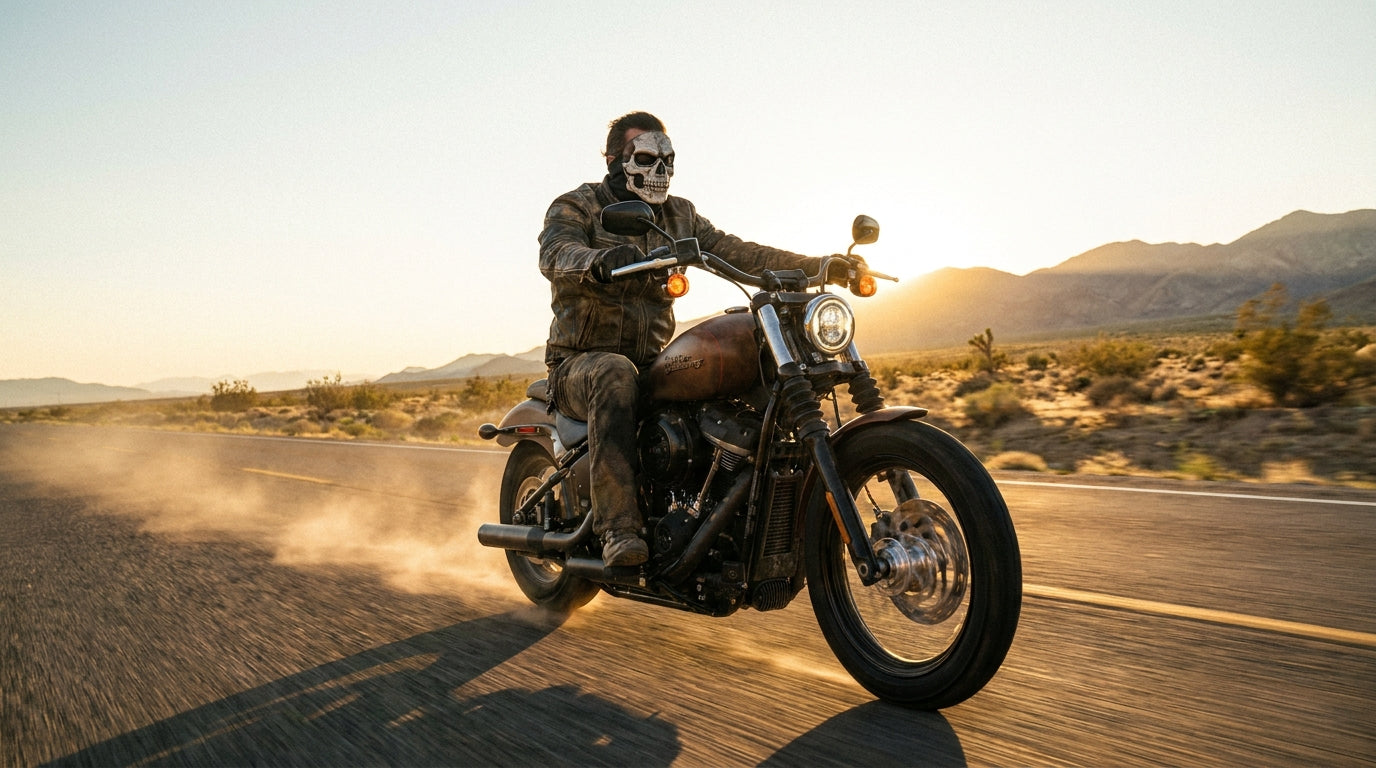
A rider pulls up at a gas station wearing a skeleton jaw mask under a matte black half-shell, and every head turns. Skeleton face masks are one of the most searched motorcycle accessories right now, with over 770 monthly impressions on Google for "skeleton face masks" alone. But the ones that look great in product photos often fail on the road. The print fades after three washes, the fabric bunches under the helmet chin strap, or the mesh is so thin it does nothing against 60 mph wind.
This guide covers every type of skeleton face mask that actually works for riding. You will know which materials hold up, which styles pair with which helmets, and which common mistakes cost riders money. If you have been searching for a skeleton face mask that looks right and performs at highway speed, this is where to start.
What Makes a Skeleton Face Mask Worth Buying
A skeleton face mask for motorcycle use is not the same product as a Halloween costume mask. Riding masks need three things costume masks do not: wind resistance at 60+ mph, breathability so your visor or glasses do not fog, and a fit that works under or with a helmet chin strap without shifting.
The skeleton print itself is screen-printed, sublimation-printed, or woven into the fabric. Sublimation printing bonds the ink into the polyester fibers at 380 degrees Fahrenheit, which means the design survives washing without cracking or peeling. Screen-printed designs sit on top of the fabric and start flaking after 10 to 15 washes, especially in hot water. If the listing does not say "sublimation" or "dye-sublimated," assume it is screen-printed and will fade.
Coverage area matters too. A skeleton face mask that only covers the nose and chin looks good in selfies but leaves the neck and ears exposed to wind, bugs, and road debris. Most riders who search for skeleton face masks want the jaw-and-teeth design that covers from the bridge of the nose down to the upper chest. That means a tube-style mask or a balaclava, not a small half-face piece. The skull face mask guide covers the broader skull design category if you want a full-skull look rather than just the jaw pattern.

Types of Skeleton Face Masks for Motorcycle Riders
Skeleton face masks come in four main formats. Each one fits differently under a helmet, and choosing the wrong style for your helmet type is the number one reason riders give up on face masks after one ride.
Tube Masks (Neck Gaiters)
A tube mask is a single-piece cylinder of fabric that slides over the head and sits around the neck. Pull it up over the nose for full skeleton jaw coverage, or leave it around the neck as a wind buffer. Most tube masks are 9 to 10 inches wide (laid flat) and 18 to 20 inches long. The one-piece construction means no stitching presses into the face under a helmet. A polyester/spandex tube mask weighs about 1.2 oz and packs down to the size of a fist. This is the most popular skeleton face mask style for riders because it works with every helmet type, from half-shell to full-face.
Balaclavas
A skeleton balaclava covers the entire head, face, and neck in one piece. The skeleton design is printed on the face opening, with the rest of the balaclava in solid black. These are built for cold weather riding below 50 degrees Fahrenheit, where a tube mask alone leaves the top of the head and ears exposed. A typical balaclava adds about 1.5mm of thickness under the helmet, which is thin enough for most full-face and 3/4 helmets without creating pressure points. The fit is tighter than a tube mask, which keeps the fabric from shifting at speed. The skull balaclava guide covers the full-coverage option in more detail.

Neoprene Half Masks
Neoprene half masks cover the lower face from the bridge of the nose to the chin, with velcro or elastic straps that wrap behind the head. The 2mm to 3mm neoprene blocks wind completely, making these the warmest option for skeleton face masks. They weigh about 2.5 oz and hold their shape when you pull them down around your neck at a stop. The skeleton print on neoprene is typically screen-printed, which means the design will crack and peel faster than a sublimation-printed polyester mask. ZANheadgear makes one of the more common neoprene skeleton half masks, retailing around $15 to $18.
Mesh and Airflow Masks
Some skeleton face masks use a mesh panel at the mouth and nose for maximum airflow. These are warm-weather masks designed for rides above 75 degrees where a solid fabric mask feels suffocating. The mesh lets air pass through but blocks about 60% of wind force, which is enough to keep bugs and small debris off your face at city speeds. At highway speed above 55 mph, mesh masks flutter and can pull away from the face in crosswinds. If you ride mostly in-town under 45 mph, mesh works. For highway riding, stick with polyester tube masks or neoprene.

Skeleton Face Mask Materials Compared
Material determines how long the mask lasts, how it breathes, and whether the skeleton print survives more than a few washes. Here is how the main options stack up for motorcycle use.
| Material | Wind Block | Breathability | Print Durability | Wash Life | Price Range |
|---|---|---|---|---|---|
| Polyester/Spandex (sublimation) | Good | High | 50+ washes | 2-3 seasons | $10-$18 |
| Polyester (screen-printed) | Good | High | 10-15 washes | 1-2 seasons | $6-$12 |
| Neoprene (2-3mm) | Excellent | Low | 15-20 washes | 2-3 seasons | $14-$22 |
| Microfiber Fleece | Very Good | Medium | 30+ washes | 2-3 seasons | $12-$20 |
| Mesh/Lycra | Low | Very High | 20-30 washes | 1-2 seasons | $8-$14 |
For most riders, polyester/spandex with sublimation printing is the best value. The print outlasts the fabric, breathability stays comfortable from 45 to 85 degrees, and the cost per mask is low enough to own two or three in rotation. Neoprene wins below 40 degrees when wind blocking matters more than breathability. The motorcycle mask guide breaks down material choices for every riding condition.
How to Fit a Skeleton Face Mask Under Your Helmet
The fit between your mask and your helmet makes or breaks the experience. A mask that shifts, bunches, or fogs your visor will end up in a drawer after one ride.
With a full-face helmet, pull the mask up over your nose first, then put the helmet on from front to back. The mask fabric should sit flat against your cheeks with no folds under the cheek pads. If the mask creates a ridge under the cheek pad, it is too thick. Tube masks under 0.8mm work best with full-face lids. The skeleton jaw design will be partially hidden by the chin bar, but it shows clearly when you flip the visor up at stops.
With a half-shell or 3/4 helmet, the full skeleton jaw is visible at all times. A tube mask is the best pairing because you can pull it up for the look and wind protection, then pull it down around your neck when you stop without removing the helmet. The mask sits below the helmet rim and does not interfere with the chin strap. Leave about two fingers of space between the mask's top edge and the helmet rim so the fabric does not bunch upward from wind pressure at speed.
Fogging is the biggest complaint with face masks under helmets with visors. A mask that vents exhaled air upward pushes warm, humid breath directly onto the visor. Fix this by choosing a mask with a nose bridge wire (a thin aluminum strip sewn into the nose area) that you bend to seal around the bridge of your nose. This redirects your breath downward and sideways instead of straight up into the visor. Some riders add an anti-fog insert like a Pinlock to the visor as a backup, which runs $25 to $40 depending on the helmet brand.

Skeleton Face Masks vs Skull Face Masks
Riders searching for skeleton face masks and skull face masks often wonder if they are the same thing. They are not, and the difference matters when you are choosing a design.
A skeleton face mask features the lower jaw and teeth pattern, sometimes with a realistic mandible, exposed molars, and chin bone detail. The design mimics the look of a human skeleton from the nose down. When worn, it creates the illusion that the rider's lower face is stripped down to bone. These designs focus on anatomical detail and usually cover from the nose to the upper chest.
A skull face mask features a full skull design, including eye sockets, nasal cavity, and the jawbone together as one image. Some skull masks add stylized elements like flames, tribal patterns, or motorcycle-themed graphics around the skull. These are more graphic and less anatomically focused than skeleton designs.
Both use the same materials and construction. The choice comes down to aesthetic preference. The skeleton jaw style is more subtle and blends into your face naturally under a helmet. The full skull design is more dramatic and works better as a standalone look without a helmet. American Legend Rider carries both styles in the skull face masks collection, so you can compare them side by side.
5 Mistakes Riders Make with Skeleton Face Masks
- Buying a screen-printed mask and expecting it to last. Screen-printing lays ink on top of the fabric surface. After 10 to 15 machine washes, the skeleton jaw design cracks and peels, leaving a faded mess. Pay the extra $3 to $5 for a sublimation-printed mask where the ink is bonded into the fibers at 380 degrees. The design will outlast the fabric itself.
- Wearing a neoprene mask in summer heat. Neoprene blocks wind well, but it also traps heat. At 85 degrees, a 3mm neoprene mask makes the lower face sweat heavily within 10 minutes. Sweat pools along the jaw line and drips into the neck. Use neoprene below 55 degrees only. For warm weather, a thin polyester tube mask breathes while still holding the skeleton design in place.
- Ignoring the nose bridge seal. A flat mask with no nose wire pushes every exhale straight up into your visor or glasses. Within three minutes of highway riding, the visor fogs enough to reduce visibility. A nose bridge wire costs pennies to add in manufacturing, but cheap masks skip it. Check the listing or feel the nose area before buying. If there is no wire, you will fog.
- Picking the wrong size tube mask for your head. Tube masks stretch, but not all of them stretch the same amount. A 9-inch-wide tube fits a head circumference of 21 to 23 inches comfortably. Riders with a 24-inch or larger head circumference need a 10-inch or wider tube, or the mask compresses the jaw and slips off the nose bridge at speed. Measure your head at the widest point above the ears before ordering.
- Machine drying instead of air drying. Dryer heat above 140 degrees damages both sublimation and screen-printed designs. It also shrinks polyester/spandex blends by 3% to 5%, which changes the fit. Wash your skeleton face mask in cold water and hang it to dry. A mask treated this way keeps its print and stretch for two full riding seasons.
If you are looking for a skeleton face mask that holds up on real rides, the skull and skeleton masks collection has options built for riders, not costumes.

No comments yet. Be the first rider to weigh in.