
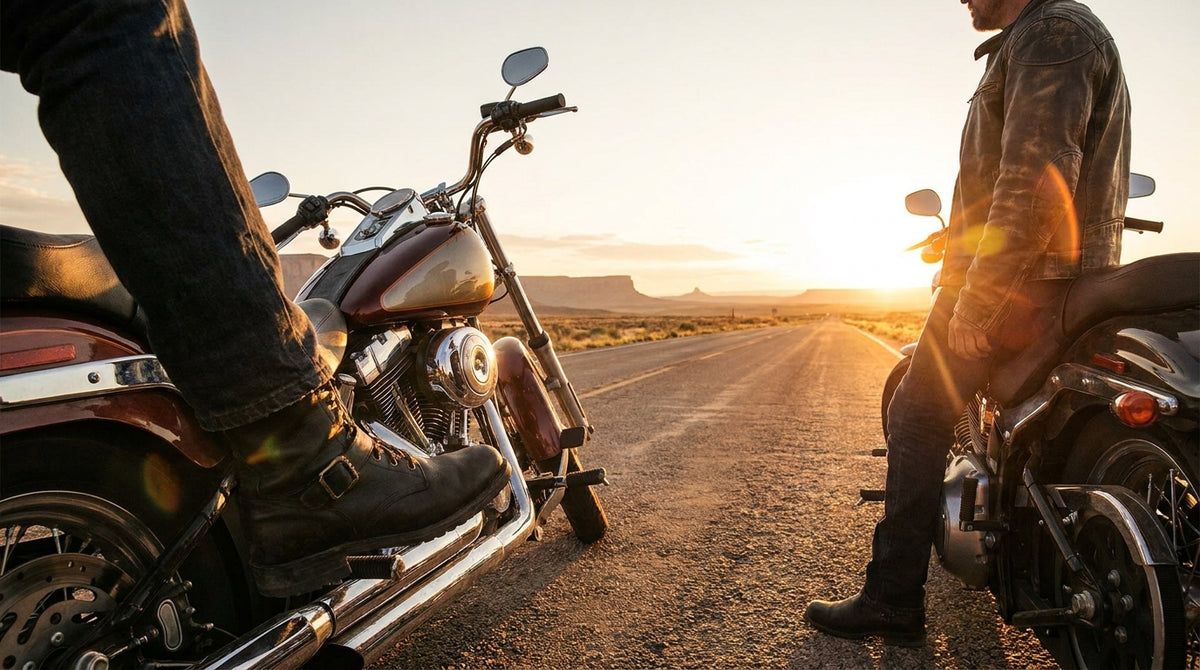
Most black boots look the same on a screen. The listing says "leather," the photos show a shiny black finish, and the price feels right. Then the boots arrive. The leather peels at the toe crease after two weeks, the soles slip on wet pavement, and by month three the finish looks cracked and tired. The difference between a $70 throwaway and a $160 boot that lasts a decade comes down to one thing: the leather itself.
This guide breaks down the leather grades you will find in black leather biker boots, which styles hold up best for real riding, and the construction details that separate a boot worth owning from one that belongs in a landfill. You will know exactly what to look for before placing an order.
Why Real Leather Matters More Than Brand or Style
A pair of mens leather biker boots from a reputable maker costs $140 to $250. Bonded leather boots from a no-name marketplace seller cost $50 to $80. The cheaper pair looks fine in photos. The gap shows up within the first season of riding.
Full-grain cowhide at 1.2 to 1.4 mm thickness does three things bonded material cannot. First, it molds to your foot. After 30 to 50 hours of wear, the leather conforms to your heel width, arch height, and toe spread. That broken-in fit is why riders with 5-year-old boots say they are the most comfortable shoes they own.
Second, real leather handles heat. Exhaust pipes on a Harley Softail run 400 to 700 degrees Fahrenheit at the headers. Full-grain cowhide resists scorch marks at casual contact distances. Bonded leather (ground-up scraps glued to a polyester backing) melts, sticks, and peels at much lower temperatures.
Third, leather develops character. Scuffs, creases, and patina from road grime give a real leather boot personality over time. Bonded leather just cracks and flakes. There is no aging curve. It goes from new to trash.
The one trade-off is weight. Full-grain leather boots weigh noticeably more than synthetic alternatives. A pair of full-grain harness boots comes in around 7 lbs total compared to about 4 lbs for a synthetic pair. That extra weight matters less on the bike (where the pegs carry it) and more when walking around a rally or a gas stop. Most riders accept the trade-off after one season when they see how the leather ages.
Full-Grain vs Top-Grain vs Bonded: Three Grades of Boot Leather
The term "genuine leather" appears on boots at every price point from $45 to $400. It means almost nothing because all three grades technically qualify as "genuine." Here is what each grade actually delivers.
Full-grain leather is the outermost layer of the hide with the natural surface intact. You can see pores, grain lines, and slight imperfections. It is the strongest grade and ages the best. A full-grain boot develops deep creases and a rich patina that looks better at year five than it did new. Price range for full-grain black leather biker boots: $140 to $300.
Top-grain leather is full-grain that has been sanded or buffed to remove surface imperfections. The result is smoother and more uniform. The trade-off is reduced breathability and slightly less strength compared to full-grain. Top-grain boots break in faster (20 to 35 hours versus 40 to 60 for full-grain) but do not develop the same depth of patina. Price range: $90 to $180.
Bonded leather is the lowest grade. Manufacturers grind leftover leather scraps, mix them with polyurethane, and bond the blend to a fabric backing. A bonded leather boot can contain as little as 10% to 17% actual leather by weight. It cracks at the flex points within one to three months of regular wear, cannot be conditioned, and cannot be resoled. If a boot costs under $70 and claims to be leather, bonded is usually what you are getting.
Black Leather Harness Boots: The Classic Biker Silhouette
Harness boots are where black leather biker boots became a cultural icon. Marlon Brando wore a pair of Chippewa harness boots in The Wild One (1953), and the metal ring at the ankle has been the defining look of motorcycle boots ever since.
A standard harness boot has an 11 to 13 inch shaft, a square or round toe, and a stacked leather heel sitting between 1.5 and 1.75 inches. The metal O-ring and leather strap wrap around the ankle. That strap is purely aesthetic. It does not tighten the boot or adjust the fit. It sits there and makes the boot look like a biker boot instead of a work boot. Weight runs about 3.2 to 3.8 lbs per boot in full-grain cowhide.
Harness boots fit cruisers and choppers best. The smooth shaft clears the shift lever without snagging, and the stacked heel positions the rider's foot at a natural angle on forward controls. Look for Goodyear welt construction so the sole can be replaced when it wears through. A well-built harness boot gets resoled two or three times before the upper gives out, which stretches the total lifespan to 10 years or more. The biker boots fit and style guide covers sizing details if you want measurements before ordering.

Black Leather Engineer Boots: Maximum Toughness
Engineer boots take everything about leather biker boots and push it further. Originally designed for railroad workers who needed steel-toe protection and oil-resistant soles, engineer boots crossed into motorcycle culture in the 1950s when riders adopted them for sheer durability.
A proper engineer boot features a 14 to 16 inch shaft, a steel or composite safety toe rated ASTM F2413, two adjustable buckle straps (ankle and top), and a Vibram or lug sole between 1.25 and 1.75 inches thick. The Wesco Boss, a benchmark in this category, weighs about 4.5 lbs per boot. That weight is part of the appeal. You feel planted on the pegs, and the boots hit concrete with authority.
The trade-off is break-in time. A new pair of full-grain engineer boots needs 50 to 80 hours of wear before the leather softens enough for all-day comfort. Wear them around the house in short sessions before taking them on a long ride. Do not soak them in water to speed the process. Water weakens the thread on welted boots and can void the warranty. For riders who want the most aggressive black leather boot available, engineers sit at the top of the list. The badass biker boots roundup covers more heavy-duty picks in this category.

Combat-Style Black Leather Biker Boots
Combat boots borrow from military design: 8 to 12 inches of lace-up shaft, lug sole, and reinforced toe. What separates the motorcycle version from surplus military boots is a medial shifter pad on the left toe and internal ankle armor for impact protection.
The lace-up closure gives riders more control over fit than pull-on styles. Riders with wider calves or those who wear boot-cut jeans over the shaft can adjust the lacing tension in seconds. Speed hooks near the top of the shaft (open metal hooks replacing traditional eyelets) cut lacing time from about 45 seconds to under 15.
A 10-inch black leather combat boot in full-grain cowhide weighs 2.5 to 3.5 lbs per boot, making this the lightest style on the list. That reduced weight makes combat boots a strong option for riders who walk as much as they ride. They cross over well to bars, restaurants, and casual settings where taller harness or engineer boots might draw more attention than you want.
Combat-style leather biker boots also accept conditioning and polish better than other styles because the leather panels are smaller and flatter. The lace-up construction means each panel gets even product coverage without the hard-to-reach curves around a harness ring or buckle strap. The black biker boots selection guide covers specific lace-up picks and sizing tips.

How to Condition and Care for Black Leather Boots
Black leather shows every scuff, scratch, and salt stain. That roughed-up look is part of the appeal for some riders. For those who want to keep the finish sharp, a simple maintenance routine adds years to the leather.
Condition the leather every 4 to 6 weeks during riding season with a conditioner like Bickmore Bick 4 or Lexol. Apply a thin layer with a soft cloth, let it absorb for 10 minutes, then buff off the excess. Over-conditioning makes leather soft and floppy, which weakens ankle support. Use less than you think you need.
For salt stains or water marks, wipe the boot with a damp cloth and let it dry at room temperature. Never use a hairdryer or space heater. Direct heat dries the leather fibers and causes cracking. If the boots get soaked on a rainy ride, stuff crumpled newspaper inside to absorb moisture and let them dry slowly away from heat sources.
Polish is optional. A beeswax-based polish like Kiwi Parade Gloss adds water resistance and restores the black finish. Avoid silicone-based sprays. They seal the pores and prevent the leather from breathing, which traps internal moisture and accelerates damage from the inside out.
Black Leather Biker Boots Compared: Style by Style
| Style | Shaft Height | Sole Type | Weight (per boot) | Break-In Time | Price Range |
|---|---|---|---|---|---|
| Harness | 11-13 in | Stacked leather | 3.2-3.8 lbs | 30-50 hrs | $120-220 |
| Engineer | 14-16 in | Vibram lug | 4.0-4.5 lbs | 50-80 hrs | $180-350 |
| Combat lace-up | 8-12 in | Rubber lug | 2.5-3.5 lbs | 20-35 hrs | $100-200 |
| Buckle/strap | 11-14 in | Rubber/stacked | 3.0-4.0 lbs | 30-50 hrs | $130-250 |
Harness boots hit the sweet spot of weight, break-in time, and classic look for most cruiser riders. Engineer boots demand more patience and more money but deliver the most protection and longest lifespan. Combat boots offer the most practical crossover for riders who spend as much time walking as riding. Buckle boots carry the most visual hardware but need careful placement checks so the metal does not interfere with the shift lever on the left boot.
Every style on this list should be available in full-grain cowhide. If a seller offers any of these styles in bonded leather for under $70, it will not perform like the real thing regardless of how the marketing copy reads. The leather grade matters more than the specific style.
5 Mistakes When Buying Black Leather Biker Boots
- Trusting the "genuine leather" label. "Genuine leather" is the lowest grade of real leather you can buy. It sounds trustworthy, but the boot could be made from the weakest split layer of the hide. Look for "full-grain" or "top-grain" specifically. If the listing only says "genuine," contact the seller and ask which grade. If they cannot answer, move on.
- Skipping the thumb press test. Press your thumb firmly into the leather and hold it for five seconds. Full-grain leather wrinkles naturally around the pressure point and bounces back smoothly. Bonded leather feels stiff, papery, or plasticky and does not wrinkle the same way. Do this test on every pair before deciding to keep them.
- Choosing a cemented sole for riding. A cemented (glued) sole cannot be replaced. When it wears through, the entire boot is done. For riding specifically, heat from exhaust pipes and hot pavement weakens adhesive over time. Goodyear welt or Blake stitch construction allows resoling, which extends boot life by 5 to 10 extra years at a cost of about $60 to $100 per resole.
- Wearing brand new boots on a long ride. Full-grain leather needs 30 to 80 hours of break-in depending on thickness and the specific hide. Wearing stiff new boots on a 200-mile ride the day they arrive guarantees heel blisters and ankle hotspots. Wear them around the house or on short errands for a couple of weeks first.
- Buying based on photos alone. Black leather photographs identically whether it is full-grain cowhide or plastic-coated fabric. The listing photo tells you nothing about actual material quality. Read the materials section, check the return policy so you can do the thumb test in person, and look for specific leather grade callouts before ordering.
If you want real leather biker boots built with full-grain cowhide, welted soles, and solid hardware, the leather motorcycle boots collection at American Legend Rider carries pairs tested for actual riding. Free returns mean you can check the leather, test the fit, and send them back if anything falls short.

No comments yet. Be the first rider to weigh in.