
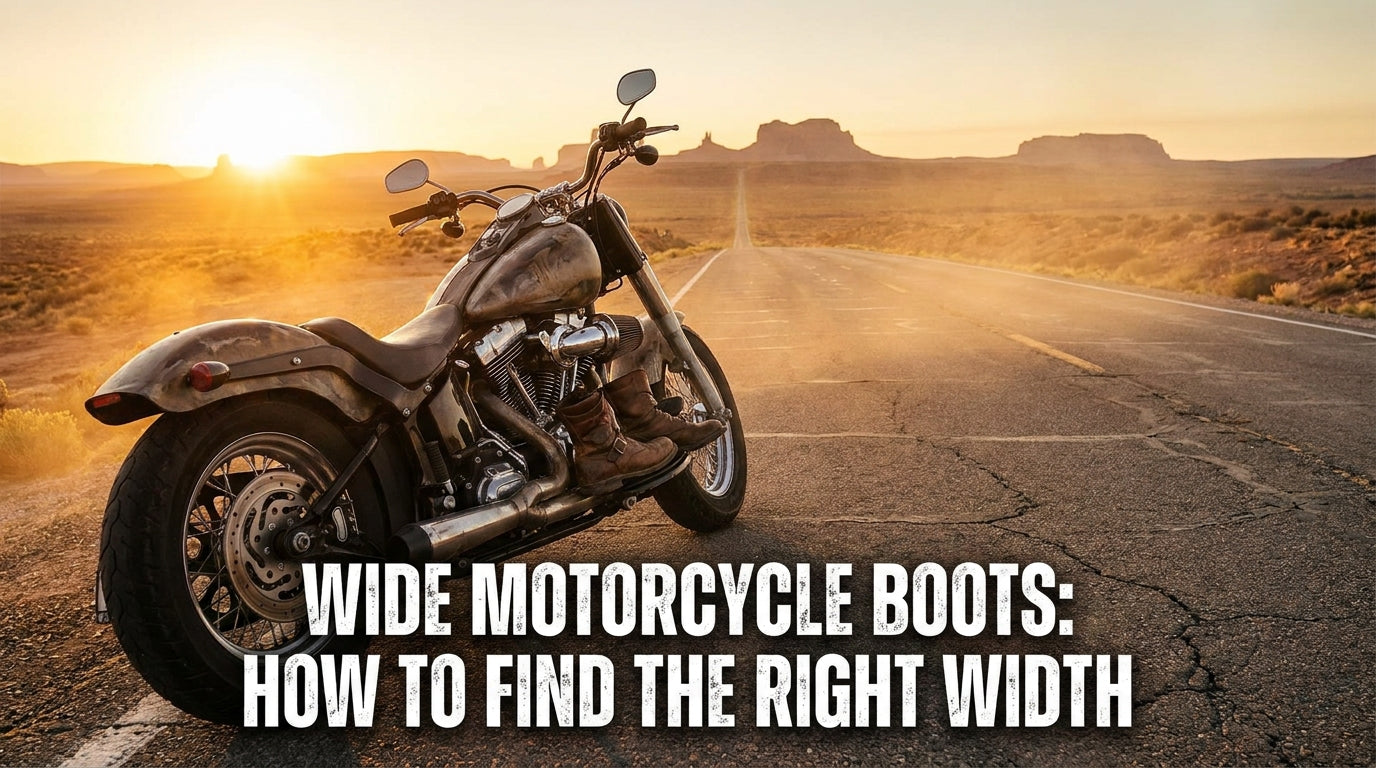
Standard motorcycle boots ship in D width. That is the industry default, and it works for roughly 60% of male feet. If your forefoot measures wider than 4.1 inches across the ball, a D-width boot will compress your toes from mile one. The fix is not sizing up. The fix is buying wide motorcycle boots in the correct width.
This guide covers how motorcycle boot widths are sized, what separates EE from 4E, and which boot styles give the most room where you need it. You will know how to measure your foot, what construction details matter for wide feet, and which mistakes to skip when shopping.
Why Standard Motorcycle Boots Run Narrow
Most motorcycle boot makers build around a D-width last. A last is the foot-shaped mold used to construct the boot, and D is the default for men's footwear in North America. A men's size 10D measures roughly 4.1 inches across the ball of the foot.
European brands tend to run narrower still. Italian boot makers like Sidi and TCX cut their lasts for slim-to-average feet. The reinforced panels, ankle armor, and thick leather on moto boots do not flex the way a canvas sneaker does. What feels snug in the store turns painful after 45 minutes of highway vibration, when heat and blood flow cause your feet to swell slightly.
The problem gets worse with composite or steel toe caps. Any boot with a rigid toe cap loses interior volume compared to a soft-toe boot in the same size. If you have wide feet already, a safety-toe boot in D width can feel like a vise by the second hour.
Sizing up does not solve the issue. Moving from a size 10 to an 11 adds about a third of an inch in length but barely changes the width. Your heel sits loose, your foot slides forward on downshifts, and the ball of your foot is still compressed. The answer is a wider width in the correct length.
Wide Motorcycle Boots: How EE, EEE and 4E Sizing Works
Boot width follows a letter system. Each letter step adds about 3/16 to 1/4 inch across the ball of the foot. Here is how the common widths compare for a men's size 10:
| Width Code | Name | Ball Width (Size 10) | Who It Fits |
|---|---|---|---|
| D | Standard | ~4.1 in | Average-width feet |
| E / EE (2E) | Wide | ~4.3 to 4.5 in | Wider-than-average forefoot |
| EEE (3E) | Extra Wide | ~4.6 in | Wide feet with high arches |
| EEEE (4E) | Extra-Extra Wide | ~4.8 in | Very wide, high-volume forefeet |
Not every boot brand offers all these widths. Most motorcycle-specific brands stop at D. The widest selection comes from heritage boot makers like Thorogood, Chippewa, and Red Wing, all of which offer EE and sometimes 4E in work-boot styles that double as solid riding boots. Thorogood's American Heritage 6-inch moc toe (model 814-4200), for example, ships in D through 4E in sizes up to 15.
When a brand labels a boot "wide fit" without a letter code, there is no guarantee it matches a real EE or 4E measurement. Some boots labeled "wide" are barely wider than a standard D. Always check the measured ball width if the listing provides it, or look for the letter code specifically.
How to Measure Your Foot Width at Home
You need two things: a piece of paper and a ruler. Stand on the paper with your full weight on the foot, wearing the socks you would ride in. Trace around the foot with a pencil held straight up. Then measure the widest point across the ball of the foot, from the outside edge of the big-toe joint to the outside of the small-toe joint.
Do this at the end of the day. Feet swell as the day goes on, and they swell more on hot rides. An evening measurement is closer to what your foot will measure inside a boot after an hour of riding. Measure both feet separately. If one is wider, size for the wider foot.
Compare your number to a Brannock width chart. A Brannock device measures width on a scale from AAA to EEEEEE (6E). Most motorcycle boot brands only stock up to EE or 4E. If your ball measurement hits 4.3 inches or more for a size 10, you need at least an EE boot. At 4.6 inches or more, start looking at EEE or 4E.
What to Look for in Wide Riding Boots
Width sizing is the starting point, but these construction details also determine how a boot fits a wide foot on the road:
Toe Box Shape
A round or square toe gives the forefoot more volume than a pointed or snip toe. Traditional biker harness boots with a round toe box offer roughly 15% more forefoot room than a pointed Western toe in the same size. If your toes splay naturally when you stand, round toe is the right call.
Full-Grain Leather
Full-grain cowhide stretches and molds to your foot shape over 30 to 50 hours of wear. A boot that feels slightly snug on day one can fit like it was built for you by the third week. Synthetic uppers and bonded leather do not stretch at all. For wide feet, genuine leather motorcycle boots have a clear advantage during the break-in period.
Closure Type
Lace-up boots give the most width adjustment. You can loosen the lower eyelets across the instep while keeping the ankle locked. Harness and pull-on styles are quicker to get on but offer zero adjustment over the forefoot. Side-zip boots fall in between. If your instep is high in addition to being wide, a lace-up boot with speed hooks is the most forgiving design you can buy.
Removable Insoles
Wide feet often pair with flat or low arches. A removable insole lets you swap in a wider, lower-profile insert or a custom orthotic. Boots with glued-in insoles lock you into whatever the factory provided, which may not suit your foot shape at all.
Best Boot Styles for Wide Feet by Riding Type
Not every ride demands the same boot. Here is how wide motorcycle boots break down by riding style, along with the width options you can realistically find on the market:
| Riding Style | Best Boot Type | Typical Width Options | Key Wide-Foot Feature |
|---|---|---|---|
| Cruiser | Harness or engineer | D, EE, some 4E | Round toe, Goodyear welt, oil-tanned leather |
| Touring | Tall lace-up or side-zip | D, EE | Waterproof liner, removable insole, shift pad |
| Sport / Street | Short riding shoe | D, rarely EE | Ankle armor, low profile |
| Adventure | Tall ADV boot | D, some EE | Shin guard, wider last on certain models |
| Casual / Daily | Moto sneaker | D, some wide | Hidden ankle armor, walkable sole |
Cruiser and touring riders have the widest selection because those boot styles share DNA with work-boot construction, where wide sizes have been standard for decades. Sport boots are the hardest to find in wide widths because the slim, aerodynamic profile is baked into the design. If you ride sport and have wide feet, the TCX Street 3 Air, which runs about a half size wider than other TCX models, is one of the better compromises available.
For a deeper breakdown of motorcycle boot types and what to look for, the complete motorcycle boots buying guide covers sole types, shaft heights, and protection ratings across every category.
Wide Toe Box vs. Full Wide Width
"Wide toe box" and "wide width" sound identical. They are not, and mixing them up leads to bad purchases.
A wide toe box means extra room in the forefoot area only. The heel cup, instep, and ankle stay at standard width. This fits riders whose heel and ankle are average-sized but whose toes spread wide when standing. Most traditional harness boots and Western-style motorcycle boots naturally have a wider toe box because of the rounded toe shape.
A wide width (EE, 4E) means the entire boot is cut wider from heel to toe on a wider last. This is what you need if your whole foot is proportionally wide, not just the forefoot. Harley-Davidson's FXRG boots, for example, use a wider last from heel to toe and fit noticeably roomier than their standard line.
Quick test: trace your foot on paper and measure at the ball and at the heel. If only the ball is wide, a standard-width boot with a round toe box will probably work fine. If both measurements run wide, go for an actual wide-width boot in EE or above.
5 Mistakes Riders Make Buying Wide Motorcycle Boots
These are the errors that lead to returns, blisters, and numb toes on long rides.
1. Sizing Up Instead of Going Wider
A size 11D gives you more length in front of your toes but almost no extra width across the ball. Your forefoot stays compressed, and now the heel slips with every step. Buy the right length in a wider width instead.
2. Trusting "Wide Fit" Labels Without Checking Width Codes
There is no industry standard for what "wide fit" means. One brand's "wide" can be narrower than another brand's D. Look for actual letter codes (EE, EEE, 4E) or measured ball-width numbers. Skip boots with vague fit labels and no data behind them.
3. Picking Synthetic Uppers
PU leather and textile panels hold their factory shape permanently. If a synthetic boot pinches on day one, it will pinch on day 200. Full-grain cowhide molds to your foot over time. For wide feet, real leather is not a luxury. It is a functional requirement.
4. Ignoring the Instep Height
A boot might measure wide enough at the ball but crush the top of your foot across the instep. Wide feet and high insteps often go together. If your foot aches across the top after lacing up, you need a lace-up boot where you can loosen the lower section, not a pull-on that cannot adjust at all.
5. Judging a New Boot on the First Ride
Even a properly sized wide boot needs 30 to 50 hours of break-in before the leather fully conforms. Walk around the house, run short errands, and apply leather conditioner to soften the flex points. A 200-mile ride is not a fair test for a brand-new pair of leather boots.
Finding Wide Motorcycle Boots That Actually Fit
Wide feet do not have to mean painful rides. The right boot in the right width, built from leather that molds to your foot shape, makes a real difference on long trips. Measure your feet, know whether you need a wide toe box or a full EE/4E width, and look beyond moto-only brands into heritage bootmakers that have offered wide sizes for decades.
If you are shopping for a pair, the leather motorcycle boots collection has wide-friendly options in full-grain leather that break in properly. For more on aggressive boot styles that still accommodate wider feet, that guide covers several round-toe harness and engineer picks worth checking out.


No comments yet. Be the first rider to weigh in.