
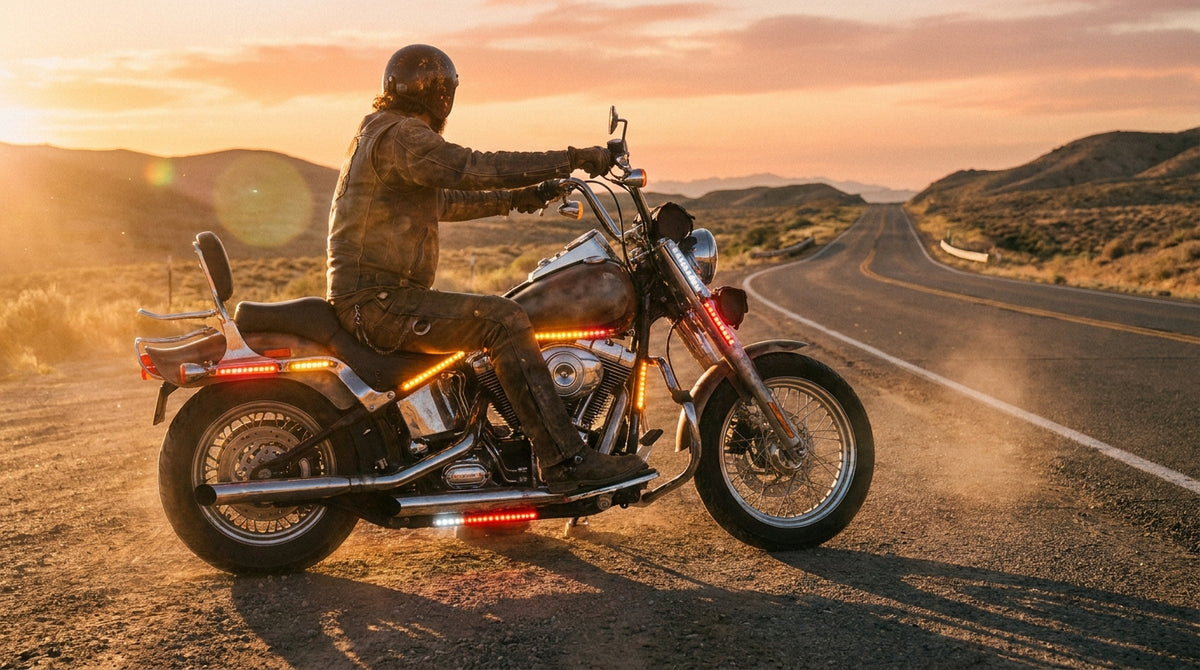
You are sitting at a red light, fully stopped, and the SUV behind you is closing fast. The driver is looking at a phone screen, not at your single brake light. This exact scenario kills riders every year. Motorcycle strobe lights exist to fix that problem. A rapidly flashing light grabs attention in a way a steady glow simply does not, and the difference can be measured in reaction time.
This guide covers the real types of motorcycle strobe lights on the market today, which ones are street-legal, how to install a strobe light kit on your bike, and where to find a setup that matches your riding style. Whether you want a flashing brake light, LED accent pods, or a full strobe kit, here is what you need to know before you buy.
What Motorcycle Strobe Lights Do (and Why Riders Use Them)
A strobe light is any light that flashes in a rapid, repeating pattern instead of staying steady. On a motorcycle, strobe lights serve one core purpose: making you more visible to distracted drivers. According to the National Highway Traffic Safety Administration (NHTSA), roughly 42% of fatal two-vehicle motorcycle crashes involve the other vehicle turning left into the rider's path. A flashing light, especially from the rear, breaks through the visual clutter of traffic and forces a second look.
Strobe lights are not just for show bikes or police motorcycles. Touring riders, commuters, and anyone who logs highway miles in mixed traffic benefits from the added attention. The flash rate matters, too. Most effective motorcycle safety gear designed for visibility uses a 4 Hz flash rate (four flashes per second), which research from the Society of Automotive Engineers (SAE) found to be the most attention-grabbing frequency without causing discomfort to other drivers.
Types of Motorcycle Strobe Lights
Not all strobe lights work the same way. The market splits into four main categories, each built for a different purpose and mounted in a different spot on the bike.
| Type | Location | Best For | Typical Price |
|---|---|---|---|
| Brake light modulator | Rear tail light | Rear-end crash prevention | $25 to $60 |
| LED pod strobes | Forks, frame, saddlebags | All-around visibility | $30 to $120 |
| Headlight modulator | Front headlight | Oncoming-traffic awareness | $40 to $80 |
| Accent/underglow kits | Frame, engine, wheels | Custom style, show bikes | $40 to $150 |
Brake light modulators are the most popular option for safety-focused riders because they are plug-and-play, affordable, and legal in all 50 US states (more on that below). LED pod strobes offer flexibility since you can mount them wherever you need extra light. Headlight modulators pulse your existing headlight to catch the eyes of oncoming drivers at intersections.
LED Strobe Lights for Motorcycles: Why LEDs Are the Standard
If you are shopping for strobe lights for a motorcycle, you will notice almost everything sold today is LED. There are practical reasons for that. A typical LED strobe pod draws about 0.5 watts per diode and outputs around 150 lumens per pod, compared to a halogen strobe bulb that pulls 15 to 20 watts for a similar brightness. On a motorcycle, every watt matters because you are running off a relatively small alternator, often rated at just 30 to 50 amps on a Harley Sportster or Honda Rebel.
LEDs also switch on and off faster. An LED reaches full brightness in under 1 millisecond, while an incandescent filament needs roughly 200 milliseconds to heat up. That snap-on response is exactly what makes a strobe pattern look crisp and attention-grabbing. Plus, LEDs handle vibration better than filament bulbs, which is critical on a motorcycle where engine vibration and road impacts are constant.
Brands like Custom Dynamics, Kuryakyn, and Eagle Lights have built their entire product lines around LED strobes and modulators for this reason. If you see a halogen strobe kit at a swap meet, pass on it.
Are Motorcycle Strobe Lights Legal?
This is the question riders ask most, and the answer depends on the type of strobe and your state. The rules break into three categories.
Brake Light Modulators: Legal Everywhere
Brake light modulators that comply with Federal Motor Vehicle Safety Standard (FMVSS) 108 are legal in all 50 states. This federal standard specifically permits "modulating" brake lights as a safety device. Products from Kisan Technologies (the TailBlazer) and Custom Dynamics (the Magic Strobes) carry FMVSS 108 compliance. If a traffic stop happens, the compliance sticker on the module is your documentation.
Headlight Modulators: Also Federally Legal
FMVSS 108 also covers headlight modulators. The standard allows motorcycles to run a pulsing high beam during daylight hours as long as the modulation rate stays between 240 and 280 cycles per minute. Most commercial headlight modulators, like the Kisan pathBlazer, are built to that spec.
Colored Accent Strobes: State by State
This is where it gets complicated. Red and blue flashing lights are restricted to emergency vehicles in every state. White and amber strobes are generally allowed in most states, but some jurisdictions (like California and New York) restrict any flashing light that is not part of the OEM lighting system. Before you install colored LED pod strobes, check your state's vehicle code for "auxiliary lighting" or "aftermarket motorcycle lighting" rules. A good starting point is your state's DMV website.
The safest approach: stick with brake and headlight modulators for street riding. Save the colored accent strobes for shows, rallies, and private property unless you have confirmed they are legal in your state.
How to Install a Motorcycle LED Strobe Light Kit
Most LED strobe kits for motorcycles are designed for riders who can handle basic wiring. Here is how a typical pod-style install works on a cruiser like a Harley or metric cruiser.
What You Need
- LED strobe pod kit (includes pods, control module, wiring harness)
- 16-gauge automotive wire (if extending leads)
- 10-amp inline fuse
- Wire connectors (solder and heat shrink, not butt connectors)
- Zip ties and adhesive mounts
- Basic hand tools
Step-by-Step Install
- Plan your mounting spots. Dry-fit each pod on the forks, frame rails, or saddlebag brackets. Mark the locations with tape. Make sure pods face outward and are not blocked by bodywork.
- Run wires to the control module. Route wiring along the frame, secured with zip ties every 6 inches. Keep wires away from the exhaust and any moving parts. A Harley Softail frame rail makes a clean wire channel.
- Wire the control module to power. Tap into a switched 12V source (ignition-on power) so the strobes only work when the bike is running. Use a 10-amp inline fuse within 6 inches of the battery terminal.
- Connect the pods to the controller. Follow the harness color coding. Most kits use red for positive, black for ground, and a third wire for the data/signal line to each pod.
- Ground everything properly. Use a ring terminal bolted to a clean, unpainted spot on the frame. Bad grounds cause flickering and random behavior.
- Test before buttoning up. Turn the ignition on and cycle through the flash patterns. Confirm every pod fires, then secure all wiring and reinstall any bodywork you removed.
A full install on a typical cruiser takes a few hours if you are working carefully. Brake light modulator installs are much simpler since most are plug-and-play harnesses that splice into your existing tail light wiring in under 30 minutes.
Strobe Brake Light Modulators: The Easiest Safety Add-On
If you only do one visibility upgrade, make it a brake light modulator. These small electronic modules wire between your tail light and the brake switch. When you pull the brake lever or press the pedal, the tail light flashes rapidly 3 to 5 times before settling to a steady glow. That burst of flashing is exactly what wakes up the driver behind you.
The Kisan TailBlazer II is the most recognized unit on the market. It is FMVSS 108 compliant, fits any 12V motorcycle, and runs about $40. Custom Dynamics offers the Magic Strobes line with multiple flash patterns and brightness settings, typically priced between $35 and $55. Both mount behind the tail light housing, completely hidden.
One detail worth noting: most modulators only flash the first time you hit the brakes after a set interval (usually 5 to 10 seconds). If you are pumping the brakes in slow traffic, the modulator flashes on the first press and stays solid on subsequent presses until the timer resets. This prevents constant strobing that could annoy or confuse trailing drivers.
Riders who wear good riding glasses for visibility should think about the other end, too. A brake light modulator covers your six o'clock.
Common Mistakes with Motorcycle Strobe Lights
Strobe lights are a simple upgrade, but riders still get tripped up on a few points.
1. Using Red or Blue Strobes on Public Roads
This is the fastest way to get pulled over. Red and blue are reserved for emergency vehicles in all 50 states. Even if you think a blue LED pod looks great on your Softail, the first officer who spots it will disagree. Stick with white or amber for auxiliary strobes, and use brake/headlight modulators for the actual safety benefit.
2. Skipping the Inline Fuse
LED pods draw minimal current, so riders sometimes wire them directly without a fuse. This is a fire risk. A short circuit in a vibration-prone motorcycle wiring run can melt insulation and ignite nearby materials. A 10-amp fuse costs under $2 and takes 30 seconds to install.
3. Using Butt Connectors Instead of Solder
Butt connectors (the red or blue crimp-on splices) vibrate loose on motorcycles. Within a few thousand miles, you will have intermittent connections, flickering pods, or dead circuits. Solder every connection, cover it with adhesive-lined heat shrink, and you will never touch it again.
4. Mounting Pods Where They Block Airflow or Contact the Exhaust
LED pods are rated for a maximum operating temperature, usually around 140 to 160 degrees Fahrenheit. Mount one too close to your exhaust headers, and the housing warps. Keep at least 4 inches of clearance from any exhaust component.
5. Running Strobes Off the Battery Without a Switched Source
If you wire your strobes directly to the battery instead of a switched ignition source, they will drain the battery when the bike is parked. On a typical motorcycle battery (12 to 14 amp-hours), even a small LED draw can flatten the battery overnight.
What to Look for When Buying Motorcycle Strobe Lights
A few specs separate the kits that hold up from the ones that fail after one rainy season.
- IP67 rating or higher. This means the pods are dust-tight and can handle water jets, not just light rain. Look for this specific IP rating on the product listing.
- Solid wiring harness. Cheap kits use 22-gauge wire that cannot handle the current or the vibration. Look for 18-gauge or 16-gauge wiring with proper connectors.
- Flash pattern options. A good controller offers at least 4 to 6 patterns. Some riders prefer a slow strobe, others want a fast double-flash. Having options lets you match the pattern to the situation.
- FMVSS 108 compliance for modulators. If the product page does not mention it, do not trust it for street use.
Quality LED strobe kits from established brands typically run $50 to $120 for a full set. Avoid the $15 kits from unknown sellers. The LEDs dim quickly, the adhesive fails, and the controllers overheat.
If you are putting together a full riding setup, strobe lights are one piece of the visibility puzzle. High-viz gear, reflective elements on your jacket or helmet, and proper lane positioning all work together with your lighting to keep you seen.
For quality riding gear that is built to last, the ALR riding gear collection is where most riders start.

No comments yet. Be the first rider to weigh in.