
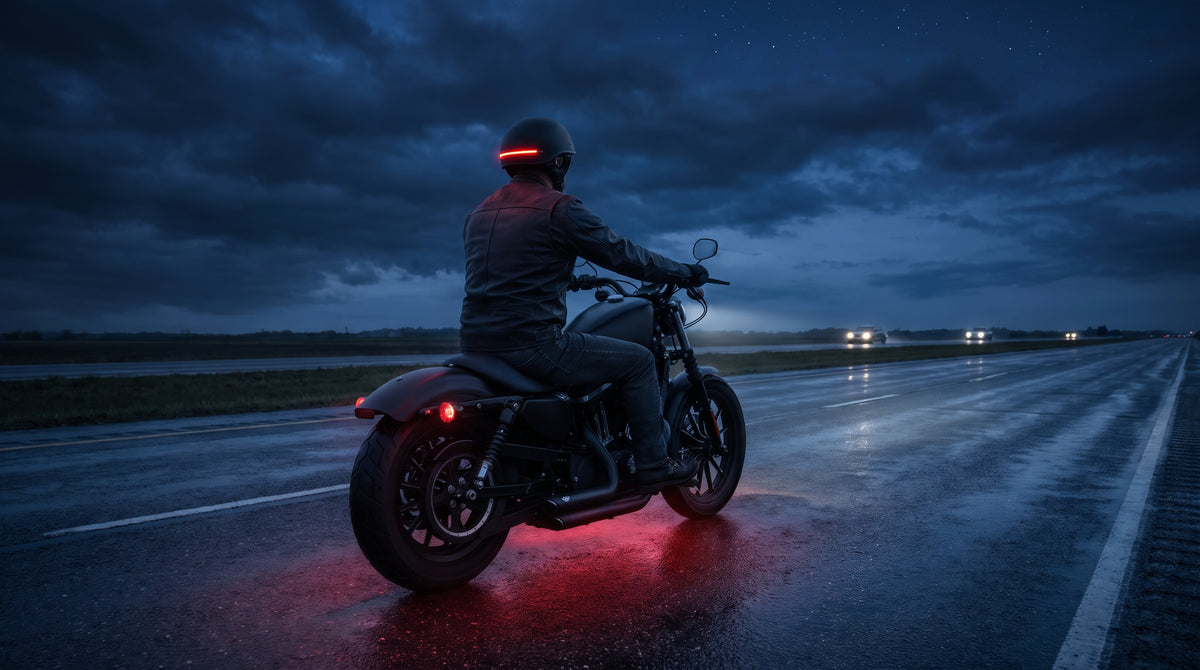
A car pulling out of a side street at dusk is not looking at your headlight. It is scanning the gap at its own eye level, about four feet off the road, and your headlight sits nearly a foot below that. Your helmet does not. It is the highest, most side-visible part of you, and it moves every time you check a mirror.
That is the whole argument for motorcycle helmet LED lights. This guide covers the four types that exist, 8 picks across helmet and bike, the DOT projection rule that decides whether a strip is legal on a certified lid, what the law actually restricts, and the five mistakes that get a strip peeled off in a week.
1. Why riders light the helmet and not just the bike
Motorcycle lighting has a geometry problem. A cruiser headlight sits roughly 30 to 36 inches off the pavement. A driver in a mid-size SUV has their eyes around 45 to 50 inches up. Your brightest light is below their natural scanning line, and behind a hedge or a parked van it disappears completely while your helmet is still showing.
The second reason is motion. A steady point of light reads as a distant car. A light that shifts side to side as you head-check reads as something closer and smaller, which is exactly the judgement a driver needs to make. Helmet lights are marker lights, not headlights. They are not there to light the road ahead. They are there to make the shape of a rider obvious from the side and the rear.
If you already run strobe lights on the bike, a helmet light is the layer those cannot cover: the part of you above the mirrors.
2. The four types of helmet lighting, and what each one is for
Adhesive LED strips
A flexible strip, usually 8 to 12 inches of surface-mount LEDs on 3M-style tape, stuck across the back or down the sides of the shell. Lowest profile, usually a few millimetres thick, and the only type that follows a curved shell cleanly. Multiple flash modes, micro-USB or USB-C charging, and a small button under a rubber flap.
Rechargeable clip-on warning lights
A sealed puck or bar that clips to a vent or straps on. Brighter per unit than a strip because it has room for a bigger cell, and it transfers between helmets in ten seconds. The tradeoff is bulk, which matters for both wind noise and the DOT projection rule in section 7.
Reflective decals, no power at all
Retro-reflective vinyl returns light straight back to its source, so a driver with headlights on sees your lid from several hundred feet. Nothing to charge, nothing to break, nothing projecting. The limit is obvious: it only works when something is shining at you. It does nothing in a parking lot at 3 am with no headlights pointed your way.
Helmets with lighting built in
Factory-integrated LEDs, wired inside the shell and certified as one unit. Cleanest look, no adhesive to fail, and no projection question. The catch is that you are buying a helmet, not a light, so your fit and style choices shrink to whatever that one model offers.
3. The best motorcycle helmet LED lights right now
Pick 1: the low-profile strip (best all-round)
This is the default answer for most riders. A thin strip across the rear of the shell, under $30, with a steady mode for highway and a flash mode for stop-and-go. It sits flush enough that wind noise barely changes, which is the usual reason people take helmet lights back off. Run it steady at speed and save the flashing for traffic, where the extra attention is worth the annoyance.

Pick 2: the USB rechargeable warning light
Go here if you swap between a half helmet in summer and a full face in winter. It is waterproof and USB rechargeable, so it lives in a tank bag and clips onto whatever lid you grabbed. Also the better choice if you want a light you can pull off and set on the ground as a breakdown marker.

Pick 3: the no-battery reflective option
Under $20, zero charging, and it never fails on a cold morning. 3D reflective vinyl on the sides of the shell covers the angle a rear-facing LED misses, which is the car approaching from a side street. The smart move is both: a strip for active light and decals for the angles the strip does not face.

If you want the reflective coverage without the sticker look, there is a full write-up on helmet wraps and decals that actually stay stuck.

4. Bike-side LEDs that make the helmet light work harder
A helmet light on its own is one small dot. It earns its keep when the bike underneath it is also shaped by light, because what a driver recognises is a pattern, not a point.
Rear light bar with brake and turn signal built in
A 48 LED bar that handles tail, brake and turn signal in one strip. This is the highest-value upgrade on most older cruisers, where the stock tail light is a single incandescent bulb that takes roughly 200 milliseconds to reach full brightness. An LED is effectively instant, which at 60 mph is close to 18 feet of extra warning for the car behind you.

Front strobe driving lights
A pair of small flashing driving lights mounted low and wide. The width is the point. Two lights spaced apart give an oncoming driver the depth cue a single headlight cannot, which is what fixes the left-turn-across-your-path crash. Check your state code before running them flashing, and read the strobe light legality breakdown first.

Fog and driving light pair for real output
When you want light on the road and not just presence, a 1500 lumen waterproof pair is the step up. Aim them low. A driving light pointed level is a complaint waiting to happen, and it wrecks your own night vision off wet asphalt.

Underglow and accent strips
Mostly style, with a real side-visibility benefit. Wireless RGB strips with a remote let you keep it to amber or white on the road and save the colours for the lot. The colour choice is not purely cosmetic, which section 6 gets into.

Wearable turn signals
An 18L backpack with turn signals on the back panel, controlled from the bars. It puts the signal at shoulder height instead of fender height, which is the same eye-level logic as the helmet light. Worth it if you commute in heavy traffic. Overkill for weekend rides.

Skull tail light with integrated signals
For anyone who wants the visibility upgrade without the generic look. Same instant-on LED benefit as the light bar, in a shape that matches a blacked-out cruiser. More of these live in the turn signals and headlights collection, and the LED turn signal buying guide covers resistor and flasher issues before you order.

5. Side by side: what to buy for which problem
| Type | Typical price | Needs charging | Best at | Main weakness |
|---|---|---|---|---|
| Helmet LED strip | $20 to $35 | Yes, USB | Rear and side presence at eye level | Adhesive fails if the shell is not prepped |
| Clip-on helmet light | $25 to $40 | Yes, USB | Swapping between helmets | Bulk, wind noise, projection limit |
| Reflective decal | $15 to $20 | No | Side angles, zero maintenance | Dead unless headlights hit it |
| Rear LED light bar | $25 to $35 | No, wired to bike | Instant brake light for the car behind | Needs wiring into the harness |
| Front strobe pair | $25 to $40 | No, wired to bike | Oncoming left-turn traffic | Flash modes are restricted in many states |
| Underglow kit | $30 to $65 | Battery or wired | Side presence and looks | Colour rules vary by state |
6. Are LED lights legal on your motorcycle?
LED lights themselves are not the issue. Colour, flashing and aim are. The pattern across US state vehicle codes is consistent on three points.
- Blue is off limits. Nearly every state reserves blue lights for law enforcement. This is the one that gets riders pulled over.
- Red facing forward is restricted. Red is a rear signal colour. A red accent strip visible from the front reads as an emergency vehicle.
- Flashing is the grey area. Some states allow flashing headlight modulators and running lights specifically for motorcycles. Others restrict any flashing light on a civilian vehicle. There is no national answer here.
Amber and white are the safe colours almost everywhere, and a steady accent light is far less likely to draw attention than a flashing one. Search your own state code for "auxiliary lamps" and "motorcycle" before you wire anything in. A helmet light sits in a different category again, because it is equipment on the rider rather than a lamp on the vehicle, and most codes simply do not address it.
7. Does a helmet LED strip void the DOT rating?
This is the question riders get wrong most often, and there is a specific number behind it. FMVSS 218, the federal motorcycle helmet standard, limits rigid projections outside the shell to 0.20 inch, which is about 5 mm. Anything standing further off the shell than that falls outside the spec the helmet was certified against.
In practice:
- A flexible adhesive strip a couple of millimetres thick stays inside the 0.20 inch limit and does not introduce a rigid snag point.
- A hard clip-on puck standing half an inch off the shell does not.
- Drilling the shell for a wire is the one thing never worth doing. The shell is the structure, and a hole in it is a crack starting point.
Strictly, any aftermarket addition is outside the original certification, so nobody can promise a modified lid still meets the standard. The honest framing is risk: low-profile adhesive and reflective vinyl add essentially none, hard protrusions add some. The full text of the standard is on NHTSA if you want to read S5.5 yourself.
8. How to install a helmet LED strip so it survives the winter
Nine out of ten failed helmet strips are adhesive failures, not electronics. The fix takes ten minutes and one wipe.
- Clean with isopropyl alcohol, not a household spray. Glass cleaner and polish both leave silicone behind, and acrylic tape will not bond to silicone. 70% isopropyl on a lint-free cloth, then let it flash off dry.
- Dry fit first. Hold the strip in place and put the helmet on. Anywhere it fouls the visor pivot or the chin strap is the wrong place.
- Mount above the lower shell edge. Most people stick it right along the bottom rim, where the helmet sets down on tables and racks. Move up an inch.
- Press for 30 seconds, then leave it. Acrylic tape reaches roughly 90% of bond strength after 24 hours at room temperature, so install the night before a ride, not an hour before.
- Never install below about 60F. Cold tape will not wet out onto the shell. Do it indoors.
9. Battery life, charging and cold weather
Helmet lights run small lithium cells, usually a few hundred mAh. Expect roughly 4 to 8 hours steady and longer in flash mode, since flashing duty-cycles the LEDs off for most of each second. That covers a commute week on one charge and a full weekend tour on two.
Two things shorten it. Cold cuts usable lithium capacity noticeably below freezing, so a light that runs all week in July may need a mid-week charge in January. And brightness is not linear: the top mode often draws double the mid mode for a difference nobody behind you can see. Mid mode steady is the setting most riders should live on.
Charge it where you charge your phone, not in the garage. A helmet light left on a cold bench for a month comes back flat.
10. Five mistakes that waste the money
- Running flash mode on the highway. A flashing light at a steady 70 mph gives drivers no closing-speed information and reads as a hazard rather than a vehicle. Flash in traffic, steady on the open road.
- Buying blue because it looks good. It is reserved for police in nearly every state. Amber and white do the same visibility job without the stop.
- Mounting a hard light high on the crown. It catches wind, it roars above 50 mph, and it adds a snag point exactly where you least want one.
- Treating a helmet light as a substitute for a hi-vis layer. A light is a point source. A reflective vest or a jacket with reflective panels gives a driver a human outline. Different jobs, and the outline wins in daylight.
- Skipping the alcohol wipe. The single most common reason a strip is in the gutter by week two. Thirty seconds of prep beats a replacement.
The short version
Buy a low-profile adhesive strip for the back of the shell, add reflective vinyl on the sides for the angles it cannot face, and run amber or white on steady. Then fix the bike: an LED rear bar is the single biggest safety-per-dollar change on most older cruisers because of how much faster it lights up than a stock bulb.
Here is the ALR position plainly. Cheap no-name LED kits off a marketplace listing are the gear we argue against, not because they are cheap but because the adhesive and the sealing are where they cut cost, and both are the parts that decide whether the light is still on your helmet in March. Buy the one that is waterproof-rated and specified, use it for years. If you are shopping, the lighting and turn signal collection is where I would start, and if you are already adding electronics to the lid, the built-in vs add-on Bluetooth helmet comparison covers doing both without a cable mess.
No comments yet. Be the first rider to weigh in.